All posts by Matthew Callan

The Electric Grandmother

There is a popular idea that our minds are like computer hard drives, continuously storing information from the moment we first draw breath, which would mean a person could conceivably remember any and every moment of their life. I don’t subscribe to this theory, as it assumes memory is a flawless, unblemished record when in truth memory is an odd, unreliable thing that is easy to warp, both by others and ourselves.

The computer brain theory also supposes that there is an objective reality that all “normal” beings perceive in the exact same way, another citation needed notion as far as I’m concerned. I’m more partial to the notion that consciousness is formed over time, and that in some way we reconstruct it at the dawn of every day. Think about the groggy strangeness you experience when you first wake up, how you need a few moments to remember where you are—a sensation that could be interpreted as your brain reforming the world as you have come to know it.

If consciousness is in fact a construct developed over a lifetime, the reason why our earliest memories are inaccessible is because our perception of the world as adults is so radically different than that of a baby. Infants haven’t yet formed their personal consciousness, and don’t understand there is a difference between themselves and the rest of the world. If we could recollect infancy it would likely be as basic sensory perceptions rather than the more complex visual/verbal nature of memories formed later. These “memories” would feel so bare and so strange to us they would seem almost alien.

For this reason, I’ve long been fascinated by memories I have of what I’ll call the Liminal Time of my earthly existence—preschool age, when I was learning language, learning what things outside myself were called, learning how to tell others what I was thinking, learning to recognize the very act of thinking and differentiate it from external actions like talking and walking. I have many memories of this time but they have an odd flavor, rich in surface detail yet with an undercurrent of strangeness as 3-to-4-year-old me struggled to understand where I was and what I was doing. The indoor playground at my preschool. A carpet store where I was dragged for one Saturday afternoon that felt like it was 9 years long. A promo for a local news story that scared me. A family party where aunts and uncles laughed at things I didn’t think were funny. I was just enough of the Me I would become to perceive and retain these sensations to this day, but I was also just enough Not Me for the memories to feel uncanny now.

Being who I am, television comprises a large number of these Liminal Time memories—usually not kids shows, but brief glimpses of grown-up programming that confounded me. Among these some of the most enduring are hazy recollections of a TV movie called The Electric Grandmother. The tale of a grieving family gifted the titular “relative,” it debuted in January of 1982, when I would have been firmly in my preschool era. I don’t know if I watched it then or was made to watch it later, perhaps in school. Though this would have been the Filmstrip Era (not yet supplanted by the TV With VCR On Wheels Era) I absolutely was made to watch afterschool specials and other TV offerings in the classroom.

Regardless, I was definitely aware of The Electric Grandmother‘s existence because I have distinct memories of certain scenes from it that both frightened and compelled Little Kid Me. In particular: a scene of the robotic grandmother siting in a rocking chair while she was plugged into a wall to recharge, and another scene where she is delivered to the family in some kind of shiny coffin. In pre-internet days, when these images would flit across my mind, I would wonder if The Electric Grandmother was an actual movie or something I’d only dreamt. I wanted to confirm the scenes that would poke my brain late at night or early in the morning were things I’d actually seen, but the feeling these images gave me were so unsettling I also feared encountering it again.

When I decided to do this TV project, The Electric Grandmother was high on my list of films to visit—or maybe revisit, I wasn’t quite sure. Yet I also had trepidations about watching it for the first time as an adult. I knew it would be an odd experience, and one I’d have trouble capturing in words due to the dreamlike nature of my memories. Having now watched it, I can definitively say yes, that experience was weird, on multiple levels and for multiple reasons.

Continue reading The Electric Grandmother →
Mad Dog Time

This piece marks the debut of a new series surveying the movie landscape of the 1990s, when everyone in La-La-Wood and beyond tried to make their own Cool Crime Movie modeled on Pulp Fiction—a film they all loved yet did not seem to understand even a little bit. Come with me on a journey through a cinematic universe where everyone dresses like a rockabilly, drops non sequitur pop culture references, and holds their gun sideways: the world of Coattail Tarantino.

In preparation for my survey of the cinematic world Quentin Tarantino birthed written earlier this year, I watched a boatload of movies from the 1990s that owed something to Tarantino stylistically, spiritually, or temporally, films that could have only been made after his success altered the Hollywood landscape. I am often asked by people I’ve made up in my head, “How did you determine what films to watch?” The answer is that I jotted down the names of several movies that immediately came to mind, then looked up lists of year-by-year releases to make note of any others that looked Tarantino-esque—basically, any film that featured crime and/or large groups of similarly dressed Guys Being Dudes strutting down sidewalks. After additional research, the list was winnowed down using a complicated process known as Vibes. In the end, I watched a lot of movies that had almost no relationship to Tarantino’s work, but this was only fair and correct. If I was going to make sweeping generalizations about the wave of Cool Bros Doing Crime Movies that littered multiplexes after the smash success of 1994’s Pulp Fiction, then science demanded I prove my theses with an ample amount of data.

It’s important to remember that Tarantino’s emergence as a cultural force created a Hollywood feeding frenzy similar to another phenomenon of this era: the flurry of major label band signings that followed “Smells Like Teen Spirit.” Just like Nirvana sent record labels scrambling to find any act that could be described as “punk” or “indie,” regardless of their musical resemblance to the original article, film production companies were desperate to release anything they could plausibly compare to Pulp Fiction. So even if a movie didn’t reflect that film’s influence or sensibilities, it’s instructive to take note of what 1990s Hollywood thought they could get away with labeling as Tarantino-esque.

As stated in my original post, the overwhelming majority of the films, while often dated in ways that could make me cringe, were no better or worse than meh. It was rare to find a pleasant surprise among the bunch, a film that was genuinely good or at least enjoyable to watch, but it was also rare to find a truly dreadful movie. The real stinkers, though, boy did they stink. I would find myself watching these movies at at a slant or through my hands, unable and unwilling to view them in full, a la George C. Scott in Hardcore. My wife and kid would hear me groaning or exclaiming in anguish and ask if I was in pain, and I would have to admit yes I was in pain because I couldn’t take another minute of Suicide Kings.

The worst of the lot by a country mile was Boondock Saints, a reprehensible tradcath revenge fantasia that took a few years off my life in a single viewing. Were it not for Troy Duffy’s cinematic Chernobyl, however, the bottom spot would have gone to 1996’s Mad Dog Time. I had never heard of it before looking through lists of films from that year, but its cool gangster trappings were enough to land it on my shortlist, a decision I will rue until the day I die. This is one of those films from the era that has almost zero relationship to Tarantino’s films, yet could have only been made after his movies created a madness for anything where Cool Dudes Do Crime. And it is terrible. Beyond terrible. There is no singular word or phrase that can encapsulate how truly, deeply, irredeemably awful this movie is, or the feeling it will give you if forced to watch it.

I am not alone in this assessment; it was named Siskel & Ebert’s worst film of that year, while Ebert’s written review for the Chicago Sun-Times called it “the first movie I have seen that does not improve on the sight of a blank screen viewed for the same length of time.” Entertainment Weekly described it as “jaw-droppingly incoherent.”

You might think a film this bad would be remembered in some capacity, a fabled flop on par with Ishtar or Gigli, yet I’m certain the vast supermajority of people out in the world, even those who were alive for its debut, have never heard of it. The only evidence I have that anyone has watched it since its release is an episode of the Have You Seen This podcast with guest Matt Christman. (I was not aware of this episode until doing research for this post, but their assessment is along the lines of Ebert’s above and mine below.) This maintenance of obscurity is for the greater good of humanity, though, as it prevents more people from being exposed to its toxicity.

When I first decided to revisit this film for a longer review, I was hoping I could rely on the extensive notes I took during my first viewing. I soon discovered that my “extensive notes” were not at all helpful, full of questions the movie refused to answer (“who is that?” “why are they doing this?”) and howls in the dark over the torture I’d inflicted on myself (“OMG I DON’T FUCKING CARE ABOUT ANY OF THIS”). This meant a second viewing would be required if I wanted to be write anything of consequence about it. After contemplating if I really wanted to subject myself to Mad Dog Time again, and enduring a series of traumatic flashbacks that could only be outdone by those who’ve lived through combat, I soldiered forth on a second viewing, which is at least two times more than anyone should watch this thing.

The naive among you may peep the film’s cast and wonder how it could possibly be so bad. Jeff Goldblum! Gabriel Byrne! Richard Dreyfuss! Ellen Barkin! Diane Lane! You might believe these pieces don’t quite fit together yet puzzle over how Mad Dog Time could possibly be so unwatchable. I’m here to assure you it is as unwatchable as anything ever made by humans, and that includes videos of executions.

Continue reading Mad Dog Time →

Gramps

This marks the launch of a new Scratchbomb series called A Very Special Television Event, where I take a look at forgotten boob tube content of yesteryear, focusing on TV movies, miniseries, short-lived series, and one-off specials.

One of my favorite leisure activities is watching compilations of old commercials. I believe there are very few activities that can give you a better sense of the flavor of a certain time than watching its advertising. Sure, someone who lived through that decade can give you their impressions of what the 1990s were like, but you will get a much clearer view of The Clinton Years by watching a collection of Must See TV promos and a buffet of ads telling you to dial 17 digits just to save money on long distance calls. (Seriously, if you were not alive then you have no idea how huge that industry was. How serious? They even got George Carlin!)

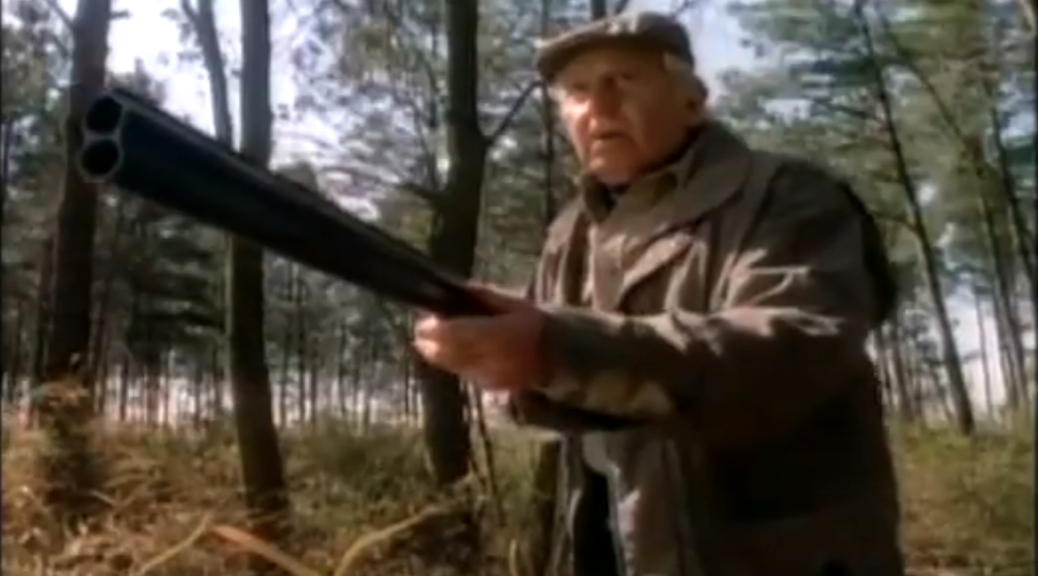
Not too long ago, I was viewing a commercial compilation from 1995 when I was stopped dead in my tracks by this teaser for a TV movie starring Andy Griffith as a sinister kidnapping grandfather. Now here was a perfect distillation of what TV in 1995 was all about.

The made-for-TV movie has been part of the boob tube landscape since the invention of the medium. In its early days, this was the platform for renowned screenwriters penning prestige work; Rod Serling’s Requiem for a Heavyweight and Paddy Chayevsky’s Marty both began their lives as teleplays prior to their Hollywood adaptations. This pedigree continued through the 1970s and 1980s, when TV movies were often the preferred format in which to discuss Serious Issues: child abuse, homosexuality, substance abuse, adult illiteracy, and similar fun topics. By the 1990s, however, TV movies had become a salacious format, leaning heavily on quickie adaptations of tabloid fodder (think “Homer S: Portrait of an Ass Grabber”) and other lurid fare, With its threatening premise (“what if your grandfather was a violent nut?”), Gramps looked like it was very much a TV movie of the 90s, and I decided I must watch it immediately.

Luckily we live in a world where no copyrights are honored (thanks, Sam Altman!), certainly not for 30+ year-old TV movies, and I found the entire thing free to watch on YouTube. I expected it to be something very much of its time, along with Pearl Jam, baggy jeans, Fruitopia drinks, and deindustrialization. What I got instead was a view of something timeless, or perhaps out of time, as something produced by an alien civilization might seem to mere humans.

Continue reading Gramps →