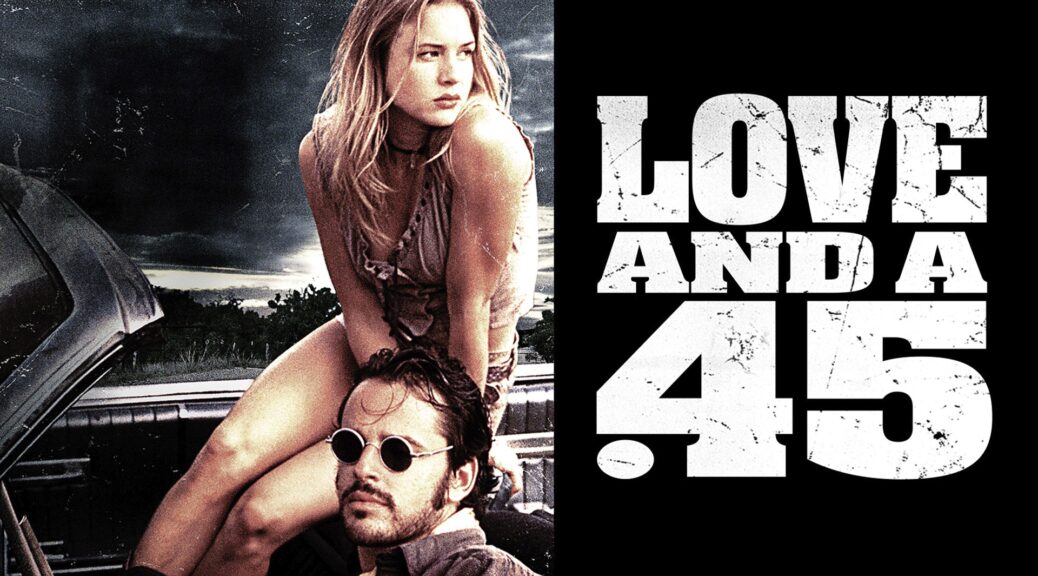
When doing research for my lengthy look at the post-Tarantino film world, I often wondered what was the first movie to be labeled as a Tarantino imitator. There were a flurry of attempts at carbon copying his style following Pulp Fiction, though Tarantino had produced enough buzz with his first feature Reservoir Dogs to inspire imitation even earlier. I don’t know if the true First Tarantino Baby can be determined with any certainty, but there is a very strong candidate for the first film to be received as one by both the public and critics: Love and a .45. Released in the waning weeks of 1994, not long after the massive success of Pulp Fiction and the hysterical controversy around the QT-penned Natural Born Killers, it was largely dismissed as a cheap ploy to capitalize on both films.
One big reason to give this movie the distinction of first Tarantino ripoff is because Tarantino himself has distinguished it in that manner. He has labeled Love and a .45 the best of his imitators, repeating this contention many times over the years and as recently as 2015. It is extremely on brand of him to not only acknowledge his copycats but to also proclaim his favorite is a virtually forgotten movie; whenever Tarantino makes a recommendation of any kind, it’s to let people know he is deeply familar with the obscure thing he is recommending. The film’s creator seems ambivalent about the imitator label; screenwriter and director C.M. Talkington has both resisted this characterization and accepted Tarantino’s award as a compliment, likely as a way to make people aware of his work.
Given the timeline of when Talkington wrote the screenplay and when the movie was produced, he is almost surely telling the truth when he says he was not inspired by Tarantino. However, I believe examining the film is worthwhile, as it tells us what both Tarantino himself and contemporary audiences saw that they perceived as pale imitations of the recently crowned master.
One thing to note about the movie is that is has some killer musical credentials. I sat up and took notice when the opening credits claimed the original music came from Tom Verlaine, and during the closing credits when I saw that it contained a duet between Kim Deal and Robert Pollard. However, I needed to learn about the latter from those credits because, as far as I heard anyway, that duet was not actually played during the movie. Likewise, the film’s official soundtrack has some choice artists on it (Meat Puppets, Jesus and Mary Chain, Butthole Surfers), but the presence of their work in the film itself is mostly at blink-and-you’ll-miss-it level. I will acknowledge that the filmmaker had some excellent taste (or at least his musical director did), but I must also note what will become a theme for my critique of this film: gathering some pretty interesting material and not doing all that much with it.
The action takes place in the kind of landscape that would be featured in many Tarantino imitators to come: the deep fried desert of Texas. It revolves around paramours Watty Watts (Gil Bellows) and Starlene (Renee Zellwegger), whose mutual love inspires them to commit a series of crimes together a la the killer couples of Badlands, Gun Crazy, and the aforementioned Natural Born Killers.
All antiheroes of the post-Tarantino era needed a philosophical affectation, something that labels their criminal activity as something much deeper than mere venality. This is why Watty enjoys consulting the I Ching before committing a robbery at the film’s outset, and why he has yin and yang tattooed on opposing shoulders. However, apart from a few obtuse asides meant to sound deep, his Taoist-lite “philosophy” does not have much bearing on the action of the movie. Watty does not technically engage in armed robbery because he swears he doesn’t like guns and won’t commit his crimes using a loaded piece. Despite this, he is constantly handling guns, cleaning them, fondling them, aiming them at others, in a way that suggests maybe he really does like guns after all. As for his lady Starlene, she prefers to use her natural assets, pouring herself into Daisy Dukes and crop tops in order to seduce the world’s dumbest motorists out of their cars and weapons.
The couple’s idyllic life of crime is upended by a series of unwanted visitors. First up, Watty is visited by a pair of psychotic gangsters demanding money he owes them. The gangsters are dressed in black suits and matching skinny ties—the kind of outfits that signify Bad Guys in Tarantino’s contemporary work. But things don’t really go sideways until Watty and Starlene are confronted by Billy Mack (Rory Cochrane, also seen in other extremely 1990s fare such as Dazed and Confused and Empire Records). An old prison buddy whose twitchiness telegraphs that he will be trouble, Billy Mack wants Watty to help him knock over a convenience store.
Due to his gangster debt and his designs on marrying Starlene, Watty agrees to the heist. Of course Billy Mack ignores his friend’s directives against both doing meth and carrying a loaded gun, so when he gets unmasked by the girl behind the counter at the store, he freaks out and domes her. In keeping with the attitudes of the times, this pointless violence against a woman is played not as an evil in its own right but a huge inconvenience to the protagonists. Watty is now implicated in a very serious crime and is a captive of Billy Mack’s squirmy, meth-abetted neediness (not to mention his loaded gun). He escapes the tweaker’s grasp at a diner using some fork and gun trickery. Filmed in slow motion, this is clearly meant to evoke Hong Kong action flicks (also a major Tarantino inspiration), but just looks kinda dorky, particularly close ups of Billy Mack as he is stabbed in the neck with diner cutlery.
Starlene is remarkably unfazed to learn that Watty was an accessory to murder, though she recognizes they should hit the road ASAP. Their escape is impeded by a pair of sheriffs who show up at their house to ask questions about the robbery/shooting. The sheriffs are violent assholes, trashing the place and roughing up Watty, and when they threaten to kill him in cold blood, Starlene intervenes, shooting one cop, who then accidentally shoots the other with the dying grip on his shotgun.
The couple’s road travels are shown with rear projection that does not attempt to look real in the least, almost psychedelic in its uncanniness. This is an interesting choice and compelling visual element in a film that is otherwise not all that compelling from a cinematic standpoint. Another intriguing aspect is the plot device of the CRIME Channel, a sort of 24/7 Cops network with sensationalistic coverage of wanted criminals and their nefarious deeds. This element gives the movie a tinge of Diet Verhoeven, though again, the film does not do nearly as much with the idea as it could or should. A roadside justice of the peace (David Lynch mainstay Jack Nance) refuses to marry the couple after seeing them on the CRIME channel, so Watty and Starlene must threaten him at gunpoint and tie him to a chair before he will bless their union. Once they are officially wed, Starlene calls in to the CRIME Channel to insist she and Watty are not cold blooded killers. This interaction promises a Natural Born Killers-type collab between the marauding lovers and the bloodthirsty media detailing their crimes, but that promise goes unfulfilled, as the film doesn’t seem to know what to do with the concept or how the couple should react to it, or even remember that the couple is supposed to be aware of the existence of the network chronicling their crime spree. Later in the film, Watty sees him and Starlene on the CRIME channel and begins to freak out, even though he was in the room when Starlene called them.
The lovers stop at the house of Starlene’s parents, old hippies who’ve surrounded themselves with swirly southwestern-y art. Her dad is played by Peter Fonda, although curiously he is said to have lost the use of his legs from meth abuse (?) and also has had a tracheotomy. Therefore Fonda, the biggest star in the movie at the time of its release, does not move or use his own voice at any point, which seems a very stupid narrative choice unless it’s what Fonda himself wanted. After hearing of their nuptials, the happy couple receives a jar full of vintage LSD as their wedding present, which is odd because I thought acid was more of an anniversary gift than a newlywed one.
When Watty and Starlene are spotted by an eagle eyed cop, it appears the jig is up until the officer is killed by Billy Mack. Remember him? While getting a super freaky tattoo on his shaved head, Billy Mack is found by the gangsters seeking their money from Watty, and they all team up seek revenge on the couple. During their pursuit, the gangsters up Billy Mack’s psychotic tendencies by periodically hitting him with some kind of meth gun (?). A bloody encounter at Starlene’s parents’ house results in the deaths of both old hippies, and soon after that pointless violence the meth-crazed Billy Mack merks the two gangsters as well. These murders don’t make much sense plot-wise but they do reduce the number of lunatics left in the film. There really is no room for multiple maniacs in this film, especially when Billy Mack and his still-bleeding head tattoo are Kubrick-staring at our young lovers with maximum howling insanity.
Billy Mack demands to be driven to the Mexican border, where Starlene uses her usual tools to sweet talk their way out of the USA. The confused soundtrack changes over not to norteño music or corridos, but to salsa, because Spanish I guess. Once in Mexico, and after the obligatory montage through the impoverished border town and its tiny unclothed children and dying dogs, Watty remembers he’s still philosophical and tries some I Ching stuff on Billy Mack in an effort to save his life. A really dumb struggle ensues, shots are fired, slo mo is employed. Somehow Starlene gets a hold of Billy Mack’s meth gun and administers a fatal dose and liberate the two lovers. To celebrate his death and their freedom, Watty and Starlene drop their vintage wedding acid and take off on the road as the rear projection solarizes a la 2001: A Space Odyssey. “Life was spreading out for us like an ever expanding pool of blood,” Watty belches out as they take off, and we assume they trip happily ever after.
Considering all of the above, it’s understandable how this was movie was called a Tarantino copy—an unfair charge temporally but a dead-on one aesthetically. It has so many of the Cool Guys Doing Crime tropes that were rife in the would-be Pulp Fictions of the 90s: the faux-deep gunman, the insanely violent antagonists, parched desert setting, forgotten stars slotted in cameo roles (Fonda). Love and a .45 even has a strong, self assured woman character in Starlene, something absent in most Tarantino imitators but very much seen in the original’s work. Perhaps this last element is what inspired Tarantino’s admiration for the film.
This was one of the first movies I watched when beginning my project, and my initial notes from that viewing are full of eye rolling asides and professions of hatred for some of its dumber elements, in particular the cringe-inducing dialogue. In sharp contrast to Tarantino, from a visual standpoint there isn’t much innovative or interesting in the film. Ideas with potential like The CRIME Channel aren’t employed competently, and there are wild shifts in tone. Watty and Starlene are portrayed as incredibly cool cats embracing their infamy, except when they are shown as terrified about getting caught, bickering in a decidedly uncool way. Performance wise, it’s a mixed bag. Renee Zellwegger, in one of her first major roles, renders Starlene a lot more clever than the Dumb Bimbo character she could have been, while Rory Cohrane goes full bozo mode in a cartoonish way that fits the film’s style. Gil Bellows, on the other hand, brings nothing to the table in the ostensible lead role. He is neither convincing as a stone cold criminal nor believable in his curious and unwarranted moments of vulnerability. He sinks any chance the film might have to be any better than okay.
Despite all this, I’ve watched a boatload of far worse post-Tarantino movies since my first viewing of this one. For that reason, I would place Love and a .45 firmly in the Meh Middle—not a great film but not an awful one either, just a firmly average Cool Crime film.
I do find it fascinating how much Love and a .45 conforms to what we expect from post-Tarantino movies, even though the filmmaker could not possibly have drawn inspiration from Tarantino. My quibbles with his public persona notwithstanding, I agree that Tarantino has a unique cinematic vision, borne of his bespoke tastes and his desire to evangelize for what he loves via his work. Apart from how well it captured the zeitgeist of the first half of the 1990s, Tarantino’s early work was also successful and widely imitated because it was so good, and felt so fresh to people less familiar with the things he himself was imitating. And yet, as early as 1994 there was at least one other filmmaker picking up on, and putting down, many of the same things Tarantino was.
Maybe Tarantino was always going to make himself into an auteur celebrity; that certainly seems to have been his ambition, and I won’t deny the depth and uniqueness of his talent as a filmmaker. But maybe, just maybe, if Love and a .45 beat Pulp Fiction to theaters, I might be discussing Talkington ripoffs instead.