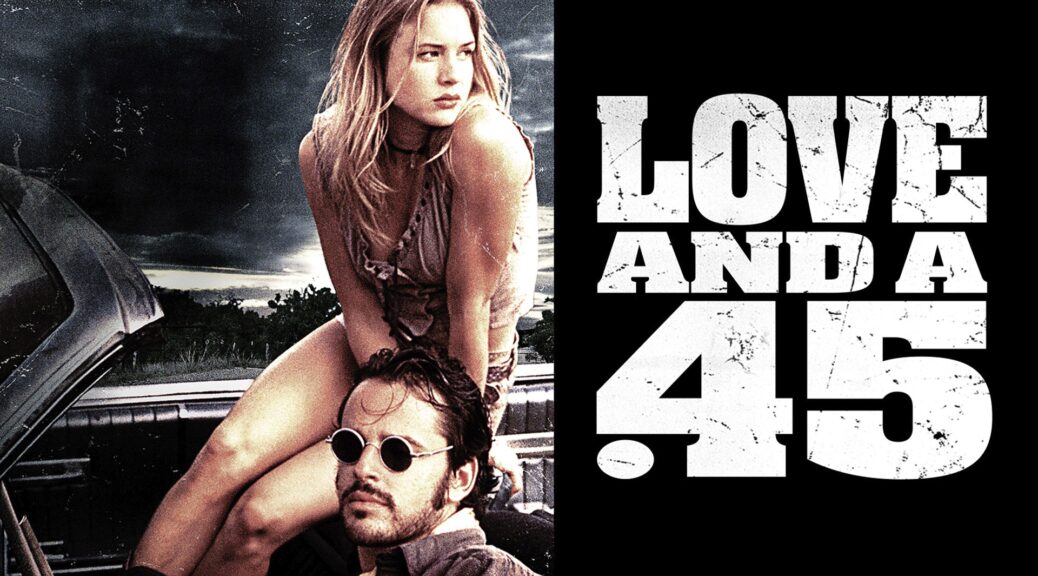
When doing research for my lengthy look at the post-Tarantino film world, I often wondered what was the first movie to be labeled as a Tarantino imitator. There were a flurry of attempts at carbon copying his style following Pulp Fiction, though Tarantino had produced enough buzz with his first feature Reservoir Dogs to inspire imitation even earlier. I don’t know if the true First Tarantino Baby can be determined with any certainty, but there is a very strong candidate for the first film to be received as one by both the public and critics: Love and a .45. Released in the waning weeks of 1994, not long after the massive success of Pulp Fiction and the hysterical controversy around the QT-penned Natural Born Killers, it was largely dismissed as a cheap ploy to capitalize on both films.
One big reason to give this movie the distinction of first Tarantino ripoff is because Tarantino himself has distinguished it in that manner. He has labeled Love and a .45 the best of his imitators, repeating this contention many times over the years and as recently as 2015. It is extremely on brand of him to not only acknowledge his copycats but to also proclaim his favorite is a virtually forgotten movie; whenever Tarantino makes a recommendation of any kind, it’s to let people know he is deeply familar with the obscure thing he is recommending. The film’s creator seems ambivalent about the imitator label; screenwriter and director C.M. Talkington has both resisted this characterization and accepted Tarantino’s award as a compliment, likely as a way to make people aware of his work.
Given the timeline of when Talkington wrote the screenplay and when the movie was produced, he is almost surely telling the truth when he says he was not inspired by Tarantino. However, I believe examining the film is worthwhile, as it tells us what both Tarantino himself and contemporary audiences saw that they perceived as pale imitations of the recently crowned master.
Continue reading Love and a .45