There is a popular idea that our minds are like computer hard drives, continuously storing information from the moment we first draw breath, which would mean a person could conceivably remember any and every moment of their life. I don’t subscribe to this theory, as it assumes memory is a flawless, unblemished record when in truth memory is an odd, unreliable thing that is easy to warp, both by others and ourselves.
The computer brain theory also supposes that there is an objective reality that all “normal” beings perceive in the exact same way, another citation needed notion as far as I’m concerned. I’m more partial to the notion that consciousness is formed over time, and that in some way we reconstruct it at the dawn of every day. Think about the groggy strangeness you experience when you first wake up, how you need a few moments to remember where you are—a sensation that could be interpreted as your brain reforming the world as you have come to know it.
If consciousness is in fact a construct developed over a lifetime, the reason why our earliest memories are inaccessible is because our perception of the world as adults is so radically different than that of a baby. Infants haven’t yet formed their personal consciousness, and don’t understand there is a difference between themselves and the rest of the world. If we could recollect infancy it would likely be as basic sensory perceptions rather than the more complex visual/verbal nature of memories formed later. These “memories” would feel so bare and so strange to us they would seem almost alien.
For this reason, I’ve long been fascinated by memories I have of what I’ll call the Liminal Time of my earthly existence—preschool age, when I was learning language, learning what things outside myself were called, learning how to tell others what I was thinking, learning to recognize the very act of thinking and differentiate it from external actions like talking and walking. I have many memories of this time but they have an odd flavor, rich in surface detail yet with an undercurrent of strangeness as 3-to-4-year-old me struggled to understand where I was and what I was doing. The indoor playground at my preschool. A carpet store where I was dragged for one Saturday afternoon that felt like it was 9 years long. A promo for a local news story that scared me. A family party where aunts and uncles laughed at things I didn’t think were funny. I was just enough of the Me I would become to perceive and retain these sensations to this day, but I was also just enough Not Me for the memories to feel uncanny now.
Being who I am, television comprises a large number of these Liminal Time memories—usually not kids shows, but brief glimpses of grown-up programming that confounded me. Among these some of the most enduring are hazy recollections of a TV movie called The Electric Grandmother. The tale of a grieving family gifted the titular “relative,” it debuted in January of 1982, when I would have been firmly in my preschool era. I don’t know if I watched it then or was made to watch it later, perhaps in school. Though this would have been the Filmstrip Era (not yet supplanted by the TV With VCR On Wheels Era) I absolutely was made to watch afterschool specials and other TV offerings in the classroom.
Regardless, I was definitely aware of The Electric Grandmother‘s existence because I have distinct memories of certain scenes from it that both frightened and compelled Little Kid Me. In particular: a scene of the robotic grandmother siting in a rocking chair while she was plugged into a wall to recharge, and another scene where she is delivered to the family in some kind of shiny coffin. In pre-internet days, when these images would flit across my mind, I would wonder if The Electric Grandmother was an actual movie or something I’d only dreamt. I wanted to confirm the scenes that would poke my brain late at night or early in the morning were things I’d actually seen, but the feeling these images gave me were so unsettling I also feared encountering it again.
When I decided to do this TV project, The Electric Grandmother was high on my list of films to visit—or maybe revisit, I wasn’t quite sure. Yet I also had trepidations about watching it for the first time as an adult. I knew it would be an odd experience, and one I’d have trouble capturing in words due to the dreamlike nature of my memories. Having now watched it, I can definitively say yes, that experience was weird, on multiple levels and for multiple reasons.
The Electric Grandmother is an adaptation of the Ray Bradbury short story “I Sing the Body Electric,” itself a retrofitted work that originated as a screenplay for The Twilight Zone in 1962. After watching The Electric Grandmother for this post I went back to watch its primordial origins as part of the Rod Serling-verse and found the two were almost identical plot-wise but markedly different in tone. This is, I’m sure, due to the differences in the intended audiences. Though the Twilight Zone version is one of the series’ more lighthearted episodes (no chilling IT’S A COOKBOOK! or THERE WAS SO MUCH TIME! twists), it does have its darker moments, and like most primetime TV of that era it was aimed squarely at adults. The TV movie, on the other hand, was produced as part of Project Peacock, an hour-long block of children’s programming that aired at 6pm on Fridays. The promo below gives a glimpse of what the series was going for. (Maybe I’ll do Donahue and Kids next?)
As people of a certain age will recall (or more accurately can never forget), children’s programming of yore loved to kill parents for pure plot reasons, and The Electric Grandmother wastes no time in doing this. It begins with an unseen elderly man remembering the titular “relative” fondly, recalling that she was “born” into his family the week his mother died. Cut to a large shadowy house on a stormy night. A trio of children ranging roughly 8 to 12 years old is fretting anxiously as their father (Edward Hermann, longtime commercial voice, Gilmore Girls elder, and the secret vampire den-father in The Lost Boys) arrives with the last doctor to make house calls. Dad and doctor dash into a dark room together, and when they emerge looking downcast the viewer understands that mom has passed on.
The next thing we see is the three kids at breakfast, all looking glum, naturally. If there’s one thing television of this era liked better than killing moms, it was telling children to stop being so depressed about the killed moms. In this instance the berating is done by both their stoic father and busybody relative Aunt Clara, who is less concerned with cheering the kids up than their hygiene and fixing up the house. Bear in mind this is not years or months after the mother’s death, but mere days. I can’t blame them for being less than cheerful, or for not reacting well to some old biddy whose idea of grief counseling is fingernail inspection.
Liberation comes when the family receives a mysterious invite to visit the lab of eccentric inventor Guido Fantoccini, played by Paul Benedict, longtime comedic actor best known as the British neighbor on The Jeffersons, or as the abused hotel clerk in This Is Spinal Tap (“I’m just as God made me, sir”). Fantoccini heard the family was in the market for a grandmother (not a mother?) and offers them a 30-day-trial on one of his robot models. If everyone in the household isn’t completely satisfied with their electric grandmother at the end of the trial period, they can return her with no further obligation. In other words, electric grandmothers operate on roughly the same terms as rescue dogs.
The kids get to pick out their future grandmother’s specs in create-a-character mode, all while they hear the grandmother’s disembodied voice giving them encouragement. The Twilight Zone‘s take on the tale shoots this segment in its trademark chiaroscuro, keeping finer details in shadows and making the whole enterprise seem a bit creepy, but the 1982 version opts for a colorful, kooky Wonka factory experience (I mean the fun romps in the indoor candy forest, not the “there’s no earthly way of knowing…” bits).
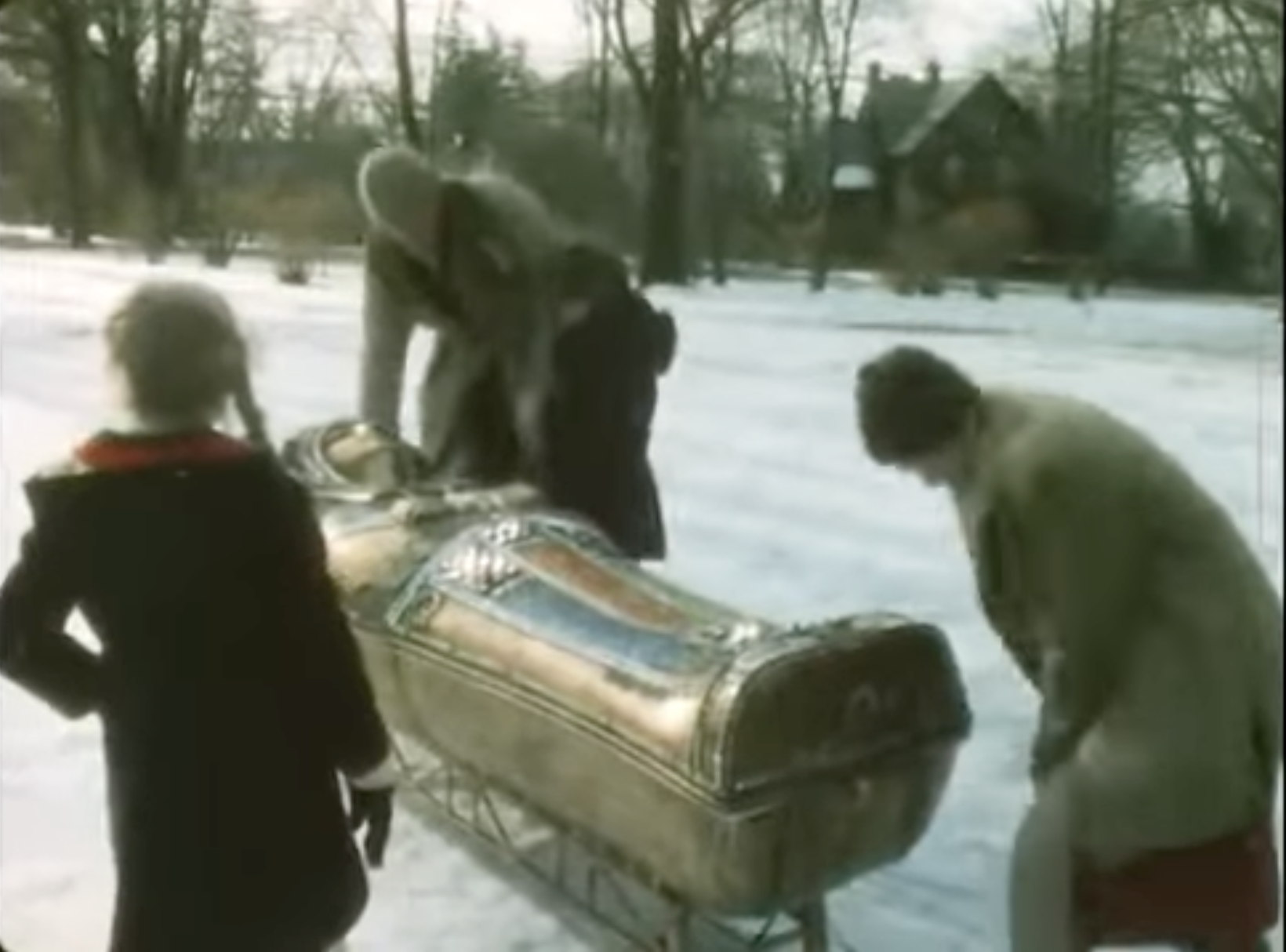
The grandmother arrives at their house via helicopter, ensconced in a golden sarcophagus replete with gold and silver and festooned in Egyptian iconography (perhaps to signal an Egyptian style belief in eternal life, though the stylistic choice is not explained). This scene was triggering to me in the extreme. Whereas most of the movie did not ring any bells, even dimly, I absolutely remembered the sarcophagus, and the grandmother’s emergence from it. It stirred a mix of fascination and fear in me, much like it must have whenever Preschool Me first saw it.
The electric grandmother is portrayed by renowned stage actress Maureen Stapleton, who plays the role as central casting Loving Meemaw crossed with Inspector Gadget. Her mechanical abilities include being able to produce a kite string/washline at will (kinda neat) and dispense milk, cocoa, and orange juice from her fingers at breakfast (kinda gross). She’s also been programmed with tons of data about all members of the household, including dad, who is impressed that she can cook a meal he remembers from his own childhood with no prompting or direction from him. The two older kids are enamored of her from the jump and lose all traces of residual Dead Mom gloom as soon as she enters their home, but youngest kid Agatha is stubbornly resistant to her charm offensive. While dad and the other kids fall head over heels, Agatha proclaims her defiance by yelling that “she’s just a machine!” and even unplugs grandma during a rocking chair recharge session.
When the 30-day trial period is up, the family is told they must return the Electric Grandmother. Agatha remains cold to her and the terms of the agreement say everyone in the house must be satisfied. The rest of the family prevails on Agatha to reconsider but she is unmoved. In her anger the girl runs away into the nearest street and is almost hit by a car, but is saved by the quick thinking and even quicker legs of the Electric Grandmother, who pushes her out of the way of the speeding vehicle as it strikes her instead.
Saved from certain death, a distraught Agatha trauma-dumps about why she never believed the Electric Grandmother’s professions of love. Her mother said she loved Agatha too, but then she “went away,” which made the mother a liar in her eyes. The Electric Grandmother insists she will never go away, because she can’t die, as demonstrated by the fact that she got hit by a whole-ass delivery truck but rose from the pavement unscratched. She even says her indestructibility makes her better than the girl’s stupid mortal mother. Agatha does a complete 180, embracing the Electric Grandmother in a moment meant to be touching but which, in light of the remarks about her deceased mother, sends some really weird messages.
The movie speedruns through the remainder of its plot. We see all the children rally around the Electric Grandmother, get on with their post-mom lives, rapidly age into adolescence and young adulthood, and then leave home for college and employment. No longer needed as a caretaker, the Electric Grandmother returns to Fantoccini’s factory and joins a salon of other electric grandmothers who sit in rocking chairs and knit and swap stories about their former charges, while charging.
Then we return to the elderly man heard at the very outset of the film, who is one of her grandchildren, now in his golden years. Back in his childhood home along with his senior-aged siblings, he calls for the Electric Grandmother to come back and help them all because they are each entering a childlike state of senescence. The electric grandmother does as instructed, once again arriving at their home via helicopter in a sparkling sarcophagus, to the absolute joy of the elderly children. And this is where The Electric Grandmother leaves us. Hooray, I guess.
It will puzzle a modern viewer as to why this is supposed to be heartwarming, as Dead Parent Gets Replaced is no longer used as a plot device in any genre other than horror. We must bear in mind the old cliché that the past is a different country. Perspectives and mores change over time, and what was once meant to evoke pathos years ago can seem dated and strange to us now. Even if we lived through a certain time, it is difficult to see things with the eyes of that time. Much in the same way I can’t tell you now why little kid me was so upset yet captivated by the image of a bejeweled sarcophagus containing a mechanical grandmother. That child is long gone, but that child was me, and is me now. Somehow the feeling remains.