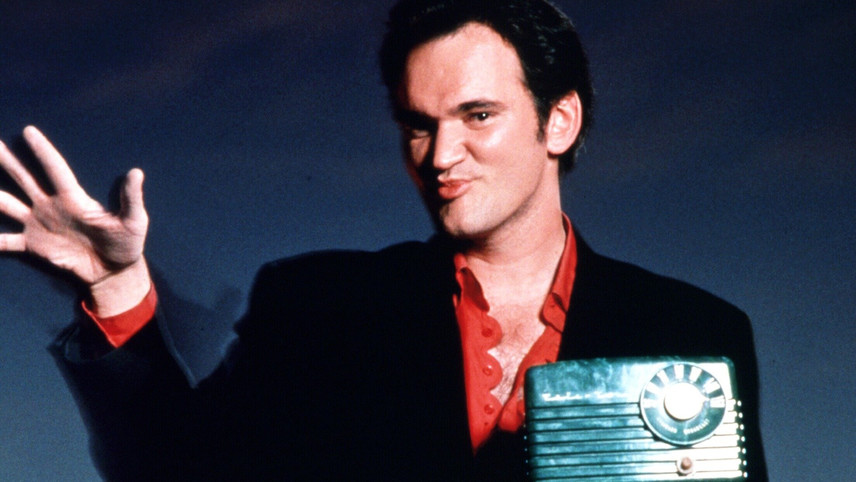
It began with Paul Dano, of course. Late in 2025, Quentin Tarantino made a podcast appearance in which he trashed that actor’s thespian abilities, firing shots that were as baffling and unprovoked as they were mean spirited. Like many people, my initial reaction to Tarantino’s slam was “fuck that guy,” less out of love or defense of Dano than in condemning the audio equivalent of a sucker punch. Unlike most people, my next move was to watch a completely forgotten time capsule of a film, 1995’s Destiny Turns on the Radio. This movie was a relic from the first Clinton term with a small role for Tarantino. The temptation to compare his acting chops against Dano’s was the main reason for revisiting it. Another reason was I hate myself, apparently.
I say “revisit” the film even though I had not previously seen it, because I might as well have seen it when it was first released. Destiny invoked a pop culture moment indelibly imprinted on my psyche: the immediate post-Pulp Fiction years, when Hollywood scrambled to exploit the sudden popularity of both Tarantino’s cool, ultra-violent aesthetic and Tarantino himself as a personality. Though his screen time in Destiny is not significant, the trailer overemphasized his presence and was soundtracked by a replacement level surf rock song so close to “Misirlou” (the song that famously runs over the opening credits of Pulp Fiction) it could have sued Dick Dale for paternity. Commercials for Destiny ran incessantly on late night cable during shows like 120 Minutes and Mystery Science Theater 3000 that appealed to a young hip audience of presumed Tarantino fans.
Then Destiny flopped at the box office and was never mentioned again, except in the sort of intrusive thoughts that I experience, when an old TV show theme song or commercial will ring in my head for days on end. I’ve forgotten the names of most of my high school teachers but if you woke me in the middle of the night I could recite several Tootsie Pop jingles for you.
Thirty years after I had taken note of Destiny, I found watching this movie a draining experience. This was not because it sucked, though it did, but because the way in which it sucked was so aggressively 1990s, so reminiscent of the air of my own youth, that it felt like having pictures from my teens shoved under my nose so I could cringe at the old fashions.
It also served as a reminder that I once loved, if not the man himself, then certainly what Tarantino’s films represented. The “indie” film revolution of the early 1990s and its mythology around self-taught filmmakers could not have been better timed for me, an impressionable high school aged kid who found it genuinely inspiring that Tarantino had educated himself as a video store clerk rather than at a fancy film school. I don’t know how I first heard of Reservoir Dogs (my dad’s slavish devotion to The New York Times and its Arts section was the most likely culprit) but I rented it from the local video store with upsetting regularity and would talk it up to whoever would listen. Its mixture of off color humor, random pop culture references, and unfettered violence truly felt revelatory at that moment, especially before I had a chance to watch the older movies from which it had kited its scenes and vibes. When Pulp Fiction proved a monster success, it felt like a validation of my early adoption. I am not absolutely sure I saw Jackie Brown on opening day but that’s definitely what I would have wanted to do back then, so let’s just say I did.
Then the love faded. As often happens with a faded love there was no single inciting incident but a series of small disappointments that chipped away at the affection. There is the matter of Tarantino the public figure, who loves to take embarrassing contrarian stances, such as his decades-long defense of using the N-word at wholesale volume in his movies. He also lashes out at any critic who dares to take issue with any of his films, sometimes with physical violence, in a way that became more like bullying the higher his star rose. More recently, his steadfast approval of Israel despite the genocide in Gaza was yet another reminder that Gen X’s cultural icons have a terrible moral batting average. There’s a few Real Ones still out there to be sure, but in total they’re hitting well below the Mendoza line.
Come the 2000s, Tarantino no longer seemed necessary to me, cinematically speaking, especially when he was leaning heavily into a grindhouse revivalism that left me cold. I have watched the films he’s made this century out of a sense of completism more than any other impulse. Some I’ve enjoyed, and none are bad films if I’m being honest, but their Easter eggs and endless references (most annoyingly to his own films ) can make the end products feel less like art and more like tracing.
Despite the break I thought I’d made with Tarantino, the cringe I felt while watching Destiny nagged at me. The affected quirks of the film were all too familiar to me because they evoked the memory of many more films from that era, whose existences I recalled vividly in trailer form. After Pulp Fiction, the major studios rushed out anything that could possibly be described as Tarantino-esque, stories about cool dudes doing crimes, sharing pop culture non sequiturs, getting philosophical about their lives of danger while firing their guns sideways in slo-mo.
I convinced myself there was a retroactive microgenre here, a la Yacht Rock, a form of art everyone was making at a very specific time and place without realizing they were making it. I refreshed my memory about the films that might be considered Tarantino Ripoffs and watched as many as I could find and stomach. Some were awful and some were decent, while the majority settled in the Meh pile, as most things do. Despite the initial impulse that led me to watch Destiny, my intent was not to take Tarantino down a peg through his imitators, a thoroughly unfair pursuit; Bob Dylan shouldn’t have to answer for every bad poet who picked up a guitar and harmonica. Rather, my intent was to examine the mid- to late 90s mini-moment in film that Tarantino inspired, to define these movies’ identifying quirks, to examine if they had any redeeming features, and to see how close they came to the original article.
The longer I ran this gauntlet, however, the harder it was to separate my conclusions about these movies from those about Tarantino himself and the generation to which he belongs. In the spirit of the aesthetics of the time, I’ll show the ending now and work my way through my process afterwards. The achilles heel of Tarantino and Gen X writ large is that the ideal they hold higher than any other is the maintenance of Being Cool, and evangelizing for Cool. As it turns out, this is a very shaky foundation on which to rest your personal ethos.
Continue reading Death Drive for QT