All posts by Matthew Callan

What The Woody Allen Scandal Means For Me, A Very Important Writer

Surely no one wished to be in Woody Allen’s shoes when Dylan Farrow’s new accusations came to light earlier this week. But I assure you, gentle reader, neither did you wish to be me, a Very Important Writer, at that moment. For the news sent me into the kind of turgid self-examination and moral reassessment known only to Very Important Writers, the men to whom the world looks for guidance.

As you are no doubt wondering, how does an allegation of pedophilia make me, a Very Important Writer, feel? As shocking as it may sound to you, this is not a question I could answer immediately.

Foremost on my mind when hearing of Dylan Farrow’s tale of unconscionable sexual abuse and violation of trust was, of course, how would I enjoy Woody Allen’s films again? Could I restrict my enjoyment to one viewing of Annie Hall while sitting on an uncomfortable chair as penance? Would it be more prudent of me to watch his more difficult films such as Interiors instead? It was a quandary not to be considered lightly, and a burden that only I, a Very Important Writer, should be asked to bear.

You can be sure that when I, a Very Important Writer, heard this news, it caused me to pace about my brownstone, lost in the recesses of my Very Important Thoughts. The walls of my humble $3.5 million home soon grew too confining. I phoned up a Very Important Writer friend of mine, but he was busy preparing for the Bread Loaf Conference, and of course also preoccupied pondering the same questions about Woody Allen’s work as I. Could we ever enjoy Allen’s films again, he wondered, and if so what would be a respectable time to wait to do so? We reassured each other that we, two Very Important Writers, should be able to solve these dilemmas in our own due time.

Hoping to clear my head, I took a stroll around my colorful Brooklyn neighborhood, peering in the window of the antique shops and the coffee shops and the charming bistro that used to be a laundromat. I stopped at my favorite watering hole and sipped a 12-year-old scotch while exchanging pleasantries about a local sports team with the ruddy-faced barkeep. I sought solace in a delightful ethnic snack from a food cart while trying out snatches of Catalan I learned during one torrid summer in Barcelona. I believe I made myself understood, for all the deficiencies in my accent, and the considerable drawback that the delightful ethnic snack’s vendor was not from anywhere near Catalonia.

And as I ran across these people, I tried not to burden them with my own burden. To do so would have been unfair, for it is a burden they could not possibly have understood, no matter how much my soul yearned to cry out, You do not understand the grief Dylan Farrow’s lost childhood has caused me, a Very Important Writer.

I returned to my home, which began to seem very much like a prison to me. A prison with an ample garden and vintage pressed tin ceilings, but a prison nonetheless. The latest issue of The New Yorker was waiting in my mailbox, but it gave me no succor, despite a fascinating feature on the oldest bookbinder in Northampton. Nor did I find any relief in a sojourn through an advance reader’s copy of Franzen’s latest, The Tepids of Winona.

Alas, it is only in work that a Very Important Writer can find peace. We are much like the ant in that sense, or the miner, or the humble mechanic who toils on my Audi. And so I resolved to document my inner turmoil, because I wanted you, gentle reader, to know that even I, a Very Important Writer, can not answer every question. I must press forward nonetheless, though I can think of no person who has been hurt more by what Dylan Farrow was subjected to than I, a Very Important Writer.
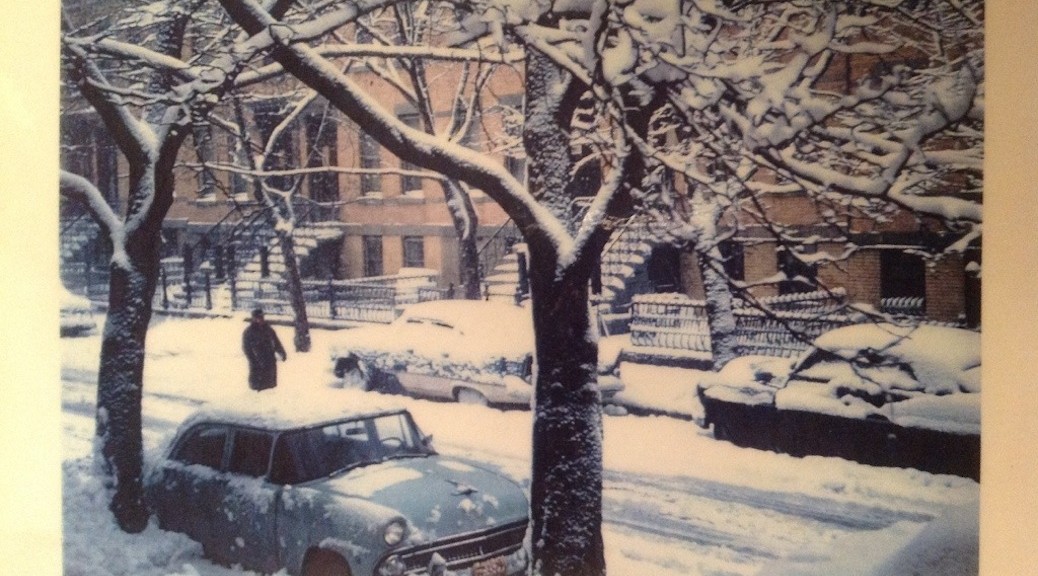
Greene Avenue, 1930

My grampa isn’t my grampa yet, so let’s call him Frank. Frank lives in Brooklyn or Queens, depending on what year it is. He doesn’t change his address, but the borough containing that address changes with the whims of city surveyors.

The subway is a recent addition to his neighborhood. The place is rapidly urbanizing, but there are still some signs of its small town past, like farms. A few small farms lie nearby, some only a few blocks away.

Thanksgiving is on the horizon, and Frank’s dad wants to take advantage of this proximity. He knows a farmer close by with more turkeys than he knows what to do with. Rather than drop way too much dough on a bird from the butcher, Frank’s dad figures he can buy one of these young turkeys, raise it in his backyard, and get it nice and fat in time for the big holiday. He doesn’t have a very big backyard, but how much room does a turkey need, really? All they do is eat and sleep. He’s seen neighbors raise chickens and roosters in their backyards. A turkey can’t be any harder.

This calculation doesn’t take into account Frank, and his sister Kathy. Once the turkey comes home and takes up residence in the backyard, they look upon it not as a future meal, but a pet. Frank and Kathy bring it scraps from the dinner table. They pet it and play with it, even though the concept of “play” seems too complex for a turkey to grasp. They name him Tom.

This presents a dilemma for Frank’s dad. He knows the kids are attached to the turkey and don’t want to see it slaughtered. He is inclined by nature to make them happy. He is not the whip-cracking type of dad, but a sentimental sort, a lover of pranks, a story teller. He ushers at St. Aloysius on Sundays, then goes from church straight to The Eagle’s Nest to bartend and exchange jokes.

Frank’s dad is also a Great War veteran. He served in France to display his patriotism at a time when the propaganda of the age said the True Americanism of anyone of German descent was suspect, a time. And it is 1930, which means Frank’s dad is a dad at the beginning of the Great Depression. He cannot afford to simply throw away food, even food whose name is Tom.

So despite his fun-loving, accommodating nature, Frank’s dad takes the turkey, chops its head off, plucks it, and hands the carcass off to Frank’s mom, who will cook it.

If the idea behind killing the bird was to not waste food, this proves poor reasoning. Frank’s mom and dad eat, but Frank and Kathy do not. They sit in their seats at the dinner table and stare at pieces of what was once their pet and burst out crying, wailing “oh, Tom…” Frank’s dad sees no point in berating his children, but reminds them that this is all the food they have. They can eat this on Thanksgivng or eat nothing. They choose nothing.

Frank will become my grampa and he will tell me this story, and in his telling it will be a funny story. He will imitate his young self crying over a turkey and laugh at the memory. He will have gone to war in a strange land, just like his father, and will come home in one piece and have to raise children on a tight budget, like his father. In his rearview, the plight of a turkey will come to seem like small potatoes.

You could call this cold or cruel, but I know my grampa was not a cold or cruel man. Just the opposite, just like his own father. Grampa just knew that parenting requires difficult decisions, and in a no-win situation, perhaps laughter is called for.

I believe that today of all days, if you can use your childhood pain not for brooding, but for laughing, then you should be thankful.

Late Night 10th Anniversary Special, 1992

Last year, David Letterman “celebrated” 30 years as a late night talk show host. “Celebrated” gets quotation marks because he didn’t mark the occasion at all, really. Even this year, when Letterman entered his 20th year of hosting The Late Show on CBS, the milestone was barely noted at all. Bill Murray (first guest on Letterman’s NBC and CBS shows) made an appearance as Liberace for some reason, but that was Letterman’s only concession to the date. He apparently loathes anniversary specials and is now at a place, career-wise, where he doesn’t have to do anything he doesn’t want to do. Like work on Fridays, or answer questions about not wanting to do an anniversary special. (This Times article on Letterman’s 30th year in late night features zero quotes from the man himself.)

That’s a shame, because it was an anniversary special that first exposed me to David Letterman as a young lad. I assume so, anyway. As a kid, I never would have been allowed to stay up late enough to see Late Night as it aired. I had no real chance to see any of Letterman’s genius until I caught a prime time anniversary special full of clips. When I saw Letterman crushing things with a pneumatic press and throwing things off a five-story building, I thought to myself, in my own little kid way, “This is what TV was made for.”

Whilst scouring my VHS archives recently, I found a tape containing the Late Night 10th Anniversary Special, which aired February 6, 1992. This is a unique artifact for many reasons. Johnny Carson’s retirement was imminent and Letterman had already been officially passed over as his replacement. This, plus a decade of accumulated slights by NBC and parent company GE, made it abundantly clear he would leave the network when his contract expired in 1993.

Previous anniversary specials were more befitting Late Night’s weird, almost community access sensibility. Take, for example, the fourth anniversary special from 1986, wherein Dave, Paul Shaffer’s band, and a crew of technicians conduct the show from the cabin of a 747 flying from Miami to New York. Not a flight they’ve chartered, but a scheduled flight, full of confused, oblivious passengers who find themselves the unwitting audience (and occasionally, victims) of this program.

Then, take a look at the 10th anniversary special below, filmed at Radio City Music Hall with Rockettes, an all-star band, and huge studio audience. It’s almost an audition for the spiffier, toned-down show he’d soon do at 11:30.

Letterman killed The Talk Show Host by creating a talk show in which the host very obviously thought the very idea of a talk show was bullshit. It is strange to see him in this 10th anniversary special, attempting to undo that killing, in his own way. He even seems genuine when thanking the audience for waiting on line to get inside.

For all of the Picture Day propriety, though, there is still plenty of weirdness on display. Observe the studio audience and note that it is packed to the gills with mooks. From the outfits worn and the reactions hooted, you’d think it was Howard Stern on stage. I swear I spotted at least three dudes in Boomer Esiason jerseys. This serves as a reminder that during their respective 1980s heydays, Letterman and Stern were often spoken of in the same breath, comedy-wise, as being (each in their own way) purveyors of edgy, take-no-prisoners laffs.

You will also see a brief appearance by Bill Murray, Letterman’s first ever guest and kindred spirit in practicing the fine art of fake sincerity. Live Stupid Pet Tricks make an appearance as well, but the real treat here is to see the clips from old shows and be reminded of just how strange Late Night was. Try not to think about how, because of Letterman’s acrimonious split from NBC, we’ll probably never see these clips outside of YouTube again. (And while you’re at it, try not to think about how we’ll never see Conan O’Brien’s greatest stuff for the same reason.)

In the final half hour, we receive another reminder of how many amazing bands Letterman had on his show, bands that never would have appeared on The Tonight Show, or anywhere else on TV at the time, for that matter.

This leads into a special live rendition of “Like A Rolling Stone” by Bob Dylan, backed by a band with an insane assemblage of musicians. I remember watching this as a kid and cringing because I hated Bob Dylan. Now I watch it and…I still kinda cringe. I’ve tried with Dylan, I really have, but me and him are never gonna happen. Since he’s the most influential songwriter of his age, I’m willing to concede the problem lies entirely with me, not him. I blame the abundance of harmonica in his tunes. I’ve reached the point in my life where I actually enjoy some of his songs, but once the harmonica kicks in, I check out. No harmonica here, but Dylan’s voice, ew boy…I think I’d take creepy Victoria’s Secret Dylan over this.

And as always, for you weirdos who like commercials, here’s a collection of ads that aired during this broadcast. Featuring: The hilariously failed Reebok “Dan & Dave” campaign, an NBC-4 News “special report” on “Sex & Sports,” a promo for a Matlock movie where he visits “a town that makes its money on murder!”, and a slew of rock-stupid Budweiser spots.