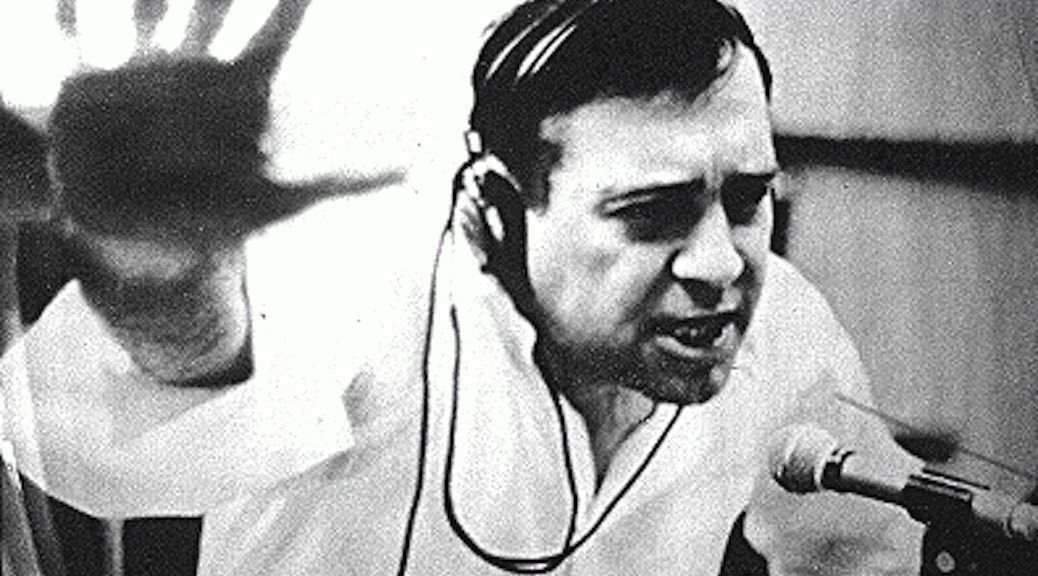
David H. Samson sits at a large oak desk in his cavernous office, stabbing fitfully at a freshly chopped salad with a plastic fork. The walls around him are lined with posters from the innumerable hit television shows he has created, shelves bowing under the weight of all the awards he has received, countless picture frames containing photos of him being embraced by celebrities, politicians, and royalty. But Samson is only here in spirit. His true vision is locked on the next great project that will occupy his fevered brain, even if, to the casual observer, it appears his gaze is on the small, viscous disk glistening on the end of his fork.
“What is this, a water chestnut?” he asks. His perception of food is as impeccable as his perception what TV audiences crave. It is, in fact, a water chestnut. “Never liked these things.”
Samson has just returned from a meeting with a team of foreign producers who hoped to adapt his latest masterpiece, the groundbreaking serial drama Slog, for French television. The producers were effusive with their praise, comparing Samson to Paddy Chayevsky and Gandhi while occasionally genuflecting. But when the time came to get down to brass tacks, Samson found his view of Slog and those of his would-be suitors to be incompatible.
“Ever since the show debuted, I’ve made it clear Slog was conceived as a 27-season arc, with 7 made-for-TV movie events, 3 theatrical releases, a Broadway adaptation, an animated series, and an imposter fragrance,” Samson sighs, showing the strain of explaining this yet again to uncomprehending minds. “The French producers could not guarantee the animated series and seemed iffy on the fragrance. It betrayed a complete misunderstanding of what Slog is all about.”
And what is Slog all about, according to its creator? “It is about…misunderstanding.”
Samson has TV writing in his blood, thanks to being the only child of the legendary producing team of Samson and Delilly. (Contrary to internet rumors, he does not have TV in his blood due to an experimental medical procedure he received in Geneva.) His parents, David H. Samson, Sr. and Marcy Delilly, were the husband-and-wife team behind such beloved sitcoms as You Make The Call!, Curtains!, and Mad About Madge! Samson-Delilly shows were noted for their gentle family-centered humor and earworm theme songs, while the couple themselves were known for their tireless political advocacy and generous charity work.
“Those two were a fucking nightmare,” Samson says.
Despite his comedy parentage, Samson’s own writing tended toward the shadows, even at an early age. He sold his first spec script for Hill Street Blues at age 5, then later used recess periods in grade school to do punch-up work for Law & Order. He grabbed Hollywood’s attention when, at the tender age of 16, he dropped out of high school to showrun the short-lived pitch-black drama The Enforcer.
“It’s still one of best projects I’ve ever been involved with,” Samson says with a sigh, The Enforcer‘s failure fraught with all the regret of a lost love. “I know it seems ridiculous to us now, but back in 1994, America simply wasn’t ready for a tormented street vigilante prone to violent outbursts played by Jamie Farr.”
Undeterred, Samson sold three of his own shows to the networks for the 1998 season. NBC bought Street Cops, a police drama with a Nietzsche-quoting antihero; CBS opted for The Bar, a legal procedural whose main character quoted Camus; and ABC launched Deep Cover, a cloak and dagger thriller with a spy who quoted both Nitezsche and Camus. Samson promised to write every episode of each series, a commitment some observers described as “crazy” and others called “seriously fucking crazy.”
“I couldn’t trust another person to carry out my vision,” Samson explains. “Would you trust another person with your children? Yes, parents let teachers watch their children all day. And day care workers. And afterschool programs and nannies too, I guess. What I’m saying is that my shows are more important than your children.”
Samson not only shepherded each show, but turned all of them into huge hits, despite a grueling schedule and the crippling hallucinations brought on by sleep deprivation. At the 1999 Emmys, he became the first person to accept awards for three different series at the same ceremony while also staving off imaginary bat attacks.
For the next several years, Samson cranked out one show after another, each more lovingly received than the last. Many credit him for ushering in television’s golden era of tormented, bestubbled antiheroes wrestling with their demons and the moral implications of their decisions. “Before Samson, dramas were drawn in broad, good-vs.-evil strokes,” says Matt Zoller Seitz. “Now, thanks to Samson, every character on TV is a huge asshole.”
“It’s hard to say what it is about Samson’s dark vision that works,” critic Tom Shales wrote back in 2004 upon the debut of Samson’s landmark biker gang series, The Devil’s Disciples. “I do know that whatever it is you get when you watch a Samson show, you get a lot of it.”
Never was this more true than in Samson’s crowning achievement, Slog. In order to devote 100 percent of his energies to Slog, the former multitasker put all other work on hold, even abandoning his labor of love, the troubled domestic drama Doll Houses, which only managed to run 173 episodes without him.
The result was a show Dave Itzkoff called “the reason humans were put on this planet. Go to your ancestors’ graves and laugh at them for not being alive to see Slog.” At the conclusion of the Slog‘s triumphant third season, Entertainment Weekly proclaimed, “We declare David H. Samson our new god. Worship him, infidels.”
Slog follows the trials and tribulations of Brad Derwood, a morally conflicted mob boss/doctor/stay-at-home dad who may be hiding a terrible secret. Each episode contains a small slice of Derwood’s endlessly fascinating life, whether that slice includes crushing a stool pigeons head with a wrench or simply waiting for his laundry to be done.
“If I didn’t capture every single moment of this character’s life, I would do a disservice to both him and the audience,” Samson said upon revealing that a future 12-episode arc would just be footage of Derwood asleep in bed.
Slog inspires fierce devotion among its devotees, thanks to its gripping storyline, and Samson’s insistence that true understanding of the show can only be achieved by watching it constantly, “to the exclusion of everything else in your life. If you think you understand it, then you’ve understood nothing. Go back and watch it again and again and again until none of it makes a bit of sense.” When recappers give an episode a less than glowing review, fans have been known to attack with harsh comments on the offending blogs, and also with baseball bats on the writers’ heads.
I ask Samson if he’s heard of the roving gangs of Slog fans who pummel anyone they suspect of never having seen the show, he smiles. “Legally, I can’t say I condone such behavior,” he says with a knowing wink. “But I can say that savage beatings are the sincerest form of flattery.”
There are a few spoilsports who dare rain on Slog‘s parade. Some critics charge that Slog too often veers into self indulgence, as in a recent episode comprised entirely of the protagonist sitting in a Pep Boys while waiting to get his car’s oil changed. Others say Samson’s whip-cracking style is needlessly hard on his actors.
“I demand a lot of everyone who works for me and I will not apologize for that,” Samson says. “I need everyone to keep focus and perspective and remember than making television is the most important job in the universe.”
Despite this, Samson has no comment on the charges that he forced series regular Bill Thompson to eat a brick on set. Accounts of the incident differ, but Thompson himself has refused comment, as his mouth is still wired shut.
Still others contend that the hyper-macho world he created for Slog leaves no room for women, and that he has never written roles for actresses that weren’t long-suffering wives, strippers, or murder victims. To this charge, Samson responds with a resounding, irrefutable, “Sure I have.” As an example, he names Lucinda, a prostitute featured in a two-episode storyline during season seven. “She dropped a cinder block on a pimp’s head. Gotta be pretty strong to do that.”
Can he name any others? “Not offhand, but the fact that I can’t proves I’m not a misogynist. If I was, I’d have preloaded examples in my brain to plead my case. This shows I’m not so sensitive.”
Samson is less annoyed by charges of sexism than by those who take issue with Slog‘s dramatic pace. “I’ve even heard people say that Slog drags a bit for the first 90 episodes,” Samson mutters with a roll of the eyes. “To them I say, Of course it does. It was always intended to drag for the first 90, then have a sharp uptick for the next 20, then plateau for the following 15, then dip a bit for another 15, then get really bad for 10. Only then is the stage set for the series’ real action.”
“If I have to explain this,” he adds, “I’ve probably failed as a writer. But it’s more likely you’ve failed as a viewer.”
Even after creating a work of art of such unflinching mastery, Samson stares beyond his salad, pupils thrusting toward the next idea. “I have this vision,” he says, expelling the words in a rush, as if glad to unburden his mind of such weighty thoughts. “It comes to me only in glimpses, sometimes in the middle of the night. I reach to grab it and it slips from my hand. I don’t know how I can make this happen, I don’t know when or where, but I know someday I will bring this to life.”
“I really want to make a show about America’s most racist magician.”