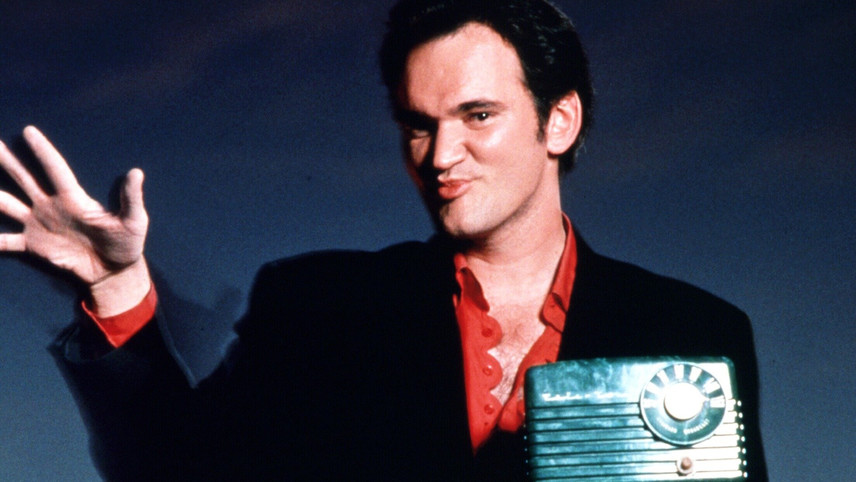
It began with Paul Dano, of course. Late in 2025, Quentin Tarantino made a podcast appearance in which he trashed that actor’s thespian abilities, firing shots that were as baffling and unprovoked as they were mean spirited. Like many people, my initial reaction to Tarantino’s slam was “fuck that guy,” less out of love or defense of Dano than in condemning the audio equivalent of a sucker punch. Unlike most people, my next move was to watch a completely forgotten time capsule of a film, 1995’s Destiny Turns on the Radio. This movie was a relic from the first Clinton term with a small role for Tarantino. The temptation to compare his acting chops against Dano’s was the main reason for revisiting it. Another reason was I hate myself, apparently.
I say “revisit” the film even though I had not previously seen it, because I might as well have seen it when it was first released. Destiny invoked a pop culture moment indelibly imprinted on my psyche: the immediate post-Pulp Fiction years, when Hollywood scrambled to exploit the sudden popularity of both Tarantino’s cool, ultra-violent aesthetic and Tarantino himself as a personality. Though his screen time in Destiny is not significant, the trailer overemphasized his presence and was soundtracked by a replacement level surf rock song so close to “Misirlou” (the song that famously runs over the opening credits of Pulp Fiction) it could have sued Dick Dale for paternity. Commercials for Destiny ran incessantly on late night cable during shows like 120 Minutes and Mystery Science Theater 3000 that appealed to a young hip audience of presumed Tarantino fans.
Then Destiny flopped at the box office and was never mentioned again, except in the sort of intrusive thoughts that I experience, when an old TV show theme song or commercial will ring in my head for days on end. I’ve forgotten the names of most of my high school teachers but if you woke me in the middle of the night I could recite several Tootsie Pop jingles for you.
Thirty years after I had taken note of Destiny, I found watching this movie a draining experience. This was not because it sucked, though it did, but because the way in which it sucked was so aggressively 1990s, so reminiscent of the air of my own youth, that it felt like having pictures from my teens shoved under my nose so I could cringe at the old fashions.
It also served as a reminder that I once loved, if not the man himself, then certainly what Tarantino’s films represented. The “indie” film revolution of the early 1990s and its mythology around self-taught filmmakers could not have been better timed for me, an impressionable high school aged kid who found it genuinely inspiring that Tarantino had educated himself as a video store clerk rather than at a fancy film school. I don’t know how I first heard of Reservoir Dogs (my dad’s slavish devotion to The New York Times and its Arts section was the most likely culprit) but I rented it from the local video store with upsetting regularity and would talk it up to whoever would listen. Its mixture of off color humor, random pop culture references, and unfettered violence truly felt revelatory at that moment, especially before I had a chance to watch the older movies from which it had kited its scenes and vibes. When Pulp Fiction proved a monster success, it felt like a validation of my early adoption. I am not absolutely sure I saw Jackie Brown on opening day but that’s definitely what I would have wanted to do back then, so let’s just say I did.
Then the love faded. As often happens with a faded love there was no single inciting incident but a series of small disappointments that chipped away at the affection. There is the matter of Tarantino the public figure, who loves to take embarrassing contrarian stances, such as his decades-long defense of using the N-word at wholesale volume in his movies. He also lashes out at any critic who dares to take issue with any of his films, sometimes with physical violence, in a way that became more like bullying the higher his star rose. More recently, his steadfast approval of Israel despite the genocide in Gaza was yet another reminder that Gen X’s cultural icons have a terrible moral batting average. There’s a few Real Ones still out there to be sure, but in total they’re hitting well below the Mendoza line.
Come the 2000s, Tarantino no longer seemed necessary to me, cinematically speaking, especially when he was leaning heavily into a grindhouse revivalism that left me cold. I have watched the films he’s made this century out of a sense of completism more than any other impulse. Some I’ve enjoyed, and none are bad films if I’m being honest, but their Easter eggs and endless references (most annoyingly to his own films ) can make the end products feel less like art and more like tracing.
Despite the break I thought I’d made with Tarantino, the cringe I felt while watching Destiny nagged at me. The affected quirks of the film were all too familiar to me because they evoked the memory of many more films from that era, whose existences I recalled vividly in trailer form. After Pulp Fiction, the major studios rushed out anything that could possibly be described as Tarantino-esque, stories about cool dudes doing crimes, sharing pop culture non sequiturs, getting philosophical about their lives of danger while firing their guns sideways in slo-mo.
I convinced myself there was a retroactive microgenre here, a la Yacht Rock, a form of art everyone was making at a very specific time and place without realizing they were making it. I refreshed my memory about the films that might be considered Tarantino Ripoffs and watched as many as I could find and stomach. Some were awful and some were decent, while the majority settled in the Meh pile, as most things do. Despite the initial impulse that led me to watch Destiny, my intent was not to take Tarantino down a peg through his imitators, a thoroughly unfair pursuit; Bob Dylan shouldn’t have to answer for every bad poet who picked up a guitar and harmonica. Rather, my intent was to examine the mid- to late 90s mini-moment in film that Tarantino inspired, to define these movies’ identifying quirks, to examine if they had any redeeming features, and to see how close they came to the original article.
The longer I ran this gauntlet, however, the harder it was to separate my conclusions about these movies from those about Tarantino himself and the generation to which he belongs. In the spirit of the aesthetics of the time, I’ll show the ending now and work my way through my process afterwards. The achilles heel of Tarantino and Gen X writ large is that the ideal they hold higher than any other is the maintenance of Being Cool, and evangelizing for Cool. As it turns out, this is a very shaky foundation on which to rest your personal ethos.
Disclaimer: Judging an entire generation is reductive in the extreme. That being said, people who come of age at a certain place and time will have shared experiences that shape their lives, thus making some collective assessment possible, provided it’s acknowledged that this is a very broad brush with which to paint people. I would also argue that, because our culture discusses generations as concrete entities with definitional characteristics, people tend to internalize what is said about their respective cohorts, regardless of whether or not those traits define the person espousing them. What someone chooses to believe about themselves and their peers is an indicator of what a person believes they should be. Many Baby Boomers speak glowingly about the antiwar and civil rights protests of their youth, whether they as individuals participated in them or not. This allows them to reap the virtue of that participation, even if it is merely reflective.
When it comes to Generation X, a cohort that includes Tarantino on one end and me on the other, we are often told they loathed the idea of Selling Out. I believe this is nominally true; the Slacker ideal that was both applied to and espoused by Gen X was a variation on the 1960s concept of tune in, turn on, drop out. However, their fear of Selling Out was in reality a mask of a deeper, less often voiced anxiety: a fear of being Uncool.
Gen X was not unique, as a group, in their resistance to Selling Out or their desire for Coolness. The Baby Boomers had similar ideals, and their celebrated counterculture was constructed in part to make Selling Out unnecessary, but the larger reason for the formation of that counterculture was the Boomers’ unifying political cause: to end the military draft and the USA’s war in Vietnam, which to them posed a literal existential threat. Gen X was never politicized to such a wide degree, in part because The Boomers had provided an object lesson in what happened when your counterculture was so aggressively politicized: you can always lose, and losing looks bad. When Gen X was entering young adulthood in the latter half of the 1970s, the general consensus on the preceding decade was that the radicals of the 60s had failed to achieve anything of lasting significance, its leaders either assassinated (Fred Hampton), on the run (Abbie Hoffman), or, even worse, doing complete 180s in their perspectives on The System (see: former Chicago 7 defendant Jerry Rubin becoming a stock trader).
It must also be remembered that the 1970s were largely a miserable time in the US. The Fall of Saigon, Watergate, oil crises, rampant stagflation–in other words, a little preview of the American Century of Humiliation now in full swing. Gen X’s first years of cultural awareness came at the same time Gerald Ford was tripping down stairs and there were miles-long lines at every gas station, priming them to believe politics was a fool’s endeavor.
For this reason, Gen X’s objection to selling out was defined on mostly aesthetic terms. For the older members, the ones around Tarantino’s age, their college years roughly coincided with Reagan’s 1980 election. There were politically oriented denunciations of his neocon revolution (find any punk 7 inch from the era to learn more), but the new Jellybean Imperium was far more often criticized for being lame. Reagan meant the triumph of braindead philistinism and surface level glamour, of Rambo and Rocky fighting the Cold War, of Lifestyles of the Rich and Famous, of Jim and Tammy Faye Bakker, of an era when the Free World was led by a failed B actor who insisted ketchup was a vegetable. What could possibly be lamer?
The new subcultures Gen X formed in response to this lameness tended to be hyper-regional, with considerable barriers of entry to outsiders and little impact on mainstream culture. The College Rock they birthed in the early 1980s had occasional Top 40 breakouts, but in the main it remained firmly on campus, its greatest heroes celebrated for their stubborn resistance to success (see: The Replacements). Exchanges were made among these scenes via DIY record labels and touring networks, but with little to no interaction with the larger culture consumed by Joe Sixpack. Such protectiveness could be termed a fear of Selling Out, but it could also be termed as an attempt to impose a cartel on the limited supply of Coolness.
This lack of a political consensus, combined with an eye-rolling attitude toward the monoculture of the time, is what I believe led to another defining characteristic of Gen X aesthetics: hyper-referentiality. Whereas their immediate generational predecessors might have bonded over the antiwar cause or hatred of Nixon, members of Gen X identified themselves via the cultural items they chose to consume or, even more often, the cultural items they had no choice but to consume as young people in those hated 1970s, Schoolhouse Rock, Land of the Lost, Happy Days, things of that nature.
Come the 1980s, it was easier than ever to revel in these memories, thanks to the explosion of home video and cable television providing ample rerun real estate in which one could live in the past. The quality of any of these items was often irrelevant; if anything, the point in remembering these things was to highlight their lack of quality. Any member of Gen X worth their salt could quote The Brady Bunch chapter and verse, but almost invariably to note how stupid the show was. The Boomers’ famous line about Woodstock–if you remembered it, you weren’t there–was inverted by a subsequent generation that defined itself by their ability to Remember Some Guys.
The biggest argument against Gen X’s fear of selling out is that, when the larger culture came for them, they gave in to it with nary a whimper. As Reagan became Bush Senior and the 1980s became the 1990s, the mainstream began to subsume the coolness Gen X had created and desired. In music, the seismic event was the mainstream success of Nirvana and the major label feeding frenzy of similar bands that followed. (Once College Rock, they would now be called Alternative, a much more inclusive and flattering term.) In film, the unprecedented mainstream success of Stephen Soderbergh’s Sex, Lies, and Videotape, made for virtually nothing outside the Hollywood studio system, launched an aesthetic revolution in that medium, leading to a Nirvana-like gobbling up of independent films and their creators by the major studios (or sometimes, as in the case of Miramax, buying the indie producers themselves). Before long, you didn’t have to transplant yourself to a downtown scene to be cool. You could go to a mall to buy a Sonic Youth album, then bop down to the adjoining multiplex to catch a Todd Solondz film.
There were haters and grumblers of course, those who had sincerely internalized the selling out = bad ideal, but largely Gen X regarded this development not as a sell out but a triumph. The culture had come to them. This was proof of their Coolness, forever and ever, amen.
Such a belief, if acquired in the flower of youth, is difficult to shake. This was especially true if you were younger at the time, coming of age in the 1990s, when the mainstream had already integrated a preestablished idea of coolness, making any rebellion even more pointless than before. Or if, like Quentino Tarantino, you helped assure your generation of its coolness in the first place.
Tarantino came to his own personal brand of coolness through the old hard work method, as is detailed in his semi-autobiography Cinema Speculation. The bulk of the book is comprised of his takes on some of his favorite movies of the (mostly) 1970s, commentaries that include some genuinely interesting insights illuminated by personal exchanges with filmmakers like John Milius and Brian De Palma. These reside alongside his trademark eye-poking contrarianism (The Friends of Eddie Coyle is overrated?!) and other headscratching takes. Of the latter, I will only mention his belief that Taxi Driver would have been a much better film if Travis Bickle had been more obviously racist and the pimp played by Harvey Keitel had been black, as he says was screenwriter Paul Schrader’s original intent. (Pause to work through your feelings about that.) It is, in short, completely on brand. If a book full of Quentin Tarantino’s opinions didn’t make you wanna throw it out a window every few pages, you’d ask for a refund.
This dirtbag version of Cahiers du Cinema is bookended by a pair of more revealing essays, ones that betray a sense of vulnerability seldom seen in his own work and, as far as I know, never in his life as a public figure.
The book’s opening essay celebrates the year in film of 1970, the flowers of which Tarantino experienced at the tender age of seven. At that time, his mother and stepfather would drag him to any movie they wished to see, regardless of its fitness for a boy his age. This is how a first grader was able to watch movies like M*A*S*H and Joe, in which Peter Boyle portrays the quintessential Nixon era Hard Hat, a boorish racist who longs to kill hippies. Perhaps this was the fount of Tarantino’s fondness for making white guys drop the N-bomb?
Tarantino spins this experience as the smithy that forged him into being much more hip and sophisticated than his peers, but he also accidentally reveals that this rendered him unable to relate to other kids his age, or to advance from Kid Stuff to Adult Stuff in a gradual and healthy way. He brags that this precocious film education left him cool the charms of hokey live action Disney fare like The Boatniks, yet mere pages later he confesses the death of Bambi’s mother in the titular animated film upset him deeply. This suggests a social development that the word “arrested” doesn’t even begin to cover. I imagine a playground scene where all the other kids are having fun on swings and slides while a young Tarantino just wants to talk about Deliverance (discussed at length in the book, released and seen by the author in 1972, when he was nine). I would call this far less cool than sad.
That feeling of sadness pervades the book’s final chapter, which centers on Tarantino’s adolescence and further cinematic education under the tutelage of a man named Floyd, his personal guide through the exciting world of blaxploitation and grindhouse films. Floyd was an ex of a friend of Tarantino’s mother and the family’s occasional roommate, a man who led a marginal existence and drifted in and out of their lives until a final Irish exit some time in the early 1980s. The second sentence of the chapter makes sure we know Floyd was “a black guy”, signaling to us that his story will give Tarantino some cover to counter the charges of racism and insensitivity that are often lobbed against him (see: those aforementioned white guy N-bombs).
It also serves as an origin story for the author and his aesthetic. Floyd had bespoke cultural tastes that didn’t neatly conform to the median of his own demographic but echo those of adult Tarantino: love of Elvis, Westerns, 50s rock and 70s soul, and a tendency to issue apologia for maligned cultural artifacts. That two of those artifacts were Stepin Fetchit and Amos & Andy is another signal that Floyd is Tarantino’s personal Cookout Invitation.
Tarantino tells us that by the latter half of the 1970s he was being raised by his mother (newly single) and a series of her female friends, which put Floyd in the role of a much needed masculine role model. This makes doubly upsetting his admission that Floyd “didn’t give a fuck about me”. In his telling, Floyd would often promise to take the young Quentin to the movies over the weekend, only for Saturday night to come and go with no sign of the man. When Floyd did actually make good on those promises, he would invariably take young Quentin to see grindhouse fare that was, even for an older teenager, not age appropriate. The same could be said for the “unvarnished masculine advice” Floyd liked to pass along to him. The nature of this advice is mostly alluded to but can be surmised from Tarantino’s admission that, thanks to Floyd’s proclamations, he eschewed performing oral sex on a woman until well into adulthood. (Sorry, if I had to read about that I’m gonna have to spread the pain around.)
If you have had the experience of being raised by a caregiver with substance abuse problems (raises hand) you will recognize in Floyd the classic Alcoholic Dad: lavish promises that go unfulfilled, a lack of healthy boundaries, a relationship more buddy-buddy than parental. Tarantino insists Floyd didn’t have problems with drugs or alcohol, but his behavior mimics that of an addict closely enough to make the difference immaterial to a child in his care. Such parental figures can love their children and express that affection, but something else will always be number one in their lives. For Floyd, maybe that something wasn’t booze or drugs, but there clearly was something that made him alienate, and alienate himself from, the people in his life. He strikes the reader as a troubled soul, perhaps someone who’d been hurt so many times he never dared to get too close to anyone again. And as a black man who’d grown up in Louisiana in the 1950s (Floyd’s background, according to Tarantino), it’s very likely he had a heavy load of psychic damage to lug around with him.
Most of the preceding paragraph is between-line reading on my part, because if Tarantino perceives such a wounded vulnerability in Floyd, he doesn’t share that perception. All of the disappointment and frustration and tragedy is paved over with one glowing proclamation from the author: Floyd was the coolest motherfucker ever. Rarely do we hear an artist so unmistakably say I make art for one person alone and learn that person is someone other than themselves. Tarantino does say this, and the person is Floyd.
When Tarantino lists Floyd’s cultural opinions (thumbs up for Charles Bronson, Don Knotts, and Jackie Wilson; thumbs down for Sidney Poitier, Charlie Chaplin, and Buddy Holly), what he’s really listing is his own personal “do this not that” rules for his art. The director says he completely rejected the Frampton Comes Alive era of bombastic arena rock that was dominant during his high school years in favor of Elvis Presley, and though he implies he settled on this taste before Floyd’s influence in his life, it also happens to perfectly reflect his father figure’s taste in music. When Tarantino shares Floyd’s sharp yea or nay takes on movies and actors, we hear the echoes of the author, in both written dialogue and in interviews, declaiming on his own faves—and just as loudly slamming others.
Like many of his peers, living in an era of regional subcultures with no roadmap to their entry points, Tarantino needed a Hip Mentor to discover what was truly Cool and denounce what was Uncool. He had Floyd, and in turn he decided he would be Floyd to the world. If good artists copy and great artists steal, what Tarantino does is a secret third thing: he curates, like a museum, putting huge labels on all of the pieces to note their points of origin, because there’s no point in Being Cool if you can’t tell us you know where to get the Cool Stuff.
Before you watch Kill Bill you don’t need to know Tarantino is mimicking Lady Snowblood and Seijun Suzuki and Sam Peckinpah and spaghetti westerns, because he will explicitly confess to doing that, sometimes within the film itself (like the Shaw Brothers title card that precedes the opening credits). If you don’t already know that Sonny Chiba is cool as fuck, one of his screenplays (True Romance) will tell you that at great length, even if this declaration is not at all relevant to the scene or film in which it appears. He will seek out forgotten or marginalized actors from his youth and drop them in his films (John Travolta, Robert Forster), mostly so you, like him, can say to yourself hey I remember that guy…
None of this is to say that Tarantino’s films are not good, or mere pastisches. If anything, knowing he is making them to satisfy an idealized tastemaker/father figure in his head casts a different light on his pop culture evangelizing. It makes his outsized reactions a bit more understandable, because he must take the matter of his/Floyd’s opinions very seriously and very personally. His films are mix tapes he gives to everyone in the hopes that they will make exactly one person bop their head.
It also gives a sharper edge to his insistence that Floyd is dead. Tarantino concedes he doesn’t know exactly what happened to the man, and if you estimate his age based on the biographical clues offered in the chapter it’s not unreasonable to think Floyd could have still been alive when it was written. No matter; Tarantino is sure that not only is Floyd dead, but that he died in some sad, lonely way, in an alley or a ditch, his meager possessions and screenplays unceremoniously dumped in the trash (yes, Floyd wrote screenplays, just like him). By proclaiming Floyd’s death, what Tarantino is really saying is Floyd was the last Cool Guy and he died for your sins. I am spreading his gospel, and apres moi le deluge.
Not everyone has a north star like Floyd, however, and this brings us back to those aforementioned Tarantino ripoffs. I determined their geologic age to begin circa 1993, a point at which a riff on his first acclaimed feature Reservoir Dogs could be possible, and to end circa 2001 (guess why). The broadest capsule description of a Tarantino ripoff is: Movies where cool dudes do crimes. The coolness is spread across all characters, even the antagonists. Everyone is incredibly, preternaturally cool, with singular purposes (revenge, mostly) that are never complicated by doubt or remorse. And it is exclusively cool dudes in these films, as the worlds they depict are hypermasculine; women exist in them largely as arm candy, unquestioned accomplices, sexual favor dispensers, or ball busting battle axes who must be avoided or shamed.
These films contain many defining tropes. Tarantino’s own movies, particularly his more recent ones, avoid many of these clichés, but all of the movies made by his imitators in the 1990s contain at least three or four of these elements:
- A nonlinear narrative
- A cast of dozens with parallel stories that eventually intersect
- Revenge presented as a higher calling than the priesthood
- Set in LA, Vegas, or a dying tumbleweed filled small town that looks like The Last Picture Show; after Good Will Hunting, the movie can also take place in Boston, but nowhere else
- A criminal underworld that all characters are familiar with and which has no barriers to entry
- A hero who is presented as supernaturally attractive to women even if not conventionally handsome
- At least one character espousing Philosophy 101-level “deepness,” larded with heavy doses of pop cultural references
- Characters with too-cute-by-half nicknames
- Characters who are newly released or escaped from prison and don’t seem too upset about the experience
- Characters with oddball quirks that no real human has ever had
- Extensive backstory given via extended narration
- Conflict among the Cool Guys demonstrated by having them all yell at the same time
- Male camaraderie expressed exclusively through ball busting, most often by lobbing homophobic insults at each other
- A sort of inverse Bechdel test where all the women are wives/girlfriends or sex workers (or both)
- Casual homophobia and racism as a shortcut to demonstrate how “real guys” talk
- Contrarianism and “both sides are bad” viewpoints presented as the pinnacle of sophisticated thought
Take for example (please) the film that sent me on this path in the first place, Destiny Turns on the Radio. The action centers around a bank robber recently escaped from prison (Dylan McDermott) attempting to get back his stash of stolen cash and his lounge singer lady (Nancy Travis), both of which have been stolen from him by gangsters. Various subplots roil among a supporting cast that includes Jim Belushi, Bobcat Goldthwait, and the first film appearance of David Cross. McDermott’s character struts around the greater Las Vegas area driving sweet 1960s convertibles and sporting Nudie suits, ostentatious and unwise behavior for someone who is still wanted for busting out of jail. His character is named Julian Goddard, his best bud is a mechanic named Harry Thoreau, and there is a mob boss named Vinnie Vidivici. “Daddy-o” style 50s patter is mixed with nonsensical attempts at deep dialogue like “The universe is expanding, I’m trying to stem the chaos.” Travis’s character reveals she is pregnant with McDermott’s baby, something that should have been physically impossible due to his prison stretch except we learn that the conception happened in a dream. And so on.
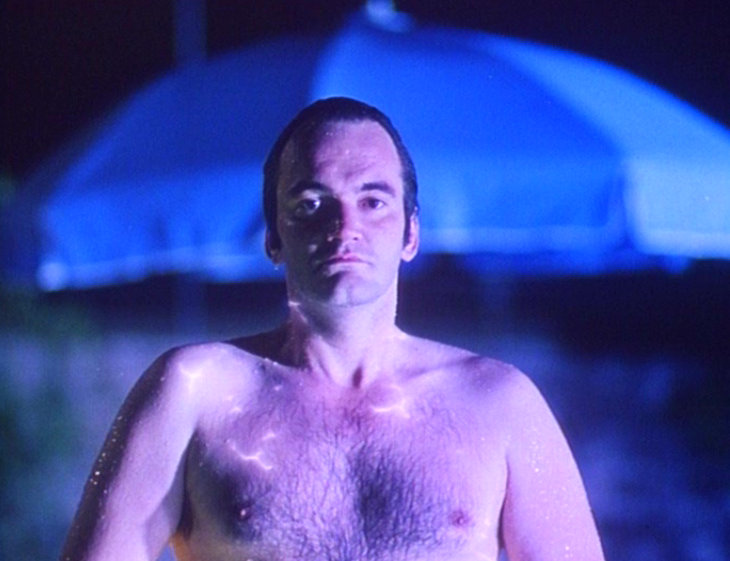
Quentin Tarantino is not the worst part of Destiny (there’s a supercut of his scenes here for the curious), though this is more of an indictment of the film than a defense of his acting chops. He does have the misfortune of delivering most of the annoying Daddy-o dialogue, and also appears in a scene in which he emerges nude and wet from a glowing yellow pool looking like a newborn Bob Hope. He does this because his character (named Johnny Destiny) is some sort of alien or perhaps demigod using the pool to travel between worlds. I think. The film is not especially clear on these points, or any other point, and not in an interesting dream-like Fellini-esque way; it’s more like the screenwriter put a bunch of severed limbs into an incubator and hoped they would knit together somehow. It ends with the lovers McDermott and Travis jumping into the yellow glowing pool and escaping to…actually, don’t worry about it. Nobody else did.
What is so annoying about the movie is not Tarantino’s hipster alien/god, or McDermott as the ostensible hero (though, sorry, he kinda sucks in this; he never quite decides what accent to use and his portrayal veers wildly between tortured soul and unflappable badass), or the mock deep monologues. What truly grated on me while watching Destiny is the fact that every character in it is meant to be Cool, including the bad guys. Jim Belushi plays Travis’s new beau, the biggest obstacle to the two star crossed lovers reuniting, and even he gets Marsellus Wallace-lite monologues to show us his tough guy humor and big pimpin’ energy.
As I watched other movies from the period, I realized that this is what I objected to: the lack of character flaws, the complete absence of vulnerability, the insistence that everyone in the movie needs to be Cool. This provided a major roadblock to building the kinds of things a viewer should expect from a narrative, minor details like “tension” and “drama”.
Granted, one could lob similar charges at a million different works, especially genre movies. The great Hong Kong action films are often built on Everybody’s Awesome dynamics. (Is anyone not cool in a John Woo movie?) Why should it be especially grating in these 90s movies?
I would say it’s because the originals were usually low-budget fare made with little self awareness on the part of the creators that they were working within a genre, and with a “throw it at the wall and see if it sticks” attitude that can compensate for flaws. Tarantino’s homages to these films were built on an encyclopedic knowledge of the source material and intended to evoke their feeling and vibes as much as make specific references to them (though they are chock full of specific references). In contrast, Tarantino’s imitators were working when his conception of Coolness had been fully integrated into the culture, and so they are largely oblivious to the fact that they were imitating an imitation. The resulting films have the same fuzzy edges as a copy of a copy of a copy.
One of the more egregious examples of this strangeness is another film from 1995, Things to Do in Denver When You’re Dead. It centers on Jimmy the Saint, played by professional suit wearer Andy Garcia, an ex mobster who wants to go straight by running a business where dying people record videos their loved ones can watch after they pass (again, don’t worry about). His presumed bone-deep coolness is never questioned. Men admire him and women throw themselves at him, even when he is speaking in an incomprehensible Makin’ Time With A Dame patois that, in real life, would earn you a puzzled glance or possibly even a push down a flight of stairs.
Jimmy is compelled into One Last Job by former boss The Man With The Plan (Christopher Walken, acting exactly how you might imagine) and assembles a crew of other stupidly named accomplices (Big Bear Franchise, Pieces, Critical Bill). When not engaged in ball busting that is exclusively expressed by calling each other “gay” (using harsher terms than that, of course) they speak in a bespoke slang translated for us by narrator Jack Warden, who constantly tells the viewer about how things were done by these guys “back in the day” even though Warden has a good 30 years on all of them. One side quest involves Fairuza Balk as a strung-out sex worker whose plan to put her life back on track involves getting pregnant with Jimmy’s baby (hooray?). The whole crew is hunted down and executed for their betrayal of the big boss, most of them killed by a hitman named Mr Shhh (I shhhit you not). It ends with all of them enjoying spectral cocktails on a ghost boat, assuring us that even in death they are extremely suave and cool. The end.
The QT ripoffs that infested cineplexes after Pulp Fiction offered a buffet of this sort of thing. Love and .45 from 1994 is a Bonnie & Clyde style “killer lovers on the run” story where we are meant to understand the violent gunman half of the couple is actually deep because he is seen consulting the I Ching before a convenience store robbery, an affectation that has virtually no impact on the story. In Truth or Consequences NM, Kiefer Sutherland (who also directed) plays a loose cannon member of a crew of robbers who dresses in a neo-rockabilly style you could call Prehistoric Guy Fieri, and peppers his monologues with smart-dumb-guy talk interspersed with observations about Yogi Bear. The 1997 neo-noir Keys to Tulsa aims for a Chinatown-esque tale of corruption and incestuous family secrets but stumbles over a confusing plot and the fact that protagonist Eric Stoltz can’t quite carry the Unstoppable Pussy Magnet label that is supposed to burden his character. (Apologies to any Eric Stoltz partisans out there; your feelings are valid but I personally do not see it.) One of the later examples, 2000’s Way of the Gun, gives its pair of heavily armed heroes the same government names as Butch Cassidy and the Sundance Kid, and also forces James Caan (playing an aging fixer for a businessman/crime boss) to utter the line “I can promise you a day of reckoning that you will not live long enough to never forget.” Writing that kind of dialogue, and making a legend like Caan say it on screen, should have earned someone a prison sentence.
The ne plus ultra of these films is the 1999 abomination The Boondock Saints, less a movie than a cinematic superfund site that answers the question “what if Opus Dei had, like, guns?” The film depicts a pair of hyper-Catholic Irish brothers in Boston who believe God Himself has tasked them with waging a two-man war against urban decay using heavy fire power and Latin hand tattoos. The film’s tone shifts are almost as violent as the on-screen action; one minute the brothers are meting out their brand of vigilante justice in cassock-like longcoats, giving their killings the air of sacraments, and the next minute they are playing practical jokes on their buddies in comic relief scenes that neither are comedic nor do they provide any relief whatsoever. The brothers are aided by a sympathetic detective portrayed by Willem Defoe, whose performance in this film should be studied by science to make sure it can never happen again.
Late in the proceedings a hitman named Il Duce is hired by local mob bosses to take the brothers out, but wouldn’t you know it, the hitman turns out to be their long lost father. By the end of the film Il Duce (played by Billy Connolly, who seems to be having fun at least) has teamed up with his abandoned brood to wash the scum off the streets and we are promised/threatened that they will return.
If you must watch this film—well first of all, for the love of god don’t do that to yourself, but if you must watch it make sure to follow it with the behind-the-scenes documentary Overnight, arguably the most unvarnished portrait of hubris ever captured on film. That way you can be assured that screenwriter/director Troy Duffy was as hoisted by his own petard as much as anyone in cinema history.
Rarely have the inevitable reactionary conclusions of the post-Tarantino action/crime film been laid out with more clarity than in Boondock Saints: a pair of vigilantes dispatch urban undesirables with the help of the police and a prodigal father named Il Duce. It might be the first, and hopefully only, Neo-Falangist film ever made.
It’s easy to say so what? about all of the above, seeing as how Boondock Saints was such a flop that its viewpoint could not possibly have made much of a cultural impact. However, I’d argue that the film reached its conclusions ahead of its peers. It was, in many ways, far ahead of its time.
In keeping with the muddling of linear time endemic to this subgenre, let’s travel back a few years from Boondock Saints’ aborted release, to 1996 and the Quentin Tarantino/Robert Rodriguez collab From Dusk Til Dawn. It doesn’t quite fit the Tarantino Ripoff angle for a multitude of reasons (you can’t really rip off yourself, for one, though of course the movie does contain a multitude of references to movies made by both Tarantino and Rodriguez), but it must be mentioned for reasons that will become clear. The film centers on a pair of criminal brothers played by Tarantino and George Clooney, whose crimes are as numerous as they are horrifying. While fleeing justice they kidnap a lapsed preacher and his kids, drive themselves south of the border, and hole up at a strip club, unaware that everyone inside is a vampire. Much bloodening ensues, though none of the vampire chomping and viscera spraying is nearly as repellent as the fact that Tarantino’s character is shown to be a serial rapist and probably a pedophile, and that these “quirks” are played mostly for laughs. (Bear in mind that Tarantino wrote the screenplay and willingly took the role.)
I will abandon any further analysis of that mess and shift focus onto its making-of documentary, Full Tilt Boogie. I did not enjoy the feature film and I enjoyed the doc even less, as it is a deathly dull chronicle of an unnecessary film, but it did have one illuminating section. From Dusk til Dawn was criticized during its production for failing to use a union crew on set, and the documentary addresses the controversy by giving Tarantino, Rodriguez, and various producers more than enough rope with which to hang themselves. The two filmmakers both play the smol bean angle, referring to the movie as a humble “indie” production, even though it had a hefty budget and was technically being made under the auspices of a major studio. The makers of Full Tilt Boogie even try to storm an IATSE convention to “debate” the labor issue, a scene that suggests a failed recreation of Roger and Me from someone who did not understand Michael Moore’s movie even a little bit. The union officials are genuinely baffled by this gambit, while the documentary filmmakers appear to be equally baffled that the union won’t meet them in the marketplace of ideas.
This serves as a reminder of just how quickly the label “indie” had been compromised and commodified. By 1996, less than two years after the release of Pulp Fiction, “indie” had already gone through the entire post-structuralist journey from a term with literal meaning (a movie made outside the Hollywood system for little money) toward complete abstraction, less adjective than genre designation. A movie could be said to be “indie” if it contained a certain focus or tropes (see the Cool Guys Doing Crimes bulleted list above) or was made by certain people like Tarantino and Rodriguez, who had debuted as “indie” filmmakers and therefore would always be “indie” regardless of how much money and studio backing they received. This is how From Dusk Til Dawn could be called an “indie” film despite a $20M budget given to it by the Disney corporation. This is also how longtime Tarantino producer Lawrence Bender can tell the Full Tilt Boogie cameras that unions are “old fashioned” because “indie” movies are made “a different way”. We find out how different when we hear crew members complain about working 17-18 hours a day in 120 degree desert heat for up to 6 days a week. In this divorcing of sign from signifier, working your crew members like rented mules is Cool, while seeking a semblance of protection from a union constitutes Selling Out.
If “indie” is what you are, anything you do will be “indie”. If you are Cool, anything you say or do must also be Cool—and anyone and anything who tells you otherwise would be extremely Uncool, even if they are a union trying to make sure people aren’t worked to death while you make your Cool Indie Film. Or if you had the audacity of being born later than the Cool guys and dare to have your own ideas about what might be Cool and Uncool.
Gen X, the kids who once resisted politics and labels with all their might, now constitute one of the most reliable Trump demographics. Even as Trump’s popularity with virtually all other demographic groups has rested firmly in the toilet, Gen X clings to him. They still don’t “believe” in politics and would never dream of calling themselves Republicans, preferring to style themselves as Independent Voters. By and large, they are not the glassy eyed ghouls getting Mar-a-Lago plastic surgery, nor do they speak of Trump possessing a divine mandate in the manner of evangelical freaks. They do, however, still believe most things are pretty lame and will probably never improve, and thus the only Cool Things to ever exist are (surprise) the things they like , which they clutch to their chests and will never let go. In the eyes of Gen X, Coolness is their exclusive bailiwick, and it will die with them. For people with such a radical death drive, there is no more fitting home than Trump World.
Tarantino himself isn’t MAGA. During the 2024 presidential campaign he proclaimed public support for Kamala Harris, spoken in “don’t let perfect be the enemy of good” bromides indistinguishable from those voiced by baseline liberals. This is a man who loves pushing people’s buttons, so given that a support of Trump would push so many buttons, I have to assume those professions of Democrat loyalty are sincere.
And yet, in that Gen X coolness death drive we hear echoes of Tarantino’s insistence that he will only direct 10 films. His stated reason is that “most directors have horrible last movies” and he wants to go out on top, though why 10 is the limit is unclear. Tarantino often mentions Billy Wilder’s Buddy Buddy as an example of a terrible finale from an acclaimed director, though Wilder made far more than 10 films before he lost his fastball and no rational person thinks less of Sunset Boulevard or Some Like It Hot because of his later, lesser works. This self-imposed hard stop has painted Tarantino into a corner, requiring him to conduct special accounting to define how many movies he’s really made (Kill Bill is one movie despite its Parts I and II, he says). It also applies enormous pressure on his next project, which would be his tenth, because by his own dictates that film must be a box office and critical triumph so he can end on the high note of his dreams.
It sounds like hell, frankly, and a hell where he’s placed himself because he can’t stomach the idea of ever making something that could not be described as Cool. He cannot accept that unc-ness comes for us all, that someone who reaches AARP age is not only ontologically Uncool, but should not even be concerned with the idea of being Cool. I can’t imagine Billy Wilder caring for one second about being Cool, but to Tarantino that was a mistake. To Tarantino, making a few late career clunkers is a fate worse than death. Like many of his peers, he would rather die (creatively at least) than satisfy himself with mere normie-ness.
This, I ultimately decided, was what so bugged me about all those Pulp Fiction wanna be’s when viewed so many years later. It reminded me of Gen X’s ideals of what was cool, what was funny, what was even acceptable. (The relaxing of what you could depict in a film that came with their indie film revolution was as much about barfing out slurs as it was about sex and violence, to say nothing of the R-word that the generation yearns to revive.) It also reminded me that I now know where these ideals would lead. The pursuit of coolness above all would transfer the concept of coolness onto a dying brain just because it said all the insults and slurs they had once been able to say. A disdain of anything political would lead to a willing acceptance of an “anti” politician if they judged him to be loud and anti enough. A generation raised on the idea of personal revenge as a higher calling would look for someone to pursue vengeance incessantly on their behalf, both at home and abroad. The Boomers at least had values to sell out, whereas Gen X never believed in anything but references, or nostalgia as a cudgel against the kids that followed them (“we drank from the hose!”), and thus were much more inclined to listen to a guy because they remembered him from TV.
Maybe Tarantino remains a loyal Dem because he believes Floyd wouldn’t think Trump was Cool. But only Tarantino has Floyd, whereas his peers have to rely on him and his imitators, copies of copies of copies who mistake themselves for the only originals ever. If you want to imagine the Gen X future, imagine a Fonzie proclaiming “ayyyy!” forever.