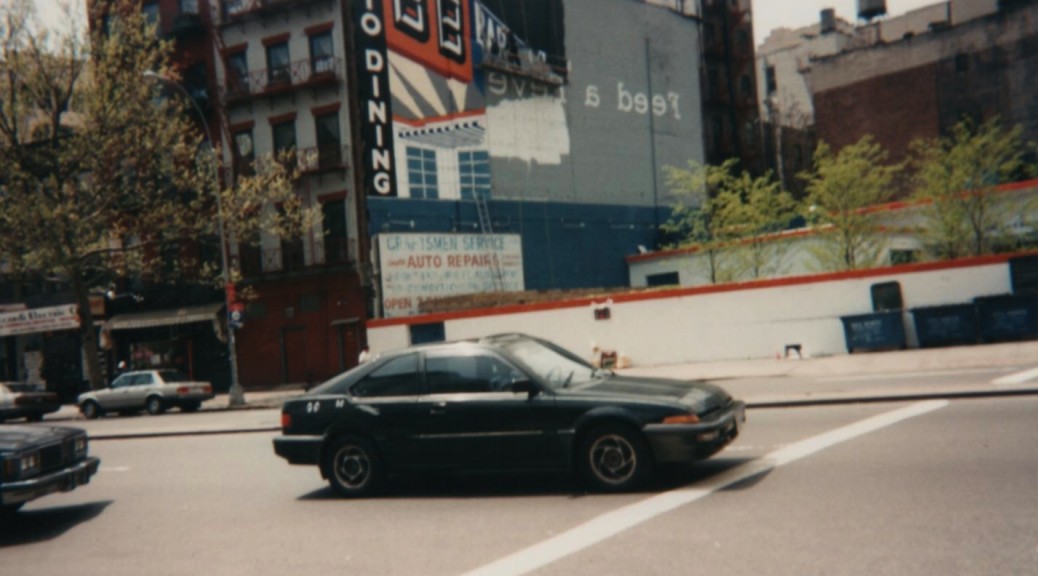
I’ve written in this space about how when I was in college I used to wander through different neighborhoods in New York City, absorbing all the sights I could. Sadly, I have very little documentary evidence of my trips, unless you count my memory. However, I recently rediscovered a whole pile of old photos I took back then, and included in this pile are some pics from a walk I took through the Lower East Side and the East Village in May 1996. In my head, 1996 seems like yesterday. In reality it’s almost 18 years ago. These pictures make that time seem even longer.
In terms of pure aesthetics, these pictures are not very good. They were taken with a crummy point-and-shoot that had no zoom. This made it very difficult to get the shots I really wanted, because that would have required standing in the middle of traffic. So I’d either have to take very close shots or stand across the street and get wide-angle shots of entire blocks while cars raced in front of me. I usually chose the latter.
Picture quality is further compromised by the fact that all shots were developed at a Genovese on 8th Street. Genovese (one of many NY stores no longer with us) was a drug store that had a photo developing department that employed very few Ansel Adams.
Despite these considerable deficiencies, I want to share these pictures because most of the sights they captured no longer exist. I look at these pictures now and I can remember what the Lower East Side felt like in the mid-90s, when it hadn’t quite become hip, and certainly hadn’t become insanely expensive. If you strolled down Rivington Street on a Sunday afternoon, it wasn’t full of people stumbling their way to brunch. It had an unsettling ancient quiet that was impossible in most of Manhattan. The only sounds you heard were old signs swaying in the breeze and neglected buildings slowly crumbling.
I try not to be one of those insufferable types who longs for a city where “realness” was exemplified by nonstop murder and romantic heroin addictions. However, I look at these pics now, particularly the ones taken on Rivington Street, deep in the heart of what is now the most insanely expensive part of the Lower East Side, and I wonder what happened to the folks who got pushed out by the unstoppable wave of gentrification and development.
One of these pics shows a huge lot on Suffolk Street. You used to see many lots in the area like this, stretches of nothing that were reclaimed by local residents to be ersatz community gardens, junk yards, and flea markets. You can’t quite make it out in the photo, but there was a shack adorned with Puerto Rican flag insignia, whose occupant played a faint salsa soundtrack at all hours. The site is now occupied by a row of very ugly and very expensive condos.
When I took these pictures, the gentrification of the Lower East Side and East Village had already begun in earnest. It was confined to very specific blocks, but a sharp eye could see that it would soon creep everywhere.
Sometimes, you didn’t even need to look very hard. It was right there in front of you. In one photo, a repair shop on West 4th and the Bowery is being converted into the Bowery Bar. The mural on the wall of the building next door is being painted over to mark the occasion, an artsy non sequitur replaced by an enormous advertisement. You can literally see both the working class and bohemia replaced by luxury.
I realize that if you didn’t live in New York back then or don’t live here now, none of this means anything to you. In an effort to display just how much has changed, I’ve paired the old photos with new ones I took recently at the same spots. I did my best to recreate the perspective of the original pics, though in many cases changes in the landscape made precision impossible. And of course, there are the differences in lighting that result from May sky vs. November sky, and the differences in overall look between cheap point-and-shoot and fancy digital camera.
Some sites changed little, synagogues and churches mostly. At St. Patrick’s on Mulberry (the original St. Patrick’s), even the road work sawhorses look the same. Most of these spots have changed, though, enormously. It almost doesn’t matter if that is a good or bad thing, because the change has happened and cannot be unchanged regardless.
While taking the new pictures, I stumbled on a bunch of storefronts that had the look of turn-of-the-20th-century, florid serifed lettering and striped awnings. I thought it was an affectation adopted by boutiques, but then remembered that a TV series was being filmed down here, one set in the early 1900s.
The bustling squalor of that time seems quaint to us now, though life was tough and cheap for the people who lived in the Lower East Side back then. Few shed tears when the residents of the 90s were slowly pushed out for luxury condos and bars. Perhaps one day we’ll see them as picturesque enough to tell their stories. Continue reading Lower East Side (Mostly), 1996