Curious Business Models Theatre Presents…Consumers

Yesterday, The Wife and I were debating where to seek out a certain piece of electronic equipment for the house (if you must know, we want to get one of those jacuzzi tanning beds–we work hard, we deserve it!). I jokingly said she should look for it at Consumers, which I thought would be a sure-fire laugh getter, but I was only greeted with silence. It dawned on me that there must be some people out there unfamiliar with the infuriating world of Consumers.

In case you are one of those blighted few, I’ll fill you in. Consumers was a big, boxy store that inexplicably sprang up all over the northeast corridor in the 1980s, despite having one of the counterintuitive business models ever.

The idea behind Consumers: the store could save overhead by not having a big showroom for all its wares, and pass those savings along to you. The stores were extremely minimalist, with only a few items on display, and sometimes a jewelry counter.

But if they had no showroom, how did you get your stuff? I’m glad you asked! Consumers had huge catalogs full of all the items they sold. It was sort of a Sears Wish Book, except it contained more than kids stuff. VCRs, jewelry, lawnmowers, you name it.

The catalog was enormous, and enticing. I remember being very impressed by them as a kid, especially the toy/video game section. They even had a teaser for Super Mario Brother 2 several months before it was released. Of course, it was just a screenshot of Super Mario Brothers 1 blown up really big, a ruse even eight-year-old me was able to suss out. But I appreciated the effort they went through to trick me.

If you wanted something at Consumers, you filled out a slip with the item’s info, then got on a Space Mountain-sized line that snaked through rows of metal corrals. Eventually, you came face to face with an actual clerk manning one of the many counter stations that lined the length of the store. You handed your slip to a clerk and waited for them to retrieve your item from the warehouse. And waited. And waited. And waited. And also waited.

And after all of this waiting, there was no guarantee the store would actually have the item in question. Consumers lacked either the ability or the willingness to implement a computerized database to track such things (even though this technology existed by the mid-80s), so the only way to determine if the store had something in stock was to actually go in the back and check.

Disappointment can happen to you at any store, of course. You go to the mall, hoping to find a certain thing, and it turns out no one has it. But there is something especially exasperating about jumping through all these bureaucratic steps, and waiting on line, and waiting for a clerk to emerge from the back, and then finding out you’re screwed. Kafka himself could not have designed a more Kafka-esque shopping experience.

This was torturous when I was a kid. We didn’t get toys too often, but when we did, it was often at Consumers, because it was cheap and we didn’t have a Toys R Us nearby. Children have no patience to begin with, but asking them to endure this rigamarole is impossible. I would hear other kids cry and scream and throw fits as they found out the toys they wanted were out of stock, and just pray they didn’t want the same thing I wanted.

This shows just how far things have advanced in the last 25 years. The modern shopping experience is all pitched toward empowering the consumer, giving them as many choices as possible and extensive previews of the product they’re considering buying. Can you imagine a store that not only required such waiting, but didn’t guarantee they’d have what you wanted? There’d be riots in the streets.

What’s even more amazing is that Consumers was simply the most austere of the catalog stores of the 80s. There were a few others, like Service Merchandise, but these other stores also had a lot of goods on display. You could actually buy things off the rack at Service Merchandise. You could not do that at Consumers.

In a weird way, Consumers was a predecessor of sites like Amazon, which also have no physical displays, which cuts down on costs. And you can think of a catalog as a low-tech site showcasing a store’s wares. The big difference, of course, is that you don’t have to leave your house to window-shop at Amazon. And if what they have is out of stock, you go to another site, or shrug your shoulders, rather than leave a store completely defeated and hating life.
Remembrance of Promos Past

Though no pitches have been thrown in anger just yet, players are in spring training camps, and that excites me. Jose Reyes is running the bases, Johan Santana is throwing bullpen sessions, and Ollie Perez has managed to eat lunch every day without hurting himself. I haven’t seen footage of any of these things, but I know they are happening, and that knowledge soothes me.

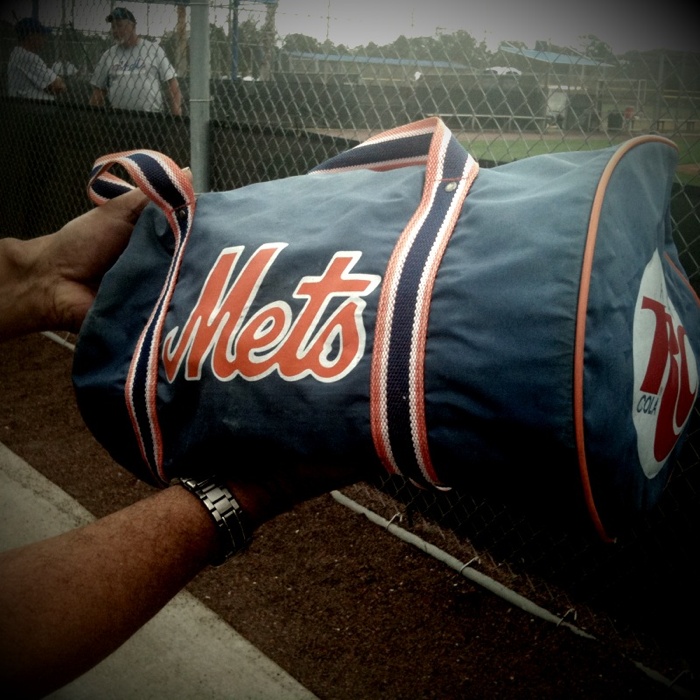
But I got genuinely excited over something I saw yesterday. Matthew Cerrone at Metsblog posted this pic snapped at Port St. Lucie.

mets_rccola_bag.jpgWhat is that? Why it’s a stadium giveaway duffel bag, clearly sponsored by RC Cola, dating to the late 80s-early 90s. The sight of this thing was nigh Proustian in the memories it dredged up. But not of actually using the bag. Just of seeing ads for BAG NIGHT! at Shea, then seeing said bag used by classmates and townfolk for the next few years. It gave me the same feeling I get when I watch old commercials, and have phrases I haven’t thought of in years ring tiny little bells in my brain.

I wanted this to be a springboard for a post on other Shea Stadium giveaways from the same era, but sadly, the interweb information on such things is rather poor. You’d think some maniac out there would have compiled a site dedicated just to this, but you’d think wrong.

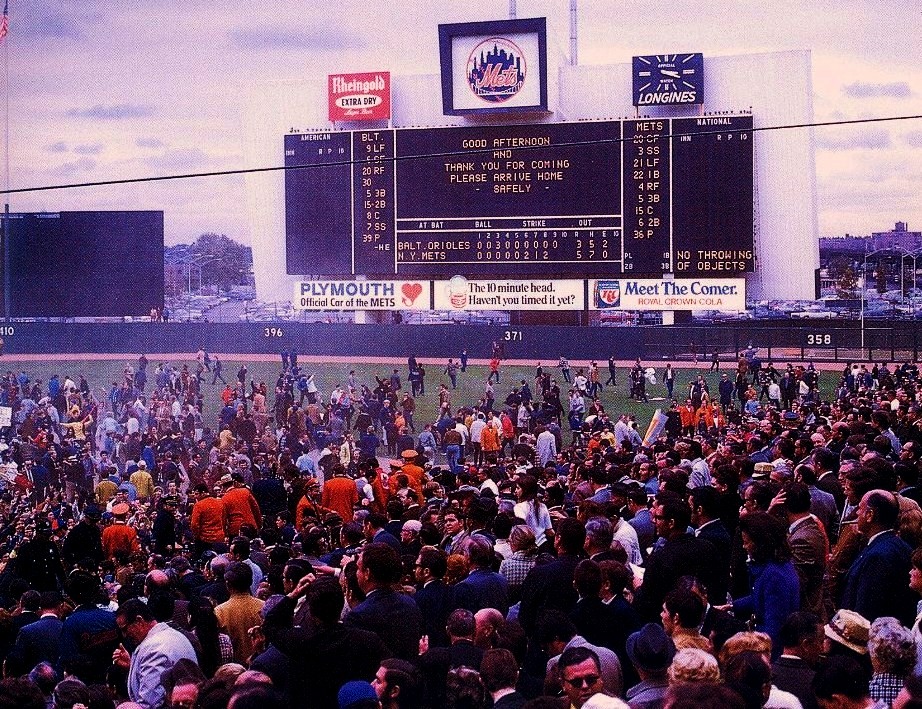
But there is some web-based evidence of RC Cola’s role in Mets history. The soda had a long, intermittent association with the team dating back to its earliest days. This was back when Shea had more small-time sponsors like Rheingold Beer and local Plymouth dealerships.

Oddly enough, they seem to have returned to this route at CitiField, where you now see ads for things like Arpielle Equipment, cash-for-gold web sites, and other second-tier businesses. Which seems kind of creepy and shady, now that I think about it.

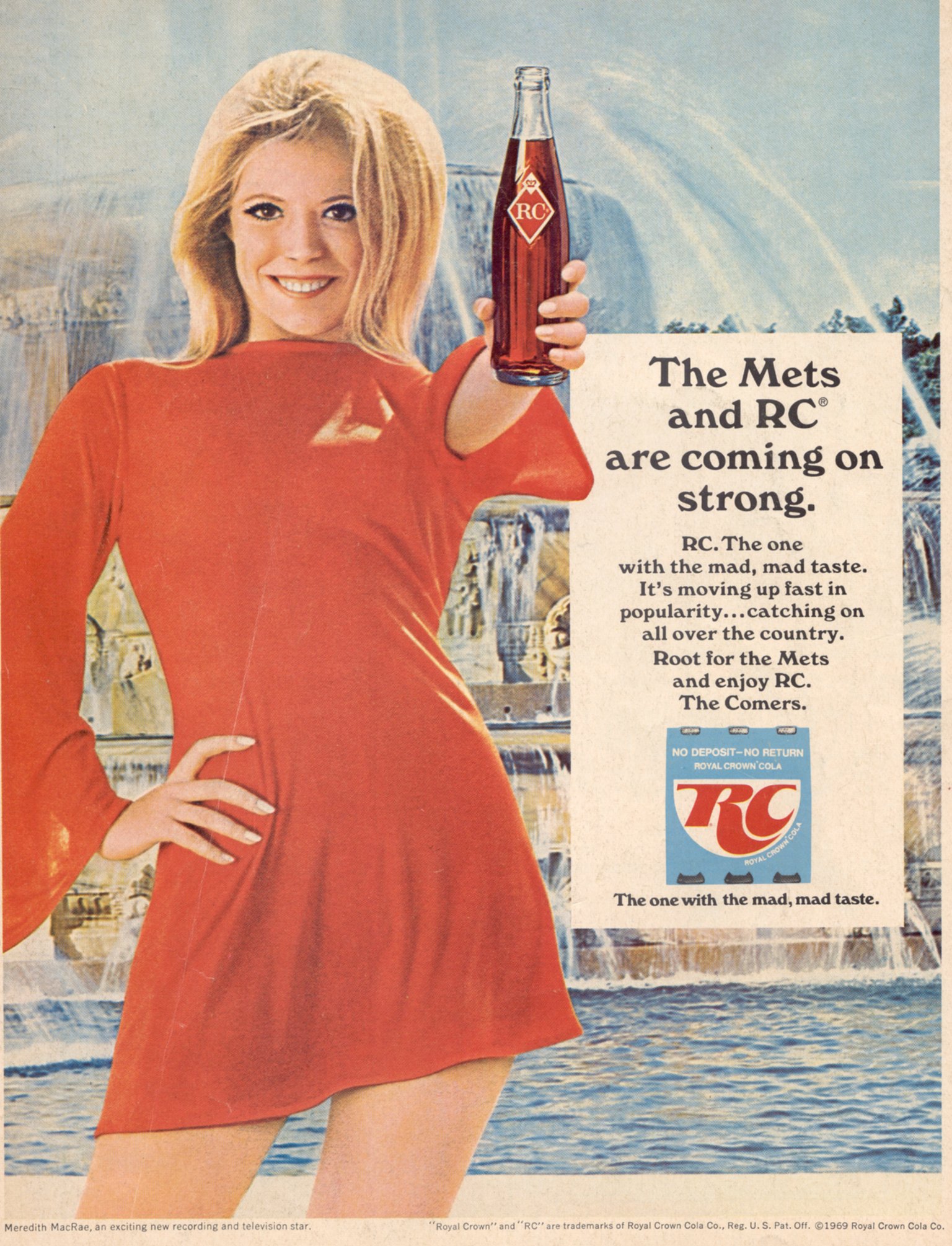
It was a fitting partnership. RC Cola was always the shameful bronze to the gold and silver of Coke and Pepsi, while the Mets were the brand new “upstart” team in town. RC even tried to play up this connection, as you’ll see in this ad from the 1960s. A shapely young lady poses with an RC Cola in front of Shea Stadium, though the facility can barely be discerned behind her, or the giant fountain which must have once been somewhere near it (or the Worlds Fairgrounds, or the designer’s imagination). I get the destinct impression that baseball was not the focus of this ad.

mets_rccola_69.jpgOther than the duffel bag, the RC Cola promo I remember the most were these commemorative cans following the Mets’ 1986 World Series victory. Decorated in a gloriously 80s design scheme, these cans declared to the world, “I know how to jump on a bandwagon as I drink.”

mets_rccola_can2.jpgRC Cola’s association with the Mets continued into the 2000s, but ended by the time the last days of Shea rolled around (hence the Pepsi Porch at their new ballpark). I would lament this fact, but considering RC Cola is now owned by Cadbury Schweppes, they’re not exactly a mom and pop outfit, either.

Plus, I don’t wanna be one of those people who complains about the merits of essentially interchangeable junk food brands. The Wife and I once snagged fantastic seats for a Mets game, and sat next to a guy who wouldn’t shut up all night about how he hated it when Shea stopped serving Kahn’s hot dogs. I was too nice to tell the guy to leave me alone, plus he seemed like he might be borderline autistic.But my point is, if you can help it, don’t be that guy. Nostalgia’s great, being trapped in the past isn’t.

Up the Middle with Skitch Hanson: Do You Believe in Exciting Olympic Hockey Games?

We welcome back Skitch Hanson to the Scratchbomb pages. You may know him from his nationally syndicated sports column, “Up the Middle”. You may have also seen him on the ESPN roundtable discussion show, Mouth-Talkers! Or you may have read one of his 79 books, such as Playing Catch with My Father, and Other Things I Wish Happened in My Childhood. Without further ado, here’s Skitch to talk about Olympic Hockey.

usahockey.jpgLast night’s Olympic hockey match between the US and Canada was quite the rough-and-tumble contest. A real battle of wills. A hard-nosed, no-holds-barred exhibition of old time hockey.

Or so I’ve heard. I’d forgotten the game was on last night, and when it dawned on me that I was missing it, I couldn’t figure out what channel it was on. My cable system’s supposed to have some sort of an onscreen guide, but you have to be a robot to figure those things out! Plus, the box hasn’t worked too well since my wife accidentally spilled three whole bottles of pinot grigio on it.

By the time I found the game, it was already over and the American players were congratulating one another. Of course, it reminded me of the Miracle on Ice some 20-something years ago. Fittingly enough, I believe last night was actually the anniversary of the USA’s historic victory over the Soviet Union at Mount Placid. I would look up the date, but I seem to have misplaced my Reader’s Digest almanac for that year.

I’ll always remember that game, because it happened during the first Olympics I covered. The day of the game, you could just feel something in the air. Even though nobody in their right mind thought the US could win, you could just feel that something special was about to happen.

Unfortunately, that feeling wasn’t enough to wake me up from a mid-afternoon nap and catch the shuttle bus to the arena. But I was a young go-getter back then, and a few pounds lighter, too–this was back when I could still see my feet. So I briskly walked the 7 miles from my hotel to the hockey game. Security wouldn’t let me into the press booth, because I was late, and because I had sweat so much my body odor was deemed offensive.

So I watched most of the game on the TVs hanging over the concession stands. The energy in the building was unbelievable. This one vendor named Antonio seemed really into it, even though I had to describe the action to him, since he couldn’t see what was going on from his station next to that cube with the heat lamps in it that they use to heat up soft pretzels.

Sure, there are some differences between the miraculous victory at Fort Placid and the one in Vancouver. The Miracle on Ice was a semi-final, and this one was just for a first round bye. And the older team was made up of college kids, while this one is entirely comprised of well-paid professionals. And in 1980, the game was both a Cold War metaphor and a boost to the sagging morale of Carter-era America. Today’s kids probably couldn’t find Russia on a map! I know my son Brad can’t! The doctors think there might be something seriously wrong with him!

My point is, last night, Americans came together to cheer on their country. In this day and age, how many times can we say that? Apart from the Olympics every other year and the occasional dance competition show. Yes, this game brought us together, made us briefly care about hockey, and got us to root against a country that cares about the sport far more than we could ever possibly imagine.

I think that has to count for something. Will it mean much if the US winds up only winning a bronze medal, or no medal at all? I don’t know. But hopefully by then, March Madness will have started.

A potentially explosive collection of verbal irritants