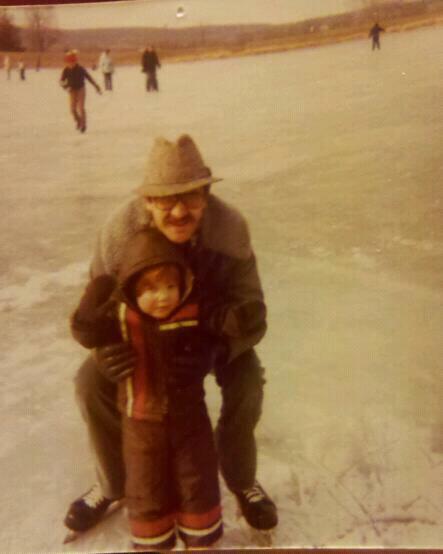
 It is an odd bit of coincidence that the whole @TimesPublicEdit thing blew up this time of year, which is when my dad is on my mind the most. He had a love/hate relationship with the New York Times. Or perhaps love/snark is more accurate.
My father read the Times without fail every day, devouring what he could on the train to work and finishing it up on the couch once he returned home. He did the Times crossword with monastic dedication, particularly on Sundays, when he would fill in all the squares with his own strange brand of calligraphy. On weekends, Dad would often copy the puzzles so my mother and him could have competitions to see who could finish them first. (They didn’t waste their time on the Monday-Thursday puzzles; too easy.) Whoever won would throw down the completed puzzle in front of the other, saying “If you need any clues, just let me know…”
I joined in on the puzzling when I was old enough to figure out that finishing Times crossword puzzle has nothing to do with being smart. Through repetition, you’d figure out recurring ploys and frequently used answers. “Baseball family” was always Alou. “Pitcher” or “vessel” was almost always ewer.
Dad would work away at a puzzle for a while, trying to figure it out, then suddenly say, “Oh, stupid…” in this annoyed tone of voice. We knew that meant he’d discovered the “trick” of that week’s puzzle. But for some reason we’d always ask what his groan meant anyway, and he’d in turn always say, “You’ll figure it out.”
When he died, it came as such a shock that there were many details of his funeral we didn’t know how to handle. But we knew one thing for sure: he should be buried with a book of Times crosswords, clutched in his arm like a Bible or a rosary.
As religiously as he read it, the Times annoyed him thoroughly. In my own budget analysis, I think he had the resentment found in many smart people born to relatively humble circumstances (something I would know nothing about…). I think he believed that if he’d just been born in, say, Greenwich, he would’ve had access to the world of class and sophistication (and bucks) found in the pages of the Times. Instead, fate conspired to see him born in crushing poverty in Ireland, then move to Queens as a kid, and grow up the son of a baggage handler. He wasn’t ashamed of any of this, but I think maybe some part of him wondered what if…
He also had pretentions of his own, or did once upon a time. He wrote poetry as a young man. He used to try his hand at gourmet cooking. By the time I was born, he’d abandoned all of this, save for making trays of stuffed mushrooms at holidays. In the Times, I think he saw something he’d either given up on or decided was now worthless to him. A piece of himself, really.
So while he continued to read the Times to the end of his life, he also loved to point out its ridiculousness. If he found some especially pretentious piece, he would say, in his best Larchmont Lockjaw, “devastating article in the Times” (a line I’m almost positive was cribbed from Woody Allen’s Manhattan, though I haven’t seen it in forever). He loved to mock the recipes in the Sunday magazine with ingredients that were completely unavailable to anyone not within walking distance of Balducci’s. (“Wild boar pancetta?!”) And he loved to read out the bitchiest capsule movie reviews from the TV insert, often trying to find the ones with the least amount of words. Nothing cracked him up more than to see a film summed up simply with “Drivel.”
I didn’t start @TimesPublicEdit with him in mind, but as I continued to write jokes for it, his memory kept popping up. I’d write something about hipsters in Bushwick building tree forts and I’d see his disbelieving smirk at a sophistic essay or his eyes rolling at a trend piece that tried way too hard. Eventually I realized that @TimesPublicEdit was, basically, a high tech version of what he used to do on the couch after work, Times in his lap, brow furrowed.
I never quite articulated this feeling until last week, when my wife voiced it for me. As the Anderson Cooper tweet spiraled beyond my control and “tricked” a few news outlets, she said to me, “I think your dad might be proud of you for this.” And for a moment, I allowed myself to think, “Yeah, he might have been.” I thought the man who exposed me to Monty Python and George Carlin at a criminally young age might have taken some kind of parental pride if he’d been alive to see it.
In order to think this, of course, I’d also have to think that he’d have had any use for social media of any kind, which is highly unlikely. And naturally, within minutes of me allowing myself this hubristic thought, @TimesPublicEdit was shut down.
Last weekend, while the account remained shut down, I found myself back at my mom’s house. On Sunday morning, we divvied up the Times and read it silently around the kitchen table. For a moment it felt like I was back in high school, reading the Book Review and the Metro section, dreaming of escaping to the city.
But that was long ago. Now, my eyes just skimmed over the words. I tried and tried to take them in, but nothing registered. It was like the paper knew I’d been mocking it, and was refusing to be understood in protest. You think you’re funny, huh? Well, guess what: This is gonna be weird for you from now on. Even if you get your little Twitter account back, you’ll never be able to just sit here and read this paper and not feel vaguely guilty and punished. Happy now, smartass?
No, I was not happy. After a few feint stabs at trying to get through the Book Review, I accepted that yes, this would be weird from now on.
Still finished the puzzle in 20 minutes flat, though.


