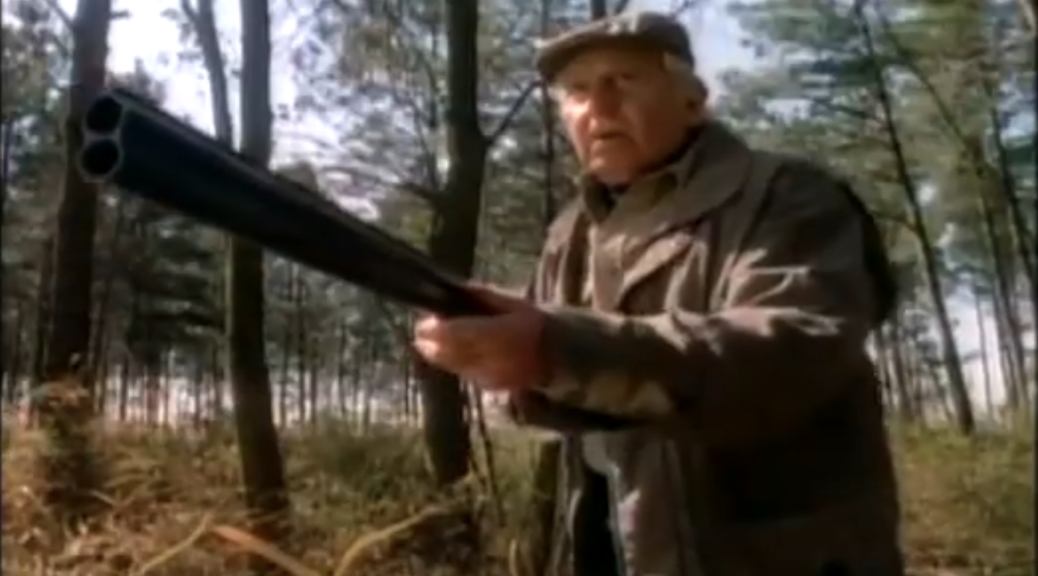
This marks the launch of a new Scratchbomb series called A Very Special Television Event, where I take a look at forgotten boob tube content of yesteryear, focusing on TV movies, miniseries, short-lived series, and one-off specials.
One of my favorite leisure activities is watching compilations of old commercials. I believe there are very few activities that can give you a better sense of the flavor of a certain time than watching its advertising. Sure, someone who lived through that decade can give you their impressions of what the 1990s were like, but you will get a much clearer view of The Clinton Years by watching a collection of Must See TV promos and a buffet of ads telling you to dial 17 digits just to save money on long distance calls. (Seriously, if you were not alive then you have no idea how huge that industry was. How serious? They even got George Carlin!)
Not too long ago, I was viewing a commercial compilation from 1995 when I was stopped dead in my tracks by this teaser for a TV movie starring Andy Griffith as a sinister kidnapping grandfather. Now here was a perfect distillation of what TV in 1995 was all about.
The made-for-TV movie has been part of the boob tube landscape since the invention of the medium. In its early days, this was the platform for renowned screenwriters penning prestige work; Rod Serling’s Requiem for a Heavyweight and Paddy Chayevsky’s Marty both began their lives as teleplays prior to their Hollywood adaptations. This pedigree continued through the 1970s and 1980s, when TV movies were often the preferred format in which to discuss Serious Issues: child abuse, homosexuality, substance abuse, adult illiteracy, and similar fun topics. By the 1990s, however, TV movies had become a salacious format, leaning heavily on quickie adaptations of tabloid fodder (think “Homer S: Portrait of an Ass Grabber”) and other lurid fare, With its threatening premise (“what if your grandfather was a violent nut?”), Gramps looked like it was very much a TV movie of the 90s, and I decided I must watch it immediately.
Luckily we live in a world where no copyrights are honored (thanks, Sam Altman!), certainly not for 30+ year-old TV movies, and I found the entire thing free to watch on YouTube. I expected it to be something very much of its time, along with Pearl Jam, baggy jeans, Fruitopia drinks, and deindustrialization. What I got instead was a view of something timeless, or perhaps out of time, as something produced by an alien civilization might seem to mere humans.
The big draw in Gramps is of course Andy Griffith, good ol’ Sheriff Taylor/Matlock himself, playing against type in the role of a villain. Granted, this was far from his first on-screen heel turn. Early in his acting career he played Lonesome Rhodes, the cornpone fascist at the center of 1957’s A Face in the Crowd, an excellent and savage media satire despite being made by snitch Elia Kazan. Griffith gives a performance in the film that is both stunning and depressingly prescient. Rhodes uses unabashed sentimentality and cry-bullying to conquer the new medium of television and lead his flock of followers lemming-like toward their own doom. Though most of Griffith’s subsequent work was in Andy Taylor-esque kindly father roles, he did portray bad guys in other made-for-TV fare; see 1985’s Crime of Innocence, one of those Serious Issue TV movies, where he plays a heartless judge sentencing kids to juvie with all the legal sadism unleashed by Reagan’s Morning In America.
So it was not a huge stretch for a contemporary audience to accept Griffith as a villain. And yet, you need only watch the commercial above to recognize that Gramps has deeper issues to overcome. Chief among these is the look of Griffith himself. The movie debuted the same year as Griffith’s final season of Matlock, when he was 69 years old—AARP age for sure but hardly ancient even by the standards of 1995. Despite this, he has the haunted look of taxidermy, his features soft yet curiously unwrinkled. You’d be forgiven for thinking he was on death’s door while filming Gramps, though in fact he would live for another 17 years and make several film and TV appearances after it first aired. His performance is not bad, and is at times amazingly restrained (though a role like this might benefit from scenery chewing; the premise screams for the What Ever Happened to Baby Jane treatment). Still, Griffith’s trademark mile-wide grin packed into a preternaturally smooth face, accentuated by the soft-focus cinematography mandatory for all TV movies and graduation photos of this era, gives him the unsettling look of The Assisted Living Joker.
The action opens with a funeral for Gramps’ ex-wife, recently succumbed to cancer. (Though we do learn his real name, Griffith’s character refers to himself, and is almost exclusively referred to by others, as Gramps.) A musician who toured with many legendary country artists, Gramps was estranged from her and his son Clark, which is explained by black & white flashbacks throughout the film showing us a young Gramps acting violently possessive toward both of them. Despite this history, and for reasons that are never convincingly articulated, grown-up Clark (played gamely by John Ritter, in a role that gives him no space at all to exercise his comedic chops) had telegrammed the old man to tell him about his mother’s passing. Gramps plays things humble and self-effacing, swearing he doesn’t wish to impose on the grieving family, until he’s aw-shucksed his way into a stay at their house.
Gramps’ reinsertion into Clark’s life happens with a speed and depth that can only be accomplished by television. Though Clark is fresh off burying his mother, the woman who fought to keep Gramps and his malign influence away from him, he and wife Betsy (Mary-Margaret Humes, who depending on your bent is known best for either Dawson’s Creek or History of the World Part I) prove remarkably forgiving of the old man. Betsy’s dad Oliver (longtime character actor Mitchell Ryan) likes the guy so much he keeps pressing the old man to go turkey hunting with him, a threatened outing that serves as the movie’s blinking neon Chekhov’s gun. Even the family’s housekeeper gets over her resentment of Gramps after he busts out his guitar and picks a few country tunes for them to duet on. The only holdout is their son Matthew, an adorable ginger moppet, who’d heard bad things about Gramps from his recently departed grandmother. Gramps wears down Matthew’s defenses with ice cream and tales of backing up country music legends that are curiously captivating to a 10 year old of this time. Matthew’s main interest at the film’s outset is playing Mortal Kombat, so it’s a bit odd that he is enraptured by Gramps’ stories about jamming with Ferlin Husky.
Before long, three generations of Gramps are swapping stories and engaging in masculine camaraderie, taking in some prime “Roundball Rock” era NBA action on TV. (Hoop enthusiasts can enjoy a brief scene of the boys watching the Larry Johnson-era Hornets take it to the hole. ) Things are so chill with Gramps and his reformed family that Betsy barely minds when he nearly kills Matthew trying to make him scale a tree.
This scene might lead the viewer to believe Gramps wants to harm the boy, but in reality his schemes are much closer to Single White Female territory. He is seen skulking around the house and hiding in darkened rooms, illuminated by a single sinister beam of light, so he can overhear all of Clark and Betsy’s business and dig up dirt on their relationship. When not engaged in his personal remake of The Conversation, Gramps eyes and paws an old photo of him and Clark fishing, accompanied by sepiatone recreations of the scene. Given that all other flashbacks to Gramps’ past are of him abusing his wife and child, it’s possible this idyll is an idealized figment of his imagination, though this interpretation might be a mere figment of my own imagination attempting to make this into a more interesting movie than than the filmmakers were capable of doing.
Gramps resents a life spent away from his son and wants to both rekindle their relationship and foster a new one with grandson Matthew. His path toward this goal requires the destruction of anyone who might stand in his way. He sours on Betsy, who is reluctant at times to have him around the house so much, and at one point he overhears her suggesting to Clark that Gramps should go back home so she can “have [her] life back.” This crisis is averted when Gramps savagely beats their housekeeper in her own home, at which point he humbly offers to take her place. From this position, Gramps plots to remove the obstacle of Betsy from his life—not through more violence, but with a series of soap opera schemes.
During one of his late night skulking sessions, Gramps learns that a coworker of Betsy’s, with whom she once had an extramarital fling, is back in town. Clark is perturbed to hear this news but appreciates Betsy’s honesty. It’s an interesting gender flip of the philandering spouse/wounded but forgiving spouse trope that would benefit from placement in a better movie. Armed with this valuable intel, Gramps cooks up a pretense to visit Betsy at her office and sneaks a peek at her appointment book, learning she has an upcoming lunch scheduled with her ex-lover. He then suggests taking Clark out to eat at the same restaurant where Betsy and her erstwhile paramour are dining. Betsy’s lunch is perfectly innocent (the ex-lover has a fiancée and just wants to share the good news) but Clark assumes they are canoodling again. As the couple tosses bitter accusations at each other, Gramps’ weird plan is coming together.
He follows his bout of romcom villainy with a bafflingly elaborate ruse that combines the treachery of a telenovela revenge plot with the incomprehensibility of an Ionesco play. Piloting his house-sized car, Gramps cruises into the small town’s curiously active red light district—so active that a slew of prostitutes are plying their trade in a very wide alley in broad daylight. (If you’re wondering if the sex workers are depicted sympathetically in a film made during the time of Anita Hill hearings, no, they are not.) He finds a hooker who vaguely resembles Betsy in height and build, dresses her in Betsy’s raincoat, and has her check into a local hotel under Betsy’s name. The plan is to leave behind Betsy’s address book as a smoking gun and plant some hotel matches in the coat for good measure, and thus convince Clark that his wife is cheating on him again. Along the way, we’re treated to the sight of Gramps about to get his freak on with the working girl. Fair warning: if you don’t want to see an elderly Andy Griffith slowly unzip a young woman’s dress, skip the next video. Sadly, I will never be able to expunge this from my memory.
When Gramps’ planted “evidence” starts trickling in, Clark and Betsy have a screaming match over the misunderstanding and she runs off to her father’s house. Oliver believes her protestations of innocence and does his own investigation at the hotel, where he encounters a bellhop with a level of perfect recall seldom seen outside of dock workers on Law & Order. After a few choice cut scenes, Oliver has unraveled the whole weird conspiracy. When he brings Gramps on their long-threatened turkey hunt, Oliver throws all the evidence in his face and orders him to leave town. But he also turns his back on Gramps and his shotgun, at which point Gramps blasts him to kingdom come in the most telegraphed murder in TV history.
The assault is witnessed by two boys, and when Gramps runs after them he is confronted by their father, who shoots him in turn. Gramps survives his assault and is seen recuperating in a hospital bed, where he convalesces while waiting to be charged with Oliver’s murder. As Betsy and Clark reconcile at her father’s funeral, Gramps suddenly becomes Hannibal Lecter, escaping hospital custody by braining a guard with a fire extinguisher and donning his uniform. He makes a beeline for Clark’s house, knocks out Betsy, and absconds with Matthew (who as yet knows nothing about Gramps’ many crimes).
Clark pieces together that Gramps must have taken Matthew to the same fishing spot seen in the photo he has been clinging to during the whole movie. Though the police accompany him to the spot, they allow Clark to pursue the old man on his own, a plot contrivance that would likely lead to bloodshed and a massive lawsuit in real life. Clark catches up to Gramps and briefly convinces him that he wants to help him escape, but Gramps gets hip to the ruse and clocks Clark with his pistol before taking off on dangerous rapids in a raft with Matthew. A woozy Clark follows, but Gramps is also ailing, his gunshot wound suddenly bleeding to a worrying degree. Why now and not earlier? Because it needs to bleed at this point in the movie and not a minute sooner, that’s why.
When Gramps and Matthew are bucked from their raft, Clark rescues his son while the old man goes careening toward a waterfall, grasping a convenient branch to keep from falling to his death. Clark attempts to save him, but Gramps tries to take his son out with him, pulling on his arm with a sinister grimace on his face. (More of this campiness might have made this a better movie, or a more entertaining one anyway.) Alas, Gramps is carried over the falls anyway, or at least a large shroud full of sandbags representing Gramps is. Then we get a few more pics of the ol’ fishin’ hole, followed by end credits. With no body seen before the end, we have to assume Gramps could return a la Jason or Freddy Krueger.
Normally when I view some puzzling work from decades ago, I can chalk up its strangeness or off-putting nature as being a product of its time. However, I was nearly an adult when this movie came out (age-wise, anyway) and like to think I remember both the content and vibes of the years I lived through. With that in mind, I want to assure all of you that this weird, weird film cannot be blamed on the 1990s. There are many cultural crimes that can be laid at the feet of that decade, but this is not one of them. I do not know what time and place could have possibly produced Gramps. I can only hope that I never find myself there.