1999 Project: Games 38-41

Click here for an intro/manifesto on The 1999 Project.

May 17, 1999: Brewers 7, Mets 6

Bobby Jones had yet another poor outing and was charged with all seven Brewer runs. But Bobby Valentine saved his harshest words for home plate ump Bill Hohn, who (in his opinion) called an inconsistent strike zone: “This was a [strike] zone where balls off the plate were called strikes sometimes. [The Brewers] were getting ’em. What did we have, five called third strikes?”

The Mets bench barked at Hohn throughout the game, which might have cost them at its conclusion.They pulled within one run after scoring three in the eighth, then got the tying run on base in the ninth when Roger Cedeno walked. A steal and a groundout put Cedeno on third with two out, so Milwaukee opted to intentionally walk Mike Piazza and face Jermaine Allensworth, who took a questionable called third strike to end the game.

May 18, 1999: Brewers 4, Mets 2

With the Mets up 2-1 going into the eighth inning, thanks mostly to seven solid innings from starter Rick Reed, Valentine brought in Dennis Cook. The lefty gave up two singles, immediately putting the lead in jeopardy.

Valentine yanked Cook and called on Armando Benitez, who struck out the first two batters he faced, but then gave up a three-run homer to Marquis Grissom. Two years earlier, when Benitez was with the Orioles, he gave up a game-winning homer to then-Indian Grissom in game 2 of the ALCS. That shot propelled Cleveland to the World Series. This one just dealt the Mets their third straight loss.

Reed’s quality start looked suspicious to Brewers manager Phil Garner, who demanded the umps examine his glove in the fifth inning. Nothing funny was found, but the request rankled Reed:

If the guy’s thinking I’m cheating, then he’s getting the wrong stats because I had a 7-and-a-fucking-half ERA coming in. If he wants to come out early tomorrow, I’ll teach him how to throw it.

Valentine was no happier. In the bottom of the eighth, Allensworth was tagged out in a rundown between first and second. The manager thought the Brewers had committed obstruction, but the umps both refused to reverse the call or lodge Valentine’s protest with the league office. Still bristling from the glove-check earlier, Valentine went ballistic and was ejected. His team left much quieter, with three straight groundouts to finish out the ninth.

May 20, 1999: Mets 11, Brewers 10 (Game 1); Mets 10, Brewers 1 (Game 2)

99_ventura_gs_1.pngThis rain-necessitated twin-bill allowed Robin Ventura to achieve a curious baseball first. The third baseman became the first man in major league history to club a grand slam in both halves of a doubleheader. Other than this historic anomaly, neither game was pretty to watch.

In the first game, the Mets roughed up starter Jim Abbott for seven runs, including Ventura’s first grand slam of the day in the first inning. But Al Leiter barely fared better, struggling with his control and turning in an excruciating effort. He left after five innings trailing 6-5, but the Mets were able to get to Abbott and the Milwaukee bullpen to retake the lead and stretch it to 11-6.

Benny Agbayani, getting a chance to start in the Mets’ hobbled outfield, clubbed two
homers of the non-grand-slam-variety and drove in five runs. Allen Watson pitched two good innings of relief but also allowed a 3-run homer to Jeff Cirillo in the eighth, which left the Mets with a slim 11-9 margin going into the ninth.

John Franco came on to save the game and turned in a typically weird/nerve-wracking inning. Grissom doubled to lead off the inning, and after a strike out, ex-Met Alex Ochoa walked to put the tying runs on base. After a flyout, Sean Berry hit a pop fly that just eluded Edgardo Alfonzo’s glove.

99_ventura_gs_2.pngGrissom scored, and Ochoa would have also, if he’d been running hard. For some curious reason, he took his sweet time around the bases, and by the time he rounded third, Mike Piazza was waiting for him, ball in
glove. Not in the mood for any Pete Rose-esque heroics, Ochoa ran into Piazza’s mitt, and the game was finally over. Despite struggling mightily, Leiter got credit for the win, his first in almost a month.

The nightcap featured another offensive outburst by the Mets, with no counter-offensive by Milwaukee. Masato Yoshii held the Brewers to one run in seven innings of work. Ventura put the game away with his second grand slam of the day in the bottom of the fourth.

The Subway Novel Project: Hot Dog, We Have a Wiener!

About three seconds after I posted my Subway Novel Project intro, my brother reminded me that we’d had a discussion about just such a novel: BoneMan’s Daughter by Ted Dekker.

What prompted our earlier discussion: He had seen an ad for the book in the subway, with this tagline:

Would you kill an innocent man for a chance to save your daughter?

As he pointed out on his own blog, this question barely warrants a response. Any parent would do this without thinking twice. I know I would.

Mind you, I can talk tough because the situation implied by that tagline would never happen. But in the extremely unlikely case that it did happen, there would be no debate whatsoever. “What, kill this guy and you’ll let my daughter go? Okay.” *bang* “That was easy!”

As ridiculous as that tagline is, I was even more intrigued by this Amazon description of the book:

A Texas serial killer called BoneMan is on the loose, choosing young girls as his prey, His signature: myriad broken bones that torture and kill – but never puncture.

Military intelligence officer Ryan Evans is married to his work; so much so that his wife and daughter have written him out of their lives. Sent to Fallujah and captured by insurgents, he is asked to kill children not unlike his own. The method: a meticulous, excruciating death by broken bones that his captor has forced him to learn.

Returning home after the ordeal, a new crisis awaits. A serial killer is on the loose, and his method of killing is the same. Ryan becomes a prime suspect, which isn’t even the worst of his problems: Ryan’s daughter is BoneMan’s latest desire.

I smell a masterpiece!

Also promising: Mr. Dekker’s bio says he’s written 22 books. I don’t think anyone should write a novel when they’re 18, but let’s assume that he’s been writing novels since he became an adult. He’s now 47 years old, meaning he averages 1.3 novels per year.

I have a theory that an author’s ability to write quality fiction is indirectly proportional to the amount of books they put out. To a point, anyway; just because someone writes one novel every 20 years doesn’t make them a genius. But if you’re churning out books at a Steven King-ian rate, chances are those books aren’t very good. Why? Because writing a novel is excruciating.

So BoneMan’s Daughter it is! I shall purchase a copy posthaste. But any of you folks have an idea for a future installment, speak up.

The Subway Novel Project: Intro and Solicitation

subway_novel.jpgBecause I don’t have enough meaningless self-imposed projects, I’ve decided to put something else in my inbox: The Subway Novel Project.

Being an eagle-eyed, New Yorker, I’ve noticed that novels are often advertised throughout the mass transit system. I’ve also noticed that these books tend to not be written by authors like, say, Paul Auster or Joyce Carol Oates.

No, they’re usually either brand-name best-selling authors like John Patterson, or people aspiring to be brand-name authors who get blurbs from guys like John Patterson because they have the same imprint at ConGlomCo Books.

Or they belong to the totally ignored world of Urban Fiction. These are authors with only one name, who have no qualms about naming sequels to earlier books the same way you would a movie (e.g., Around the Way Girls 2 through 4). You will never see these authors in the NY Times Book Review, even though their tomes outsell Phillip Roth’s last 14 novels.

The reason I’m doing this: I’m trying to get back on the Fiction Horse. I’ve spent much of the last few years writing non-fiction, and I’ve been stuck at 100 pages of a novel that needs to be finished before it has any hope of seeing the light of day. Because this is such a fantastic time to be working on fiction. (For those unfamiliar with entertainment market fluctuations, it ain’t.)

So why read this stuff? Because years ago, I did some freelance copyediting/proofreading for mass market fiction. And next to earning an MFA in fiction writing (pause to pat self on back), reading this stuff was the best writing instruction I ever received. No, of course the writing in these novels wasn’t very good. But what was so instructive was how they weren’t very good.

One hallmark of all the books I read: An obsessive-compulsive urge to use adverbs, especially when “describing” how people talk. (“‘I bet you get around,’ Frank said devilishly.”) Rather than insert clues about your characters’ true motives, or describe a compelling scene, just throw -ly at the end of the word and call it a day. It’s so much easier!

Or, start a chapter with someone doing some mundane everyday task–walking the dog, taking out the garbage, etc.–while reminiscing about something that’s happened between when the last chapter started and the next one began. What tense is that? I think it’s called past-imperfect-and-totally-unnecessary-framing-device.

Romance novels were the worst, although not for the reasons you might think. Sure, the love scenes were overwrought and full of some of the most ridiculous prose ever. My favorite line of all time, describing how a woman felt as she stared into her man’s eyes while in the throes of passion: “She felt captivated, as if by a wizard.”

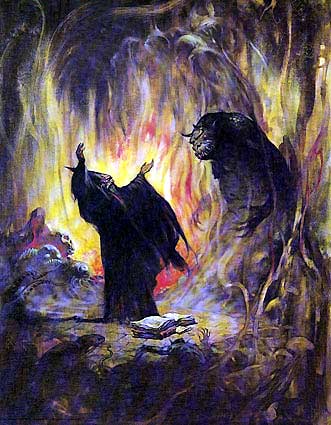
A WIZARD! That killed me. I had a mental image of the cover of this future masterpiece: Woman: bodice ripped, cleavage heaving. Man: shirtless, ripped, leonine hair. And behind them, a totally bitchin’ Frank Frazetta poster.

But what really bugged me about the romance novels: they constantly endangered their characters for no discernible reason except to move the plot. The author’s handprints were smeared on everything they did. And the only kind of danger that existed in this world were a villain (more often than not, a villainness) who existed for the sole reason to stand in their way. Or the threat of physical danger, the cheapest arrow in a writer’s quiver.

Once the villain(ess) had been dispatched and the lovers had no more obstacles, one (or both) of them would get into a car accident. I must have read 20 romance novels over the course of my freelance work, and this happened in at least 15 of them. All because the author had ended the book too soon and had no idea how else to threaten their characters. And had no idea how to write a book in which their characters were not constantly threatened by their mighty pen.

Long story short, I think I’m in need of some of this instruction again. So I’m going to pick a Subway Novel, read it, and review it here. Then do it again and again until I either finish my novel or kill myself.

But before picking a book, I wanted to solicit the audience and see if there’s any book you’ve seen advertised on the subway. I will also accept books you’ve seen people read on the subway. And I will also accept books you’ve seen on the bus. I will not accept books you’ve seen people reading while driving to work, because I hope you’d call the cops if you saw someone reading while behind the wheel.

However, in order to maintain what little integrity this project has, I’ll need some sort of evidence that you’ve seen this book on the bus or subway. Presumably of the photographic variety. Or a drawing. Or just describe the scene really well.

So, any suggestions? Speak up.

A potentially explosive collection of verbal irritants