All posts by Matthew Callan

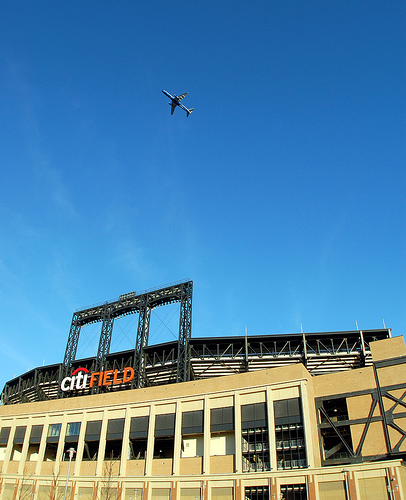
Citi Field, 4:12pm

citifield3Citi Field has a bad rap, I think, because people confuse the stadium with the mediocre (at best) team that’s played there for five seasons, and the hated ownership that pushed for the stadium’s construction. As far as I’m concerned, however, there are a few things to recommend the place.

I like that when I go to Citi Field, I see a New York that I recognize, and one I don’t see or hear about anywhere else. What this New York is, exactly, is difficult to express, which is part of the reason why you don’t hear about it. Another part comes from the fact that most people who write about New York are either transplants or move in lofty circles, and so they barely come into contact with this New York. And it would never occur to most of the people who are part of this New York to express what they are. As far as they’re concerned, there’s nothing to express. It would be like asking a fish to tell you about the ocean.

I see a New York I recognize at Citi Field because the crowd there has diversity, an overused word but one for which I can find no suitable substitute. But that diversity is only a very small part of what I mean. For all these surface differences they possess, there is something shared among those who make up the crowds at Citi Field. You saw it at Shea once upon a time, too. It’s not Mets fandom, really. That’s part of it, sure, but fandom is only a reflection of something deeper.

There is a feeling that I get when I go to Citi Field, surrounded by the kind of people who choose to go to Citi Field, the kind of people I come from. I get this feeling nowhere else. It is an odd mix of nostalgia for the past and a jaundiced eye at the present. In those stands, you hear grumbling when The Opposition goes deep, or a shortstop lets a grounder zip through his legs, but the grumbles are accompanied by smirks. It has the unspoken undercurrent of, Did you really think this would work out?

And yet, all you need to do is run a video of Piazza or Gooden or Seaver on the scoreboard and the fans begin to nod reverently. And they’ll tell each other, I was at that game, even if the guy next to you was with you at that game. They must speak these words aloud because they can scarcely believe that they of all people were allowed to witness such things. They are people who are willing to allow that great, impossible things can happen in their lives. They just don’t expect them to happen any time soon.

I attended the first Mets game ever played at Citi Field, an exhibition against the Red Sox. I wandered into the Caesar’s Club that night, an enclosed bar/restaurant area behind home plate. There I saw people who got what they thought they wanted, a first class modern facility to replace outmoded, crumbling Shea Stadium, only to feel immensely confused. They were people uncomfortable with comfort. One man lowered himself into a lounge chair slowly, as if he was afraid it would disappear if he moved too fast.

Some say the iconic phrase coined by Tug McGraw in 1973, Ya gotta believe!, was originally said in jest to mock an exec making a lame clubhouse pep talk, that it only became a rallying cry when the Mets went from worst to first at the tail end of that season. I’d like to think this is true. It says so much about the people who choose to follow the Mets. It is a joke always threatening to become serious.

I like that when I left Citi Field on Sunday, the last game of the season, readying myself for a long winter, I caught a brief glimpse of something over the Promenade roof. I could see the relics of the World’s Fair in the distance, the Unisphere and the NY State Pavilion and the cone of a spaceship that once circled this earth and came back again. Those structures rose alongside Shea Stadium, at a time when people—in Queens of all places—still believed in the future.

Jean Shepherd and the Dayak Curse

shep2On April 6, 1966, Jean Shepherd began his radio show by warning listeners that they were about to take part in an experiment of great scientific import in conjunction with a major university. It would be a potentially dangerous experiment, so if any listeners wanted out, they should switch to another radio station immediately.

As soon as his theme song was over, he played a recording of a flute. It sounded like a field recording. You could hear crickets chirping in the background. Once the music ended, Shep told his listeners this was an ancient, mystical flute played by the Dayak tribe of Borneo. This flute was intended to be used only in battle, as it had magical properties that would kill any male under the age of 18. Since the flute’s effects took 72 hours to fully take hold, he encouraged any teenage listeners to send their name to WOR on an index card with the word CURSES written on it, so that the university conducting this experiment could monitor their health.

It’s easy to say, in our more sophisticated age, that this was obviously a hoax. People were considerably more gullible back in 1966, particularly in regard to any sort of media. As you listen to this show, notice that Shep (who was not above laughing at his own jokes) does not crack in the least. He delivers all the details soberly and in as straightfaced a manner as he can. I can only imagine what kind of panic Shep’s “experiment” could have caused, or how many complaints it must have drawn to his radio station. Broadcasters don’t do things like this now, and they certainly didn’t do them in 1966.

Shep performed variations on the Dayak Curse “experiment” several times before and after this one, but the example from 1966 is by far the best version and the best recording. It’s also one of the best examples of exactly what he used to do on the radio. And though Shep rarely took calls on the air, he did so in this show to talk to young listeners, who invariably tell him they “feel kinda funny” in adorably thick Queens/Bronx accents.

If you stick with the whole show, you’ll hear Shep use a few news items on sea monsters, drunk sailors, and car-hating elephants, topped by ad copy for a tranquilizer disguised as a proto-feminist tract, all to comment on what he called The Human Comedy. You’ll also hear what radio commercials sounded like in 1966 for The New York Times (extremely pretentious) and Miller High Life (extremely brassy).

[audio:http://scratchbomb.com/media/1966%2004%2006%20Human%20Comedy.mp3]

Office, 8:35am

My grandmother always had music on in her house, cascading out of a majestic wooden cabinet stereo that looked like a cathedral to little kid Me. Frank Sinatra, or his contemporaries. I picture that stereo and see its speakers rumbling with Tony Bennett’s “The Good Life.”

But more often than not, she had the radio tuned to a local radio station that broadcast something they called “Music from the Terrace.” (As a kid, I thought they were saying “Music from the Terrorists.”) The “terrace” was taken from the name of the street on which the studio was located (Radio Terrace), presumably because it sounded fancy. The “music” was an endless stream of easy listening instrumentals. Not muzak, exactly. Orchestral arrangements of old showtunes and movie themes. A million strings sawing away at “Days of Wine and Roses” in unison.

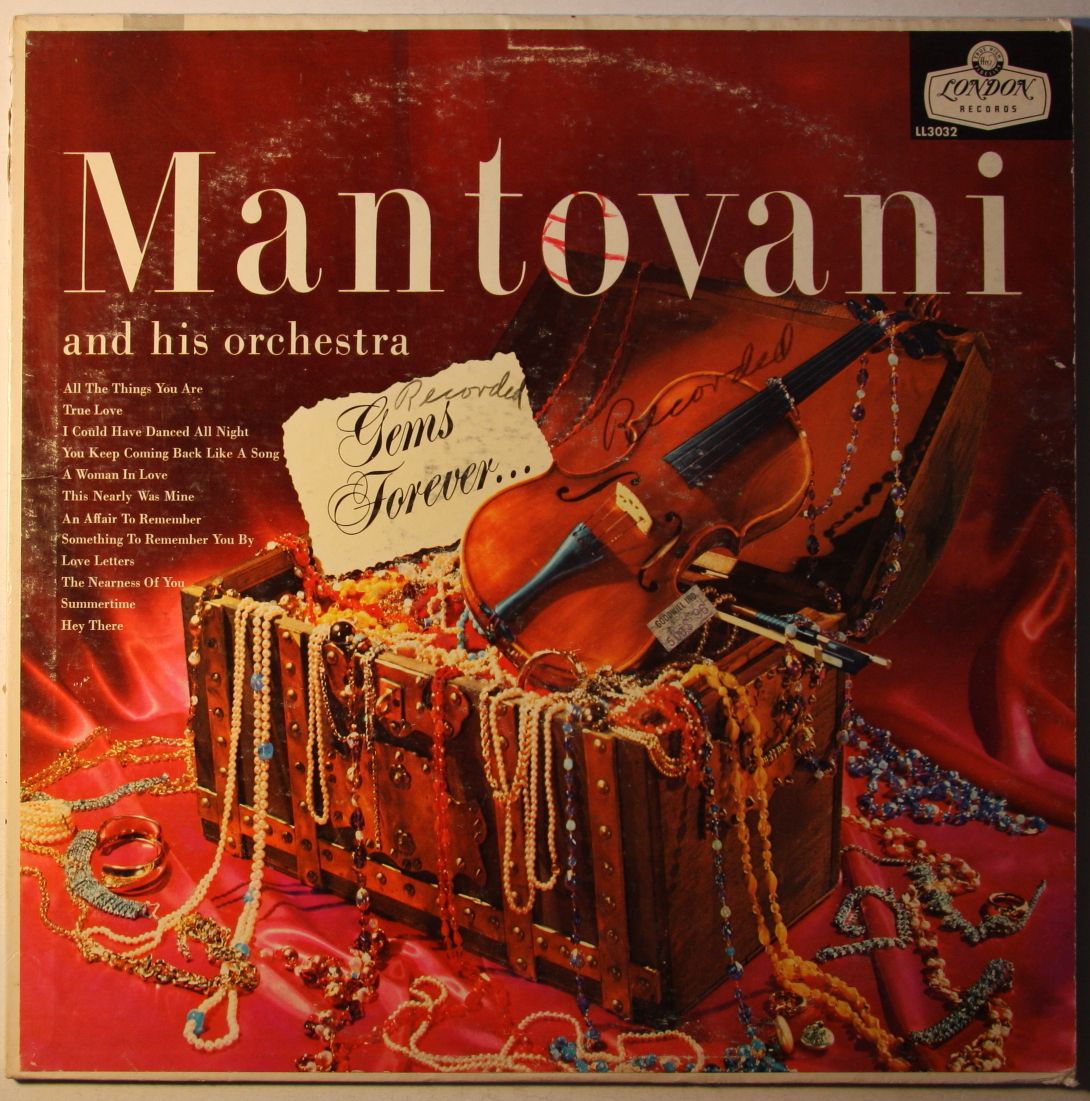
mantovaniThere were many perpetrators of this genre once upon a time, but the first and most successful was Mantovani, who sold roughly eight billion albums jam packed with this kind of thing beginning in the 1950s. At a time when most music was sold in 45 form, he was one of the first artists to recognize that there was dough to be made in albums, and the first to sell a million copies of a single LP. Like Liberace, another one-named dynamo of this time, he realized there was a market in selling oppressively mellow, treacly music to folks who just staggered out of World War II. Men and women who’d slogged their way through Normandy and Guadalcanal, who feared the bomb and Stalin and Mao, they craved escapism.

Unlike Liberace, Mantovani wielded an entire orchestra with which to lull a weary generation to sleep. His arrangements could barely be called that, as they consisted largely of an army of violins playing the tunes of songs grown ups of this era would have already heard innumerable times. And they couldn’t get enough of them. My grandmother had tons of these albums in her collection. Some of them were enormous, mighty sleeves bound up in leatherette with gilt lettering on the cover. Perhaps he invented the boxed set, too.

In 1959, Mantovani had six albums in the top 30 at the same time, a feat I doubt has been equaled by any other recording artist. In 1959, Miles Davis released Kind of Blue, Charles Mingus released Mingus Ah Um, Bill Evans released Portrait in Jazz, and Dave Brubeck released Time Out. Howlin’ Wolf put out his first LP. Elvis Presley was at the height of his powers, Johnny Cash was climbing toward his. Folk music was starting to break into the mainstream via folk-light acts like The Kingston Trio.

All of these events are more important, musically, then anything Mantovani did. But if you wanted to know who was selling albums in 1959, the answer was Mantovani. And it would be the answer, more or less, until The Beatles came along.

To the best of my knowledge, no one has advocated a Mantovani reappraising. There’s no Chuck Klosterman to sing his praises for once ruling the business side of music. Most of his biggest fans are no longer with us, and the ones who are left wield no power.

This is, I think, why I go overboard with my own enthusiasms, be they the 1999 Mets, or Jean Shepherd, or a Looney Tunes special no one ever watched but me. The things we love are fragile, and they won’t last for long after we leave. I can’t stop the march of time but maybe I can keep up with it for a few steps.

Love goes in cycles: First something is loved, then it is scorned for being out of date, and then it lives again as retro. And from there, it slowly fades out.

Think about how much you know about your own family. You probably know what your parents loved. You might know what your grandparents loved. But in all likelihood, you can reach no further than that. The things that were loved before then are gone forever. Entire worlds, dead. Those people lived and loved just as much as you have, and there isn’t the slightest hint of them left.

Something brought Music from the Terrace to mind this morning. I can’t say what, I just know that it reappeared to me. So this morning as I settled in at my desk, readying myself for a day of work, I looked for Mantovani on Spotify. I didn’t expect to find anything, but it turned out there were plenty of albums available to stream. Most had the appearance of cheap reissues, and many of them were labeled in Spanish for some reason. Still, they were there.

I clicked on one and…it was still as deadly boring as when it trailed out of my grandmother’s cathedral stereo years ago. I expected at least nostalgia and found only pillowy violins. I endured two songs before moving on.

And yet, I’m glad to find out Mantovani exists in this ultra-modern format. I’m comforted by the knowledge that a trace remains of someone’s love.