 We are bu-HACK on The Fan, and my next guest is one of the greatest living American writers. One of the best. One of the legends. There are writers who are known as being great writers, and this is one of those writers. His name is Don DeLillo, and he’s got a great new novel out called Point Omega. Don, thanks for being on the show.
 Thanks for having me, Mike, though I’m not quite sure why you wanted to speak with me…
Nonsense. I’m not just a sports guy. I know a lot about a lot of things, okay? You don’t get three number one shows by being a one-trick pony. I read, okay? I read books. I read a lot of books. I read a lot of printed material, material printed on paper. And your books are among the books I’ve read, and I enjoy them very much. I think you are one of the shining beacons of American letters, okay?
Wow, that’s very nice of you to say.
But I do have a bone to pick with you. In your 1997 masterpiece Underworld, you start out the novel with an extended set piece about the famous Shot Heard Round the World playoff game between the Dodgers and the Giants in 1951.
Yes, and?
And you make no mention of Mickey Mantle.
Continue reading Mike Francesa, Novel Critic
All posts by Matthew Callan
Curious Business Models Theatre Presents…Consumers
Yesterday, The Wife and I were debating where to seek out a certain piece of electronic equipment for the house (if you must know, we want to get one of those jacuzzi tanning beds–we work hard, we deserve it!). I jokingly said she should look for it at Consumers, which I thought would be a sure-fire laugh getter, but I was only greeted with silence. It dawned on me that there must be some people out there unfamiliar with the infuriating world of Consumers.
In case you are one of those blighted few, I’ll fill you in. Consumers was a big, boxy store that inexplicably sprang up all over the northeast corridor in the 1980s, despite having one of the counterintuitive business models ever.
The idea behind Consumers: the store could save overhead by not having a big showroom for all its wares, and pass those savings along to you. The stores were extremely minimalist, with only a few items on display, and sometimes a jewelry counter.
But if they had no showroom, how did you get your stuff? I’m glad you asked! Consumers had huge catalogs full of all the items they sold. It was sort of a Sears Wish Book, except it contained more than kids stuff. VCRs, jewelry, lawnmowers, you name it.
The catalog was enormous, and enticing. I remember being very impressed by them as a kid, especially the toy/video game section. They even had a teaser for Super Mario Brother 2 several months before it was released. Of course, it was just a screenshot of Super Mario Brothers 1 blown up really big, a ruse even eight-year-old me was able to suss out. But I appreciated the effort they went through to trick me.
If you wanted something at Consumers, you filled out a slip with the item’s info, then got on a Space Mountain-sized line that snaked through rows of metal corrals. Eventually, you came face to face with an actual clerk manning one of the many counter stations that lined the length of the store. You handed your slip to a clerk and waited for them to retrieve your item from the warehouse. And waited. And waited. And waited. And also waited.
And after all of this waiting, there was no guarantee the store would actually have the item in question. Consumers lacked either the ability or the willingness to implement a computerized database to track such things (even though this technology existed by the mid-80s), so the only way to determine if the store had something in stock was to actually go in the back and check.
Disappointment can happen to you at any store, of course. You go to the mall, hoping to find a certain thing, and it turns out no one has it. But there is something especially exasperating about jumping through all these bureaucratic steps, and waiting on line, and waiting for a clerk to emerge from the back, and then finding out you’re screwed. Kafka himself could not have designed a more Kafka-esque shopping experience.
This was torturous when I was a kid. We didn’t get toys too often, but when we did, it was often at Consumers, because it was cheap and we didn’t have a Toys R Us nearby. Children have no patience to begin with, but asking them to endure this rigamarole is impossible. I would hear other kids cry and scream and throw fits as they found out the toys they wanted were out of stock, and just pray they didn’t want the same thing I wanted.
This shows just how far things have advanced in the last 25 years. The modern shopping experience is all pitched toward empowering the consumer, giving them as many choices as possible and extensive previews of the product they’re considering buying. Can you imagine a store that not only required such waiting, but didn’t guarantee they’d have what you wanted? There’d be riots in the streets.
What’s even more amazing is that Consumers was simply the most austere of the catalog stores of the 80s. There were a few others, like Service Merchandise, but these other stores also had a lot of goods on display. You could actually buy things off the rack at Service Merchandise. You could not do that at Consumers.
In a weird way, Consumers was a predecessor of sites like Amazon, which also have no physical displays, which cuts down on costs. And you can think of a catalog as a low-tech site showcasing a store’s wares. The big difference, of course, is that you don’t have to leave your house to window-shop at Amazon. And if what they have is out of stock, you go to another site, or shrug your shoulders, rather than leave a store completely defeated and hating life.
Remembrance of Promos Past
Though no pitches have been thrown in anger just yet, players are in spring training camps, and that excites me. Jose Reyes is running the bases, Johan Santana is throwing bullpen sessions, and Ollie Perez has managed to eat lunch every day without hurting himself. I haven’t seen footage of any of these things, but I know they are happening, and that knowledge soothes me.
But I got genuinely excited over something I saw yesterday. Matthew Cerrone at Metsblog posted this pic snapped at Port St. Lucie.
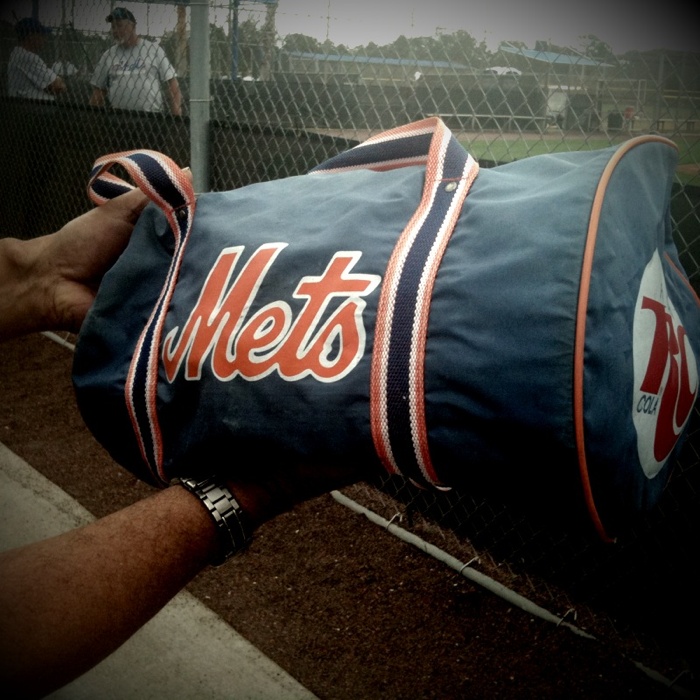 What is that? Why it’s a stadium giveaway duffel bag, clearly sponsored by RC Cola, dating to the late 80s-early 90s. The sight of this thing was nigh Proustian in the memories it dredged up. But not of actually using the bag. Just of seeing ads for BAG NIGHT! at Shea, then seeing said bag used by classmates and townfolk for the next few years. It gave me the same feeling I get when I watch old commercials, and have phrases I haven’t thought of in years ring tiny little bells in my brain.
I wanted this to be a springboard for a post on other Shea Stadium giveaways from the same era, but sadly, the interweb information on such things is rather poor. You’d think some maniac out there would have compiled a site dedicated just to this, but you’d think wrong.
But there is some web-based evidence of RC Cola’s role in Mets history. The soda had a long, intermittent association with the team dating back to its earliest days. This was back when Shea had more small-time sponsors like Rheingold Beer and local Plymouth dealerships.
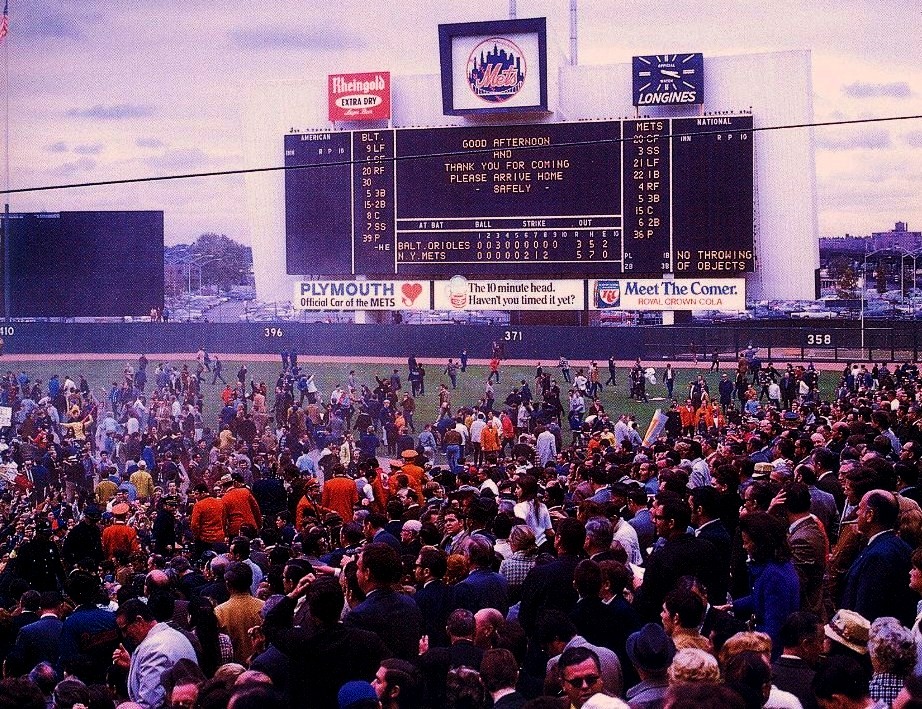
Oddly enough, they seem to have returned to this route at CitiField, where you now see ads for things like Arpielle Equipment, cash-for-gold web sites, and other second-tier businesses. Which seems kind of creepy and shady, now that I think about it.
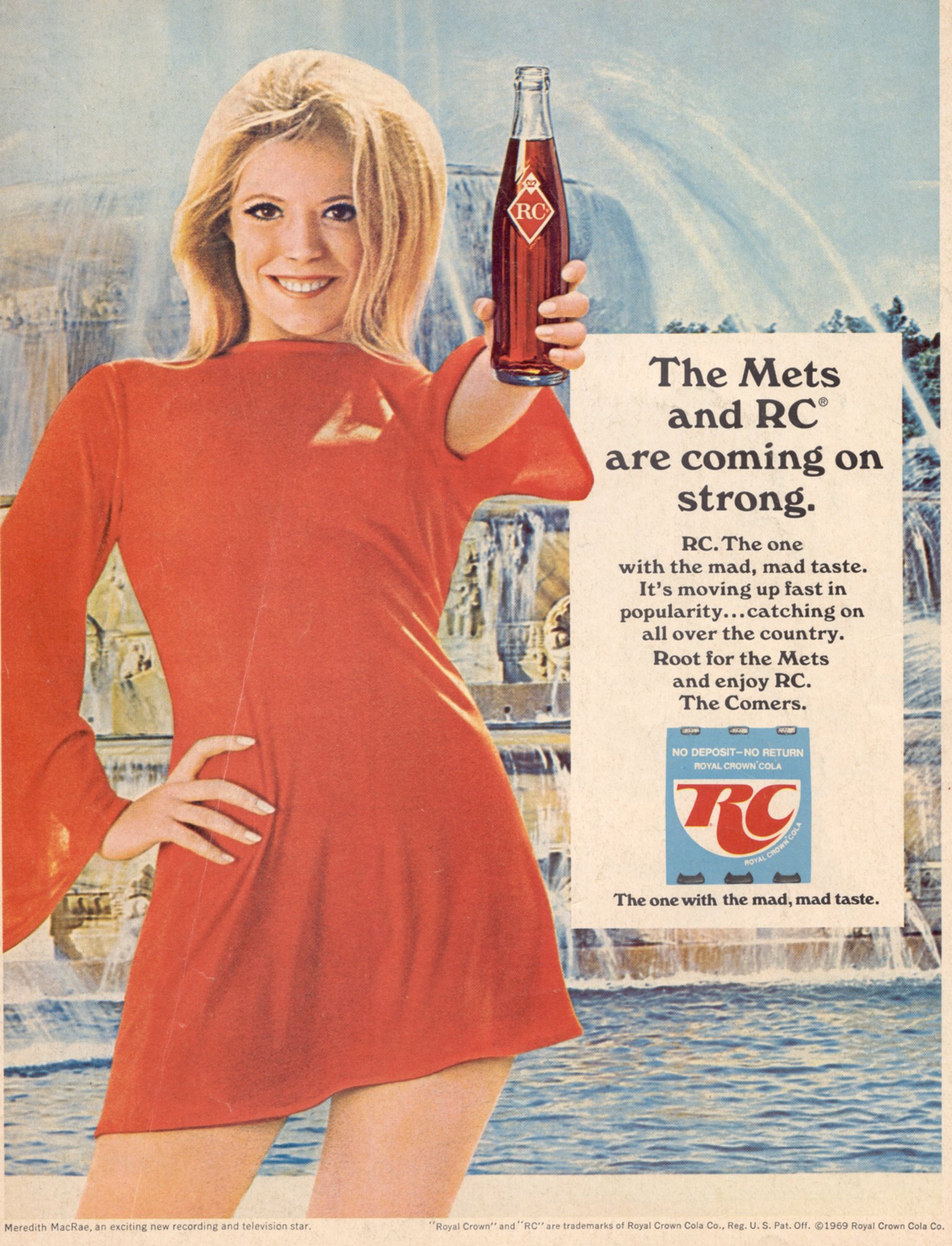
It was a fitting partnership. RC Cola was always the shameful bronze to the gold and silver of Coke and Pepsi, while the Mets were the brand new “upstart” team in town. RC even tried to play up this connection, as you’ll see in this ad from the 1960s. A shapely young lady poses with an RC Cola in front of Shea Stadium, though the facility can barely be discerned behind her, or the giant fountain which must have once been somewhere near it (or the Worlds Fairgrounds, or the designer’s imagination). I get the destinct impression that baseball was not the focus of this ad.
 Other than the duffel bag, the RC Cola promo I remember the most were these commemorative cans following the Mets’ 1986 World Series victory. Decorated in a gloriously 80s design scheme, these cans declared to the world, “I know how to jump on a bandwagon as I drink.”
 RC Cola’s association with the Mets continued into the 2000s, but ended by the time the last days of Shea rolled around (hence the Pepsi Porch at their new ballpark). I would lament this fact, but considering RC Cola is now owned by Cadbury Schweppes, they’re not exactly a mom and pop outfit, either.
Plus, I don’t wanna be one of those people who complains about the merits of essentially interchangeable junk food brands. The Wife and I once snagged fantastic seats for a Mets game, and sat next to a guy who wouldn’t shut up all night about how he hated it when Shea stopped serving Kahn’s hot dogs. I was too nice to tell the guy to leave me alone, plus he seemed like he might be borderline autistic.But my point is, if you can help it, don’t be that guy. Nostalgia’s great, being trapped in the past isn’t.