Recently in Warm Thoughts for a Cold Winter Category

A few years back, when I revealed I was getting hitched, my cousin insisted on organizing my bachelor trip. He kept the destination a secret for as long as humanly possible, but since we've know each other literally our whole lives, I trusted his judgment.

The day we left, he revealed that we (meaning he, my two brothers and I) were going on a trip much like the ones we took when we were kids. Every few years, my grandparents would herd all of us and our parents upstate, either to Cooperstown or Niagara Falls. This trip would combine the two. Maybe that's not your idea of bachelor trip craziness, but it was exactly what I wanted. Nostalgic, silly, and awesome.

The first night of the trip, we stayed in a small town a few miles outside of Cooperstown, in the same strip motel we stayed in as kids (which we did some serious damage to the first time around; I'm surprised we didn't check in under aliases). If you've never been to the area, know that Cooperstown itself is pretty small, in both size and temperament. Being a suburb of Cooperstown is like being a suburb of Hooterville.
For most of video game history, any ol' company could make a baseball game. (The same was true for most sports, but we'll concentrate on America's pastime here.) At first, these games rarely attempted to use real players or even real teams, except for those cases in which one player lent his face to said game.

(This is where I would link to the (in)famous Sammy Sosa High Heat baseball ad, but the video has been removed from the interwebs. Killjoys.)

This was perfectly acceptable by the standards of the day. Technology did not yet allow video games to remotely resemble The Real Thing, so it was okay to play as teams like the Los Angeles Swervers and the Chicago Bear-Children. Verisimilitude was not even a desired trait in sports video games--NBA Jam was a smash hit in the early 90s, but it's llikely the young'uns of today would not accept a hoops game where basketballs burst into flames.

Then, two things happened: Graphics improved, and the post-strike collective bargaining agreement allowed for all teams and players to share in formerly nebulous revenue streams like video games. In football, the Madden franchise emerged, set the standard for realism in sports games, and raised it with each subsequent edition. Baseball tried to follow suit, but by the late 90s/early 00s, when there were a plethora of baseball games for every platform, of varying degrees of quality.

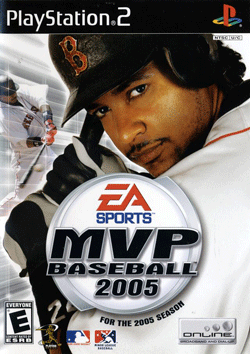
mvp05.gifEventually, one titan emerged: EA Sports' MVP Baseball series. I own several incarnations of this game, and remember thoroughly enjoying the realistic gameplay and graphics, and all the extras. The 2005 edition allowed you to accumulate MVP "points", which you could cash in to "buy" retro uniforms, old ballparks, and legendary players. I used to love playing games at the Polo Grounds or Forbes Field, which were either shown in sepiatone or at dusk, because I'm a dork like that.

It had a fun Owner's Mode, which allowed you to create your own stadium and even control the minutiae of a franchise like setting concession prices and scheduling promotion dates. It was also one of the first (if not the first) game to allow you to not only call up players from the minors (many of whom were real prospects), but actually play games for your minor league franchise.

Unfortunately, the 2005 edition was the last one EA Sports produced. Beginning in 2006, MLB awarded the exclusive cross-platform rights to 2K Sports. The hardware companies themselves (Sony, Nintendo, etc.) could make their own games for their own systems, but only 2K could make a game for all consoles. It was neither the first nor last time MLB made a dumb, shortsighted decision.

So while every other sport gets an annual game from EA, the top sports game producer by far, baseball gets a rarely-well-received treatment from 2K. Scour gaming sites, and reviews are rarely more enthusiastic than "it's decent". By all accounts, last year's edition was full of problems.

I say "by all accounts" because I haven't played too many of these games. I have a Playstation, and they produced a pretty good alternative of their own, MLB:The Show. I bought these for a couple of years until the rigors of fatherhood left a lot less time to waste in getting good at video games (because the modern video game involves an enormous time investment to attain competence).

The Show was pretty good, and the newer versions for Playstation 3 border on amazing. The 2009 edition allowed you record your own cheers and taunts and customize them on a player-by-player basis, an option that has a world of mean-spirited possibilities. But I always felt like baseball games hadn't advanced beyond the last installment of MVP. I was not alone in this opinion, if interweb grumbling is any indication (for instance, see the shout out MVP receives in this sneak peek of the impending release of MLB 2K10 at IGN).

So this past weekend, I blew the dust off my copy of MVP Baseball 2005 and gave it a spin. I expected to be blown away, or at least get the same twinge of nostalgia I receive when I play old Nintendo games. Sadly, I was disappointed on both fronts.

It turns out, video games had progressed in the 5 years since (weird, I know). Load screen times that were once acceptable seemed painfully drawn out to me. The game had only about 9 songs on it, only a few of which were any good, and repeated themselves with annoying frequency. Once upon a time, a game with 9 real songs would have been mind blowing, but the rules have changed.

"Annoying frequency" could also describe the broadcast announcements, voiced by Duane Kuiper and Mike Krukow. They call games for the San Francisco Giants, and not every well. But even a great broadcast team would be affected by the limited number of announcements they could actually make in this game. Again, the mere fact that such announcements were sort-of customized for game situation was once a wonder. No longer.

I also found the gameplay a bit clunky, particularly throwing and fielding. Catching a routine fly ball in the outfield was far too risky. The batting and pitching interactions were decent, but that was about as much as I could say about it.

I looked forward to enjoying the retro uniforms and stadiums, but since I had deleted my profile from on overloaded memory card a long time ago, I couldn't access any of them. And the thought of putting in all the time to acquire them, just so I could play the Nationals in powder-blue Expos uniforms, was too frightening to contemplate.

Granted, I think what most people really lamented (at least initially) was that EA Sports was no longer allowed to make a baseball game. Obviously, if they'd been allowed to do so, they would have progressed just as the other video game firms did. But over time, I think the wish for EA Sports to reenter the field devolved into a fetishization for the last game they did make.

Ironically, it is this relatively new desire for a REAL sports video game that dates MVP 2005 so much. That was as real as it got back then, but now it's aged in dog years. If the game was more fantastical or wacky (a la the aforementioned NBA Jam), it would probably have aged better. But it didn't.

The moral of this story? Sometimes, the passing of time, and less than ideal modern conditions, can lead you to romanticize the past. But chances are, either things are not as good as you remember, or the present isn't as hideous as you think, either.
new-york-trilogy.jpgPaul Auster is one of my favorite fiction writers. He's also a Mets fan. The latter fact has nothing to do with the former--his work would be just as good if he liked the Red Sox, or the Rockies, or no baseball team at all. Then again, his novels are very New York, and they have a very Mets-ian cast to them, as Brandon Stosuy pointed out in this 2005 review for the Village Voice:

His hard-luck, Mets-loving characters wouldn't work as fans of the Yankees ... In Hand to Mouth, Auster admits that in his late twenties and early thirties, "everything I touched turned to failure," including his marriage, his bank account, and his writing. That's OK, though--his best characters are dealt the same lot and still make sure to check box scores that add up to another losing season.
Auster's books are often about psychic torture, the longing to capture things which can not be captured, and pursuit of insane goals that can never be realized. If that's not what it's like to be a Mets fan, it's damn close.

The Mets exist at the peripheries of many of his stories, mentioned in passing, usually by the narrator/main character. A reader unfamiliar with the team's history or mythos might see these details as mere window dressing. But a Mets fan will recognize them for the touchstones they are.

My favorite examples are in City of Glass, the first book of Auster's New York Trilogy. A man named Quinn, who writes mysteries under the pseudonym William Wilson (more on that later), gets drawn into a bizarre mystery of his own when a wrong number leads to him being hired as a private detective (despite not being one). Early in the story, he ducks into a diner to get a late night meal.

As the counterman swung into action, he spoke over his shoulder to Quinn.

"Did you see game tonight, man?"

"I missed it. Anything good to report?"

"What do you think?"

For several years, Quinn had been having the same conversation with this man, whose name he did not know. Once, when he had been in the luncheonette, they had talked about baseball, and now, each time Quinn came in, they continued to talk about it. In the winter, the talk was of trades, predictions, memories. During the season, it was always the most recent game. They were both Mets fans, and the hopelessness of the passion had created a bond between them.

The counterman shook his head. "First two times up, Kingman hits solo shots," he said. "Boom, boom. Big mothers--all the way to the moon. Jones is pitching good for once and things don't look too bad. It's two to one, bottom of the ninth. Pittsburgh gets men on second and third, one out, so the Mets go to the bullpen for Allen. He walks the next guy to load them up. The mets bring the corners in for a force at home, or maybe they can get the double play if it's hit up the middle. Pena comes up and chicken-shits a little grounder to first and the fucker goes through Kingman's legs. Two men score, and that's it, bye-bye New York."

"Dave Kingman is a turd," said Quinn, biting into his hamburger.

"But watch out for Foster," said the counterman.

"Foster's washed up. A has-been. A mean-faced bozo." Quinn chewed his food carefully, feeling with his tongue for spare bits of bone. "They should ship him back to Cincinnati by express mail."

"Yeah," said the counterman. "But they'll be tough. Better than last year, anyway."

"I don't know," said Quinn. "It looks good on paper, but what do they really have? Stearns is always getting hurt. The have minor leaguers at second and short, and Brooks can't keep his mind on the game. Mookie's good, but he's raw, and they can't even decide who to put in right. There's still Rusty, of course, but he's too fat to run anymore. And as for the pitching, forget it. You and I could go over to Shea tomorrow and get hired as the two top starters."

"Maybe I make you the manager," said the counterman. "You could tell those fuckers where to get off."

"You bet your bottom dollar," said Quinn.

I scoured through Retrosheet to see if I could find this game--given the players mentioned and when the book was written, it would have to have been in 1982. Near as I can tell, Auster's description is not of an actual game, but a conflation of any number of hideous Mets losses in the awful days of the early 80s, of which there were plenty.

(I also discovered Neil Allen was not a very good closer. In 1982, he was responsible for seven losses in relief and four blown saves for a team that didn't have many late-inning leads to protect. He gave up three runs twice and four runs once to hand the opposition a win. Three times, he snatched victory from the hands of Mike Scott, who didn't have many good starts when he was a Met.)

Later in the book, after a labyrinthine mystery drives Quinn insane, he finds himself in a strange apartment, trying to make sense of what's become of his life:

...So many things were disappearing now, it was difficult to keep track of them. Quinn tried to work his way through the Mets' lineup, position by position, but his mind was beginning to wander. The centerfielder, he remembered, was Mookie Wilson, a promising young player whose real name was William Wilson. Surely there was something interesting in that. Quinn pursued the idea for a few moments, but then abandoned it. The two William Wilsons canceled each other out, and that was all. Quinn waved good-bye to them in his mind. The Mets would finish in last place again, and no one would suffer.

I found this passage particularly chilling, as I often perform similar mental exercises to make sure my brain is sharp and I'm not insane--despite the fact that being able to recite a team's lineup off the top of your head is a form of insanity.
Two years ago, as Shea Stadium counted down its last days, I wrote a few posts on some of the best games I attended there. However, I never quite got around to writing about my absolute most favorite game ever at Shea. Let me remedy that error now.

The year is 1991. The Mets are in the midst of their first losing, uncompetitive season in many a year (and the first of many, until Bobby Valentine righted the ship). They would end the year 77-84, which, in a few years, would seem like Shangri-la in comparison. They're on their last homestand of the year, playing a series against the Pirates, who have already clinched the division (yes, 1991 was indeed a long, long time ago). Manager Buddy Harrelson would be fired with seven games left in the season. The outcome of these games mean virtually nothing to anyone.

My older cousin was going to college near where I lived in upstate New York. Said college had a big block of tickets for the last game in this series. Would I be interested in attending with him, even though it was on raw, rainy September night? Yes, I would be, because I hadn't been to a baseball game in a very long time. Also, I was 14 years old and hating junior high with a deathly dread, and I hoped that I would get home so late from Queens that my mom would take pity on me and let me stay home from school the next day (though I knew she probably wouldn't).

We traveled down to the city in a school bus, no lights or anything. I brought a book or two to read on the trip, but that quickly proved pointless. I also finagled some dough from my mom to buy a scorebook, which was no small feat, because we had no money for such frivolities. But my mom knew that I scored every game I went to and indulged me this one luxury.

However, I didn't have any money for food or drink. Mom plied me with a sandwich and probably a Capri Sun (shut up) in a paper bag. Only in retrospect does this seem vaguely sad to me. At the time, it was a state of affairs I was used to--i.e., being dirt poor and just happy to be doing anything out of the house, even if it meant I had to bring my own food and drink.

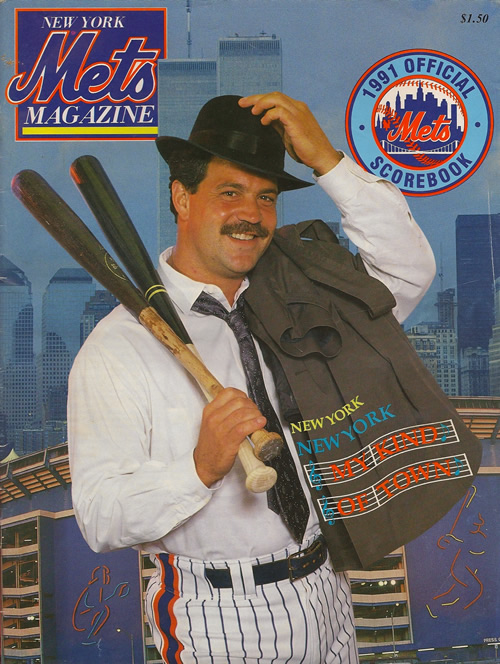
91mets_cover.jpgThe state of the Mets at the time should be apparent by the cover story on the aforementioned scorebook: Rick Cerone, a pudgy Newark native and ex-Yankee catcher who was just keeping the dish warm for up-and-coming prospect Todd Hundley (a September callup that year who himself was profiled briefly in the same scorebook).

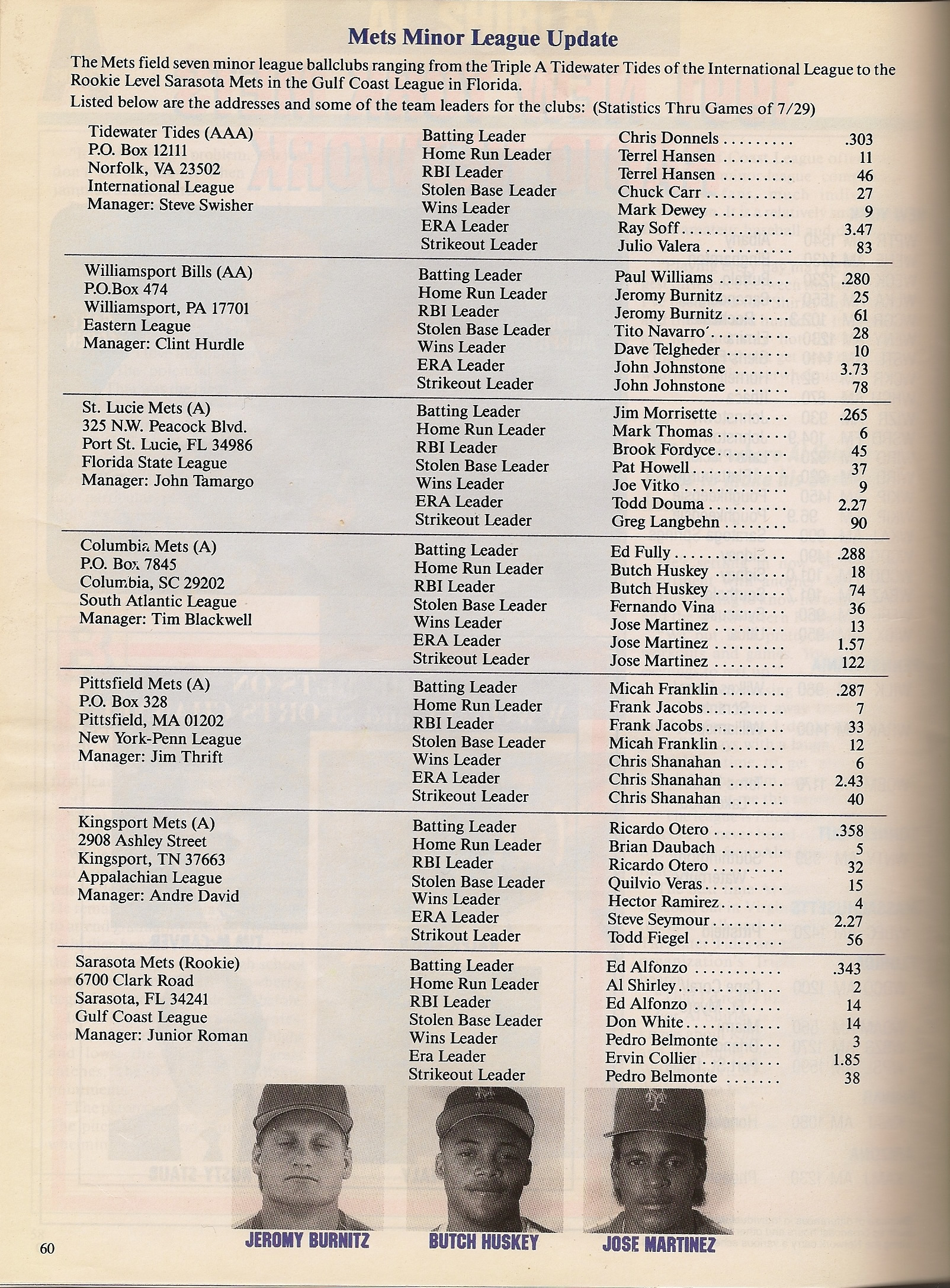
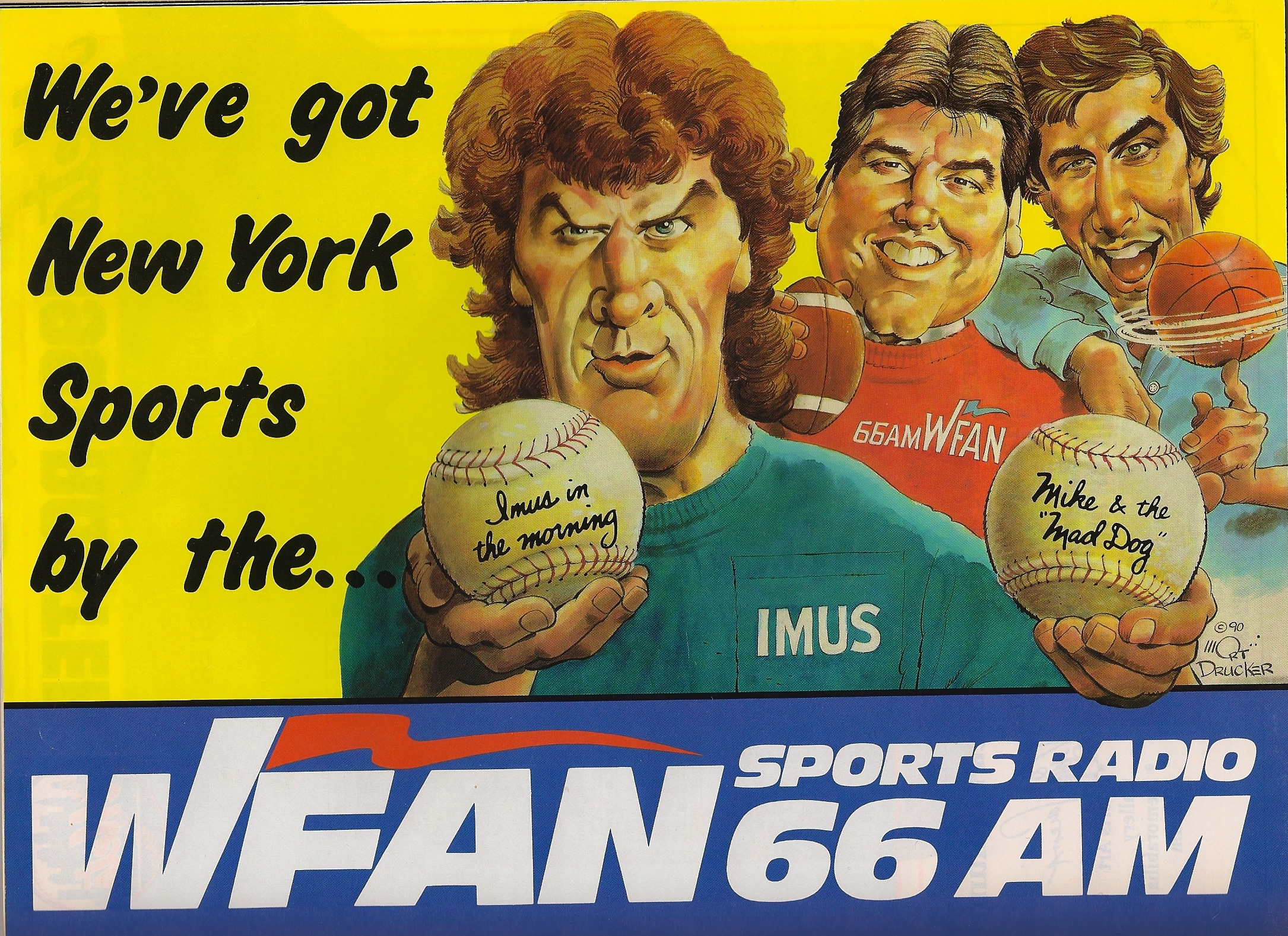
I've scanned a few other gems from this scorebook for your viewing pleasure. Here's a page dedicated to the Mets Radio Network, with a pic of a young Gary Cohen possessing a full head of hair. Here's a page on the Mets' minor leaguers of note, led by Jeromy Burnitz, Butch Huskey, and Fernando Vina; the Rookie League Sarasota Mets were paced in batting average and RBIs by a young'un reffered to as "Ed Alfonzo". And here's a saucy ad for WFAN, featuring a painting by Mad Magazine artiste Mort Drucker. Mr. Drucker rendered Don Imus a bit like John C. Reilly, and was a bit too flattering to Mike Francesa (ie, didn't make him look like a house), though he nailed Chris "Mad Dog" Russo's cockeyed stupidity.

Our seats were in the upper deck, which at Shea was a steep, intimidating place. You could look down the stairways toward the field and feel as if the whole deck was getting more and more vertical every second, like the steps would collapse into a ramp a la some James Bond villain trap. You were always one wind gust away from plunging to your death.

You especially felt this way if the upper deck was not well populated, which it was not this evening. In fact, other than the group from the college (which couldn't have been more than 25 people), there was nobody in the upper deck. I don't mean there were very few people there. I mean there was literally nobody there. If you were looking at it from field level, it would have seemed even odder, since this one populated patch was halfway between home and left field.

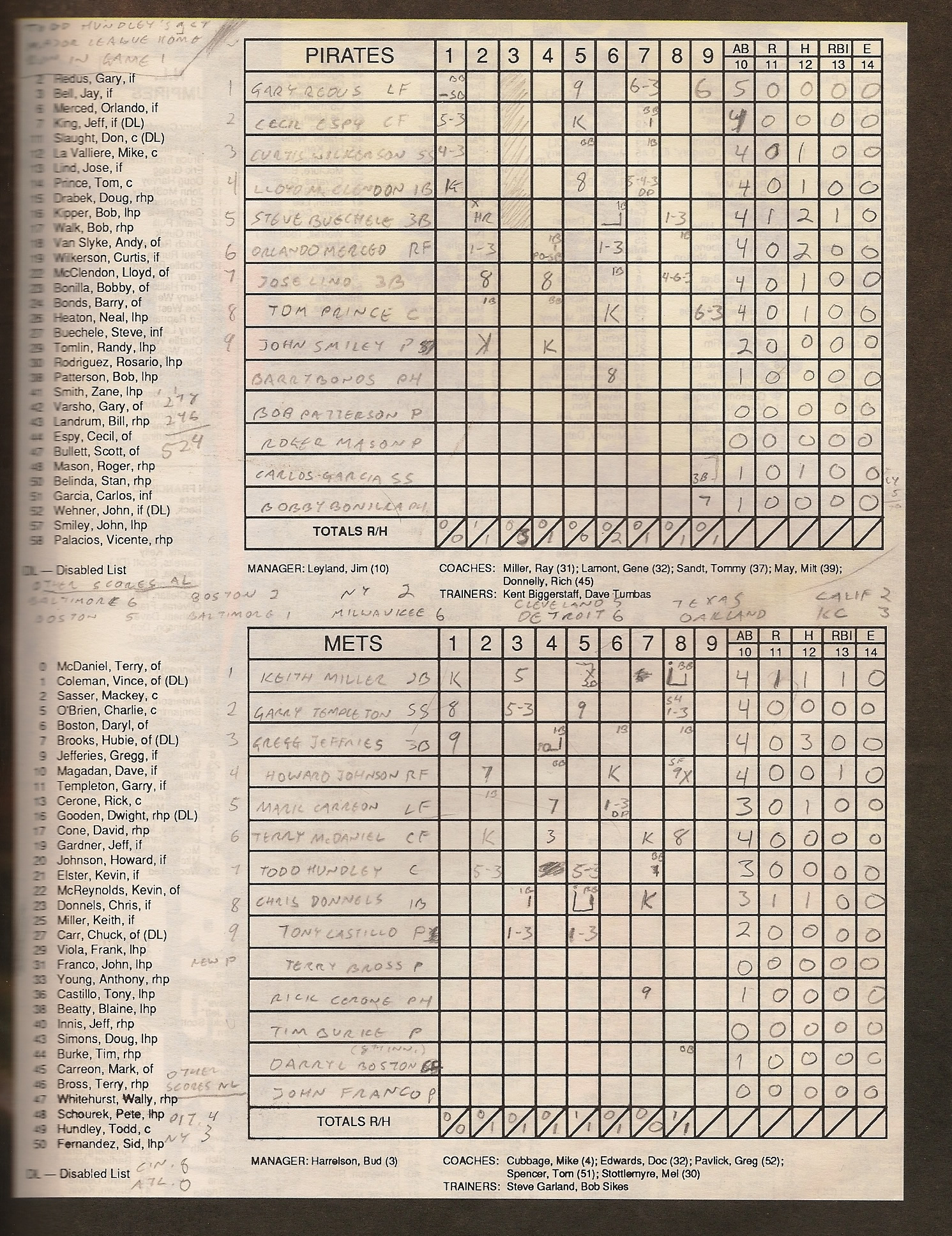
The rest of the stadium was not exactly jam packed, either, nor should it have been. The two teams didn't exactly trot out their A squads for this game, as my scorecard will attest. (It will also attest to my insane desire to chronicle every bit of the game. I know if you read this site, it's hard to believe I can be obsessive, but it's true.)

Then again, the game I attended was actually the second half of a day-night doubleheader. The first game--a rainout makeup from the previous day--was a four hour and twenty minute, 15-inning slog that must have exhausted and angered every single person involved in it. The Mets rallied in the bottom of the ninth to tie the game at 2, then, after the Pirates took a brief lead in the top of the 14th, tied the game again in the bottom half thanks to Todd Hundley's first major league home run (which I also made note of on my scorecard). But the Pirates scored again in the top of the 15th. The Mets couldn't rally a third time, and lost 4-3.

In other words, nobody wanted to be on the field, and anyone in attendance would have been some stripe of insane.

Slowly, the other folks who'd come down on the trip (who I don't think my cousin knew well, if at all) drifted away from their seats, either to get beer or hot dogs or relocate. By the time the second inning ended, my cousin and I were the only people in the upper deck. We didn't notice it happening, but all of sudden we realized we'd been abandoned. We had an entire tier of Shea to ourselves. It was awesome and terrifying, as if we'd been made captains of a ship that was just about to go careening over a waterfall.

My cousin suggested we travel downstairs. There were clearly plenty of seats to be had. I reluctantly agreed. I was totally happy to be one of two people in the upper deck, as scary as it felt. Because at this time in my life, I was as play-by-the-rules as Hank Hill. I would not break rules under any circumstances, and felt extremely guilty even contemplating doing so, even for a victimless crime such as this.
One year, for my grandfather's birthday, my brothers and I "bought" him (despite not having any money at all) "1986: A Year to Remember", an hour-long highlight video of the newly minted world champion Mets. Grampa--who lived next door to us--had a VCR, and we did not. So we invited ourselves over to watch it with him. Even if he wasn't home. Every day. For two years. That is not hyperbole. I will swear on the holy book of your choice that this is true.

I can probably recite every word in this video, from beginning to end. I acquired a not-at-all legitimate copy on DVD a few years back, and I still watch it every now and then. It is wall-to-wall awesome, pure and simple. Watching it over and over again at an early age did permanent damage. It is probably the biggest reason why I became such a huge baseball fan.

Why? It's hard to say, because it's ingrained in my consciousness so much. I can't identify why this video is so great any more than I can comment on the greatness of The Beatles or a sunset. But maybe we should start with the musical montages. They are many and varied. This video contains:

  • A segment about the team's hotfoot pranksters, like Roger McDowell, to the tune of Emerson Lake and Palmer's "Karn Evil 9"
  • The leadership of Keith Hernandez and Gary Carter, as exemplified by Bob Seger's "Like a Rock" (a good decade before it was adopted as Chevy's anthem)
  • A montage of "partners in grime" Wally Backman and Lenny Dykstra set to Duran Duran's "Wild Boys"


As you might expect, the video does not allude to the Mets' hard partying ways, and it glosses over controversies like the Houston bar fight and George Foster's carcinogenic clubhouse presence (though a doc about 1986 produced by SNY a few years ago does). But who wants downers like those when you can watch a chock full of unbelievable clips from an insane season?

Though not commercially available, a body can track down this video in one form or another on the interwebs. If you just want to view it, it's still available in streaming chunks on the Mets' official web site. Just point your browser here and pick a month from the drop-down menu in the lower right corner.
The Numbers Game by Alan Schwarz is on my shortlist for best baseball books of the last 10 years. In fact, I'm hard-pressed to think of any that can beat it. The main reason: while so-called traditionalists deride or dismiss the sabermetric approach to baseball, Schwarz's book shows that stat obsession has existed as long as the game has. He even makes a convincing argument that baseball's number-rich nature is the main reason it became America's pastime in the first place.

The book is a brief history of baseball statistics: how they began, how they evolved, and who pioneered what. Schwarz points in particular to one largely unsung founder of baseball as we know it, Henry Chadwick. As early as the 1840s, newspapers published rudimentary "abstracts" about baseball games. It took Chadwick to refine these abstracts and turn them into the box score that we still use today.

In Schwarz's estimation, the simple comprehensiveness of the box score meant that it could (a) be printed in the newspapers without taking up too much real estate, and (b) give the reader a concise but thorough sense of what happened in the game. So the average working stiff (who lacked the money and free time to go to a ballgame) could follow a team even if he could never attend a game in person. It is probable the biggest factor in turning baseball from a game to a sport.

Chadwick also became an evangelist for baseball, and tried to develop and perfect the way it understood itself through stats. Some metrics he developed caught on, others never did, and still others would wait 100-plus years until the game understood their merit.

Schwarz also shows that every era has had its own Nerds vs. Jocks debate. He traces the roots of fantasy sports all the way back to the 1940s, and highlights a few lonely Bill Jamesian figures throughout the game's history who have, for the most part, been completely ignored by the MLB establishment and statheads alike. And he also shows that Billy Beane and his methods of team construction didn't appear out of thin air.

In short, Schwarz shows that the history of baseball's stats are really the history of the game itself. It is a thousand times more interesting than a book about math has any right to be. You can easily plow through this book in a day or two, and you'll wish it lasted longer.
Does anyone make statues anymore? Chances are if you're wandering through a park and you see a statue, it's a good 50 years old. I don't know if the blame lies with Vietnam or the soaring cost of bronze, but at some point, the idea of immortalizing a HERO in art form became passe. If you do see a more recently completed piece of public artwork, it's likely a large cube or abstract figure, with a purposefully vague one-word title like FREEDOM or PRIDE.

Well, there is one place where you can still see a freshly constructed, representational statue: a baseball stadium. All sports refer to its stars as "heroes" when what they really mean is "guys who play good", but only baseball backs up that ethical confusion by literally putting its "heroes" on pedestals.

According to this post at Wezen-Ball, all but five MLB teams have at least one statue in their home park. Admittedly, the definition of "statue" is stretched pretty wide in some cases, as in this bizarre thing seen at Toronto's Rogers Centre (entitled "The Crowd"), or this outfielder that patrols the Tropicana Field bathrooms.

There are also a few "scene" statues with anonymous figures, like this one outside Whatever They're Calling The Place Where The Diamondbacks Play Now. (A cute idea, but the D'Backs logo on the player's uni is already outdated. Ooops!) Or this one outside Miller Park, saluting the hard working (and presumably hard drinking) workers of Milwaukee. However, the vast majority of stadium statuary are depictions of legendary baseball players.

The Tigers' Comerica Park has the most statues of all--seven--and all of them are dedicated to former Detroit greats. (The Phillies also have seven statues, but two of them are generic depictions of baseball action that used to live outside the now-demolished Veteran's Stadium.) The White Sox run a close second with six, and have the statue portraying the most recent event: their 2005 World Series title. Click here to see not-yet-disgraced Illinois Governor Rod Blagojevich unveil the statue and get the shit booed out of him by a South Side crowd that had him pegged as a Cubs fan.

Surprisingly, the Yankees only have two (unless you count the plaques in Monument Park, which I do not). And they're really one large, detached statue: a rather bland depiction of Don Larsen tossing to Yogi Berra during his perfect game in the 1956 World Series. But I'm sure one day there will be a bronze recreation of when Derek Jeter drove all the snakes out of the Bronx.

The Nationals have three statues, despite only existing for five years. Two are of old Senators (Walter Johnson and Frank Howard) and one is of Josh Gibson, a Negro League legend who played for the DC-based Homestead Grays. These statues tried to be adventurous and capture "movement". An admirable experiment, but the results are kind of terrible. They all wound up looking like multi-limbed cement monsters.

George Brett's statue gets my vote as the most picturesque, as it looks over the waterfalls of Kansas City's Kauffman Stadium. A close second would be Roberto Clemente's statue outside PNC Park, which greets fans as they cross the Pittsburgh bridge named after him. Juan Marichal's statue in San Francisco is an eyeful, as it captures his unique, super-high kick delivery. Stan Musial's statue is also impressive, although his name on the pedestal, chiseled in huge letters and adorned with gold leaf, makes it look like the title of a musical.

The worst? There's none that are horrible, honestly, but a few that tip the Weird Scale. The dead, hollow eyes of Steve Carlton's statue in Citizen's Bank Park will haunt my dreams forever. Red Schoendienst's statue outside Busch Stadium is pretty great, showing him turning a double play. But in order to portray that motion in statue form, the sculptor supported him on a column of hardened Play-Doh.

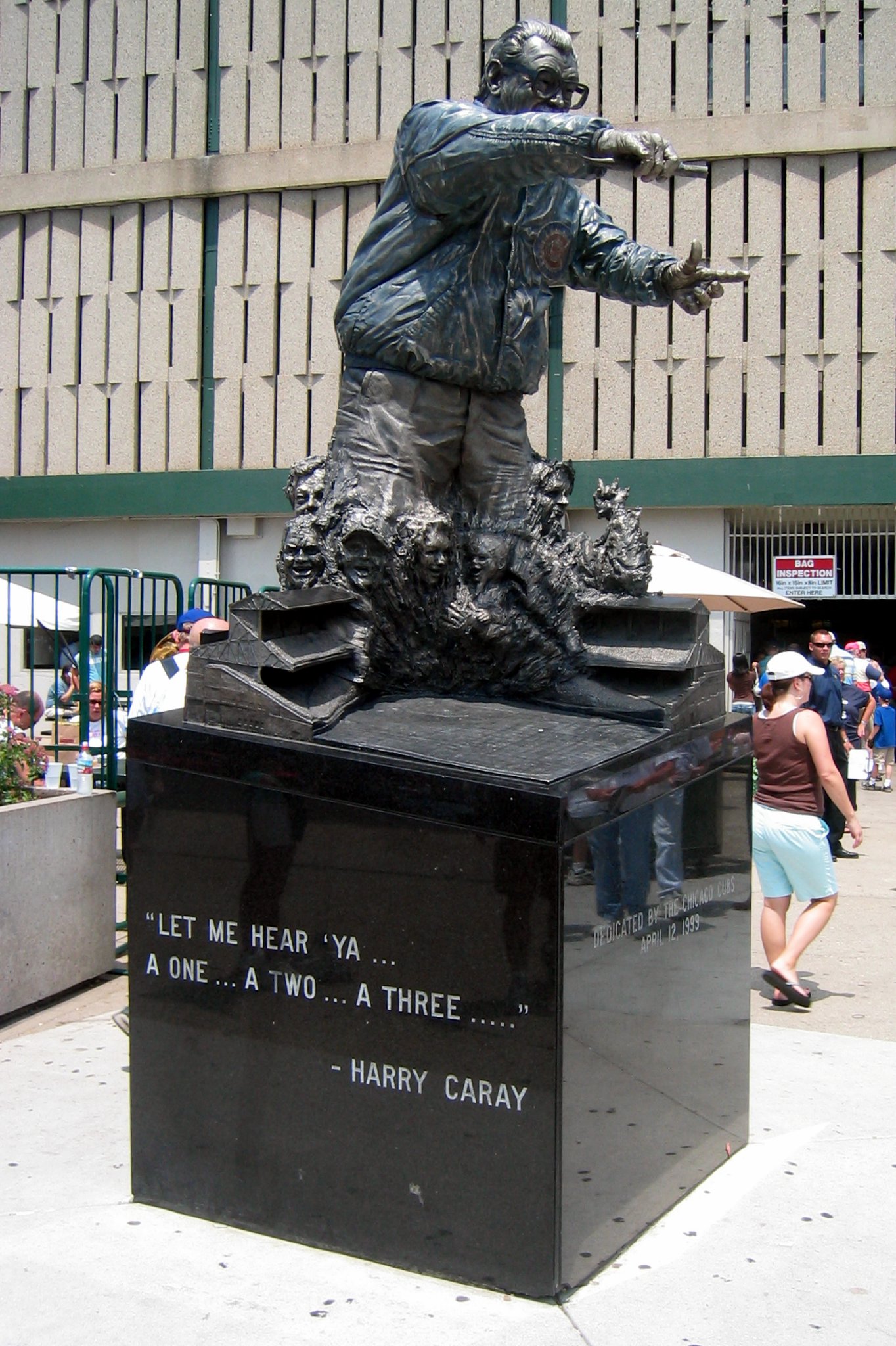
harrycaray.jpgBut for pure WTFness, nothing beats Harry Caray's statue outside Wrigley Field. If this piece of art just stopped at his torso, it wouldn't be that bad, although his arm gestures make him look like he's trying to imitate the redesigned Jesus in Dogma. But the sculptor's acid must have kicked in when he reached the belt, because all of a sudden, Harry's pants start MORPHING INTO OTHER HUMANS. AAAAAAAAH!

I don't know what this is is supposed to convey. Harry rose to the heights (?) of announcerdom because of his fans? Or he stepped in a still wet, small-scale proletarian version of Mount Rushmore? Or he absorbed multiple twins in the womb, and they are just now asserting themselves? I really don't know how to explain this, but whatever the real story is, I think David Cronenberg should make a movie about it.
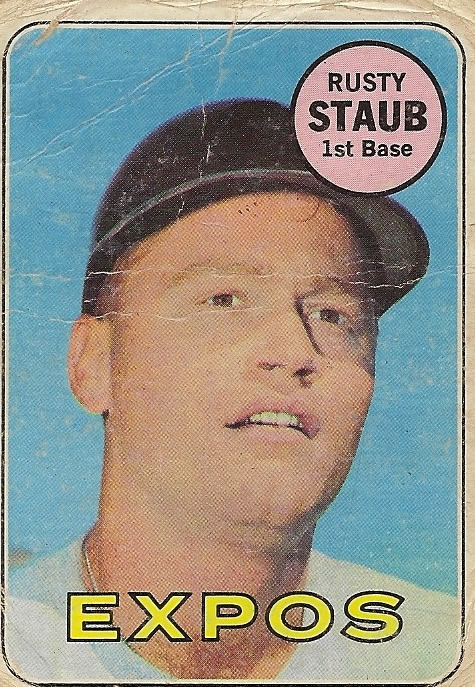
A recent post at Mets Guy in Michigan concentrated on what may be the worst Mets-related baseball card of all time (and perhaps the worst baseball card of all time, period): a Hostess-produced card for Rusty Staub in which the photo retouching is abysmal. I won't recount the story here; just click on this link and marvel at how horrible it is (and the interesting hypothesis forwarded to explain its hideousness).

The post also touched on a longtime feature of baseball cards: the hastily altered player photo. Back in the days of no Photoshop and longer production schedules, it wasn't always possible for the baseball card people to get a picture of a player in his new duds if he was traded in the offseason. Or even if he was traded the year before, since back then, most baseball card photos were taken during the previous season. And by my own amateur sleuthing, most of them were taken in either New York or LA. So if were swapped midseason and never made another trip to either coast, there might be no pics of you in your current uni.

69_rusty.jpgFor a good chunk of the 1960s, Topps (the biggest baseball card producer) didn't much care for verisimiltude. If a player was suddenly traded before the cards were made, they just used a generic, hatless picture, or blacked out his hat entirely, as evidenced by Rusty Staub's 1969 Topps card (seen to your right). Rusty went from the Astros to the Expos in a very late offseason trade (January 22), and since Montreal had yet to play a game, Topps--rather than find out what the Expos' uniforms might look like--scraped away the Houston logo on his helmet and called it a day.

Beginning in the early 1970s, Topps either decided this method was not worthy of their standards or hired some very ambitious/anal art directors. Because at this time, they began to document a player's new home to the best of their abilities--as ham-fisted and transparent as those efforts might appear.

When I was a kid and mired in a baseball card obsession, I bought a whole box of cards from 1977 for like five bucks. Why 1977? Because (a) that's the year I was born, and (b) it was the first year the Blue Jays and Mariners played, which at the time was the last MLB expansion. This historical fact fascinated me for dumb little kid reasons.

Topps wanted to document the freshman year for those two teams, of course. But since neither had yet taken the field, they had to improvise. In some cases, they did so admirably. In others, not so much.

Even as a young'un, I could tell something was off about some of these cards. I even recognized bad paint jobs on some of these unfortunate players. It was necessary for the aforementioned Toronto and Seattle squads, since this was their inaugural year, but they weren't the only teams treated to some paintbrushery.
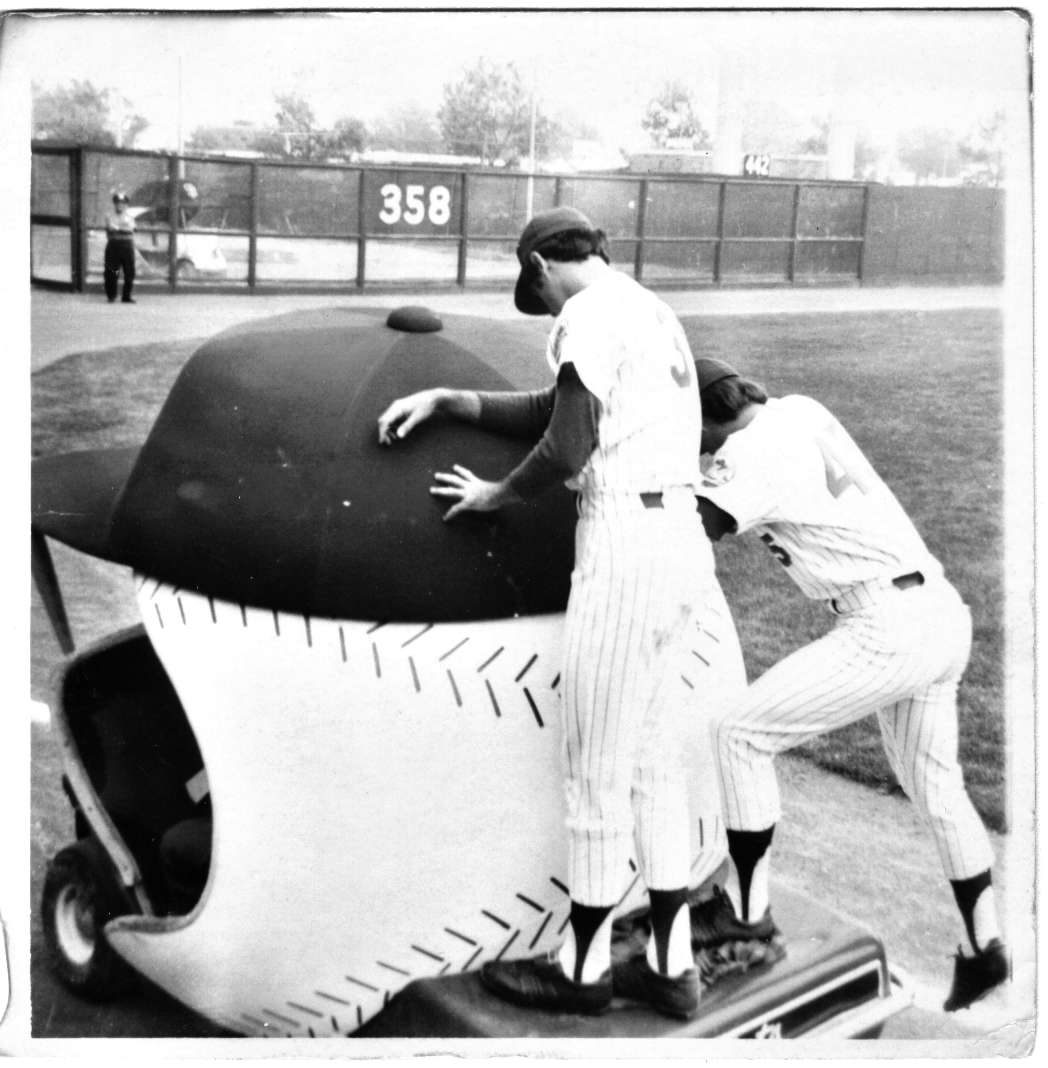
mets_cart.jpgYesterday, I wrote about stadium organists, a feature of the game that is quickly dying out. Another aspect that's already dead is one that probably shouldn't have lived to begin with: bullpen carts. Yes, once upon a time, relievers were shuttled from the bullpen to the mound in vehicles of varying size--sometimes a full-sized automobile, but more often golf cart-type contraptions.

In a weird way, the bullpen cart feels like it should be a more recent innovation. After all, today's athlete is supposed to be spoiled rotten, so it would stand to reason they would insist on being chauffeured to the mound like the fancy boys they are. But no, it was the supposedly blue collar relievers of yesteryear who were slowly puttered onto the field in embarrassingly tiny go-carts.

Paul Lukas of Uni-Watch wrote an exhaustive history of the bullpen cart a few years ago. My favorite tidbit:

1986: With happy fans spilling onto the field after the Mets' division-clinching victory on Sept. 17, Mets fan and former Shea Stadium vendor Eric Bennett heads straight to the bullpen, where he hijacks the team's bullpen buggy. He takes it for a brief outfield joyride before the engine conks out.
janejarvis.jpgLast week, Jane Jarvis passed away at the age of 94. Jarvis was Shea Stadium's first organist, from 1964 all the way through 1979. She's still remembered by fans who heard her as a delightful and witty practitioner of that uniquely American art form, stadium organ music. Marty Noble wrote a remembrance of her, and shared the tidbit that during the 1977 blackout, Jarvis entertained the sweltering Shea crowd with such ironic song selections as "White Christmas" and "Jingle Bells"

I'm not old enough to have enjoyed Ms. Jarvis' stylings, but I do miss ballpark organists. Most MLB teams still have an organist, but their playing time has reduced significantly in favor of prerecorded music instead, which is a shame. Both New York teams still have organists, but I can not tell you the last time I actually heard one play at either stadium.

I'm not too old school when it comes to most things in baseball; I think the game is more often hurt by its emphasis on tradition than it is helped. But there are two points where I see eye-to-eye with the Get Off My Lawn crowd: the DH is an abomination, and stadium organists are vastly superior to any other form of in-game entertainment.

In the long history of baseball, organs are a relatively recent feature of the game experience. The first stadium organ didn't appear until 1941, when the Cubs installed one in Wrigley Field, and they didn't really catch on elsewhere until after World War II. But the organ has become a sound as associated with the game as the crack of a bat. Playing "charge!" on an organ is musical shorthand for "there is a baseball game being played right now".

I have a feeling that the almost exclusive use of prerecorded music is a relatively recent phenomenon, one that crept slowly into the game in the last 15 years or so. While compiling The 1999 Project, I listened to and watched a whole bunch of games from that season, and noticed that Shea was still very organ-centric back then. Pitchers and batters entered the game to their own hand-picked tunes, but all other musical cues came from an organ.

In that spirit, please enjoy this video about Lambert Bartak, the man who has manned the organ for the college world series for the last 50+ years.

Mel Allen, longtime Yankees broadcaster and the voice of This Week in Baseball, did many a commercial in his day. Enjoy this one from the early 80s, in which Mr. How 'Bout That shills for an Atari baseball game with an unhealthy amount of reverb on his voice. Realistic graphics!


Speaking of This Week in Baseball, I have several episodes of it from the late 80s and early 90s in The Vast and Dusty Scratchbomb VHS Archives. I would love to digitize and share them with all of you, really I would. But as I've said many times, MLBAM would come down on me like a ton of bricks for doing so.

As a meager substitute, please accept "Gathering Crowds", the TWIB end credits theme song used for, oh, about 900 years. This song actually makes me mist up a little bit. DON'T JUDGE.

Also, don't ask me to explain the assemblage of still images in this "video". I am not responsible for its visual content, but I am grateful for the audio.

One of the most fun/excruciating parts of the baseball offseason is wondering just how many days are left until the season begins anew. Wonder no more!

Evan "Funk" Davies, the awesome WFMU DJ who spins every Tuesday at 11pm, alerted me via tweet to an extremely simple webbed site that will inform you exactly how much longer we must wait. The site is called Pitchersandcatchersreport.com, and it's about as bare-bones as a site can get. But it does what it says: Tells you exactly how many days remain on the calendar before pitchers and catchers report to spring training. It also has countdowns for when all players report and Opening Day. So just bookmark that and keep checking it until the number hits 0.

In case you're much too busy to look at the site (but not busy enough to read this one), as of today, there are 16 more days until pitchers and catchers report to spring training, 19 until all players report, and 67 until Opening Day. As my body thaws out from a walk-heavy commute in single digit wind chills, that is a warming thought.

UPDATE: As Mr. Davies pointed out in the comments, this site may be off (as in, it probably is). Unless they're using some New Math I don't know about. Whatevs. LET ME THINK IT'S ONLY 16 DAYS UNTIL SPRING TRAINING. TELL ME SWEET LITTLE LIES.
Like Joe Posnanski, who I covered in a previous Warm Thoughts... post, Ive written about my love for sportswriter Tim Marchman before on this site. Unlike Posnanski, Marchman doesn't have much of a national profile. He wrote for the now-defunct New York Sun for a few years, and now pens the occasional column for SI.com. He runs a very close second to Posnanski as my favorite baseball writer.

Marchman isn't quite as poetic as Posnanski, and he has a calm, cool style that's somewhat at odds with recent trends in sportswriting. Nowadays, you either have to be a manic Super Fan liek Bill Simmons, or a angry, grousy crab like virtually everyone else. Marchman, by contrast, is measured and erudite. You can tell he chooses every single word carefully, which you can not often say of his contemporaries.

But he can also bust out the occasional bon mot, as he did in a column last December about the Mets' lack of hot stove activity.

Think of the market as a greasy street at the ash end of Las Vegas at a quarter to five in the morning, and Minaya and his rivals as the sad lot slumping along the sidewalk. Should they really listen to the sharps and touts sidling up to them, making offers? One supposes that they could catch some luck. They could catch something else just as easily.

Marchman's specialties are the numbers of baseball: sabermetrics and dollars. Take his recent column about Tim Lincecum's impending arbitration case. It's a case that has a lot of owners shaking in their boots, because Lincecum asked for a record high salary ($13 million). Marchman touches on players' historic lack of luck in this process (they lose 60 percent of all cases) and what Lincecum's prospects are for remaining a great pitcher (prognosis: positive).

Or another recent column about the Reds' signing Cuban defector Aroldis Chapman. By his math, the economics of the deal don't quite add up. At the same time, he likes to see that teams like the Reds are taking high risk/high reward chances like this.

I love that the Reds are laying marks on real talent rather than squandering $5 million on Kyle Farnsworth or someone like him. I love that Reds fans are (rightly) so excited about this. I love that Chapman can finally start thinking about the best players in the world rather than worrying about money. Mostly I love that it was the Reds, rather than the Yankees or Angels, who signed him.
I posted this video on the site last September, but a gem like this deserves a second look.

In case you forgot, Hall of Famer George Brett was captured on video torturing Royals players during a spring training exercise by telling an excruciatingly detailed story about pooping his pants. Some genius took that video and not only autotuned Brett's voice, but also inserted a plethora of hilarious visual cues. Enjoy.

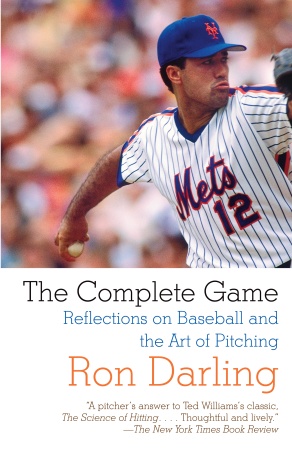
completegame.jpgMost jock memoirs are exercises in narcissism, which is to be expected. Athletes who reach the pinnacle of their chosen sport have, in all likelihood, been praised and coddled like little emperors their entire life. So they must be on top in everything. Even if they try to stress their humility, it's to show that they are far more humble than you could ever be. Even if they talk about a fall from grace, like declining skills or drug addiction, it's to show that only they could plunge to such depths and rise again.

That's what makes The Complete Game by Ron Darling such a rare specimen. The book opens with the famous first paragraph from Bart Giamatti's "The Green Fields of the Mind" ("It breaks your heart. It's designed to break your heart..."), which should give you an idea of the tone employed in the book.

The book is divided into 10 "innings", each of which chronicles an actual inning that Darling pitched in his career. A few of them are from triumphant outings, like game 4 of the 1986 World Series, or a complete game shutout he pitched against the Blue Jays while with the A's. But far more of the book is dedicated to struggle: fighting your way through a game where you don't have your best stuff, or failing miserably, or being done in by tide, time, and the affairs of man.

One chapter is devoted to a shellacking Darling took at the hands of the Cubs, giving up two homers and six runs before being yanked, and he delves deep into what it feels like to have a manager take the ball from you and tell you to hit the showers in front of an angry crowd. Another chapter covers a crucial late-season game against the Cardinals in 1987, where Darling pitched five hitless innings, then made the unwise decision to dive for a Vince Coleman bunt. In the attempt, he tore all the ligaments in his pitching thumb and was done for the season.

Even one the best performances of his career, recounted in the final chapter, was ultimately a failure. While at Yale, he pitched 11 no-hit innings against St. John's in the college world series, the longest no-hitter in NCAA history. But he finally gave up a hit in the 12th inning, the runner came around to score, and his team's anemic offense could not bail him out. So one of the best collegiate pitching performances ever went for nought.

The book is one long reminder of just how hard it is to pitch in the major leagues, and how thin the line is between success and failure. You could easily read it in one sitting, but that's more a testament to how engaging it is, rather than indicative any lack of depth or insight.

In that way, it's very similar to Darling's personality as commentator on SNY. Whenever he sees a pitcher struggling on the mound, he always references his own bad outings. Because failure is much more instructive than triumph.

I don't think I've read any other book about baseball (or any other sport) that traffics in so much failure, yet ultimately affirms everything there is to love about the sport. If you don't want to pony up the dough for the hardcover edition, the paperback is due out in March. But in either case, read it.
Thanks to confluence of various time-crunching factors, I was unable to post my week-daily Warm Thoughts for a Cold Winter story yesterday. So to make up for it, we'll have a doubleheader today.

My first post will be short but sweet. The Mets have a mini-camp this week, with players like Johan Santana, Oliver Perez, and Daniel Murphy in attendance. What is a mini-camp? I don't really know, but it seems a lot like high school gym class warmup exercises.

So a small portion of the Mets are in Florida, stretching, long tossing, and doing other calisthenics that only vaguely resemble baseball. At this point in the winter, it's close enough for me.

johan_minicamp_10.jpg

I received The Fireside Book of Baseball as a Christmas present, probably not too long after it was published in 1987. There were three earlier editions of the book, published in 1956, 1958, and 1968, respectively. The cover photo has a wide-angle picture taken at Shea Stadium during the 1986 World Series (if I had to guess, I'd say either game 1 or 7, since it looks like Ron Darling is on the mound). It's an anthology of baseball writing, arranged alphabetically by author, and including all types of pieces. There's reportage, profiles, biography, fiction, poetry, parodies, and even some cartoons and photos to accompany the action.

I dig this book out at least once every year, because it's one of the best baseball books I've ever read, and probably ever will read. The Fireside Book's basic philosophy is, Here's a buncha stuff about baseball. Enjoy! It's not meant to be read in order, or all in one sitting. Just flip to a page, and chances are you will find something great.

Like "The Age of the Muffin", a history of post-Civil War baseball by Robert Smith (not the cure frontman). Or Bill James, in a very un-Jamesian piece, probing the story of a mysterious gambling ring in an obscure Louisiana semi-pro league in the 1940s. Or an excerpt from the autobiography of Japanese home run king Sadaharu Oh. Or a poem comprised of the rules for a women's softball league. Or an all-too-brief glimpse of Moe Berg in old age, the former major league catcher who doubled as a spy for OSS in the years before World War II.

It has contemporary accounts of famous games, with a heavy emphasis on the 1980s. Like Moss Klein's account of game 5 of the 1986 ALCS, and The Curse of Gene Mauch. Or Murray Chass's first-hand account of The Pine Tar Game (proving that he wasn't always a crabby, bitter douche). Or the magnificent Roger Angell's take on game 6 of the 1975 World Series.

It has fiction, like a chunk from Robert Coover's The Universal Baseball Association, one of the greatest and least-appreciated baseball novels ever. And there's excerpts from works of fiction that aren't strictly about baseball, like William Kennedy's Ironweed and Phillip Roth's The Great American Novel.

There's even transcriptions of legal documents, like the offical DH rule, and the motion to dismiss that struck down Charlie Finley's sale of Rollie Fingers and Joe Rudi to the Red Sox in 1976 (and which contains a convoluted and fascinating dissertation on MLB's antitrust exemption). And a poem consisting of the names and nicknames of 269 players both famous and obscure.

Some pieces have the traditional starry-eyed, childlike wonder associated with baseball. But there's also plenty of failure in this book, too. And regret. And skullduggery. I like a book that can admit there are plenty of shitty, weird, and wrong things that happen in the game, without seeming cynical in the process.

Unfortunately, this book is out of print now. A fifth edition was published in 2000, but I have never seen it, so I can not vouch for its contents (plus, it too is out of print, so the point is moot). But if you ever spot the 1987 edition of The Fireside Book of Baseball in a used book shoppe or thrift store, snatch it up immediately. No price is too high.
For other Warm Thoughts for a Cold Winter, click here.

Last night, I finally took a tour through my site's stats for the first time since I did a ground-up reboot in December 2008. (My first "new" post was on December 7, a date which will live in infamy.) I was surprised by two things. The first was the amount of unique hits I've gotten since then (which I won't reveal because I'm afraid it's not actually a big number at all and you'll all laugh at me).

For the first time, I saw concrete, non-anecdotal evidence that people are reading this thing. So thank you, mostly anonymous well-wishers. I am truly grateful. I'm pretty sure at least 55% percent of you aren't pron bots, and those of you who are have been very tasteful about your Britney vids and bang buses.

So I dug deeper to suss out some other details hitherto unknown to me. For instance, the most often used term on this site is "Tom", thanks to The Best Show Logs, which reference that name quite frequently. The four next most popular keywords are "scratchbomb", "christmas", "joe", and "baseball". Where does "joe" come from? Your guess is as good as mine.

phillips2.jpgBut what really knocked my socks their ass? The number one search term on this site since its reboot a year-and-change ago: STEVE PHILLIPS. Yes, that Steve Phillips. Ex-Mets GM, ex-Baseball Tonight "analyst", current unemployment line occupant. I knew I'd raked him over the coals a time or two on this site, but I had no idea my not-at-all disguised contempt for him would be so popular.

Granted, this could very well mean nothing. Because I also discovered that the top three search terms of the last week were "rudolph the red-nosed reindeer",  "danzig", and "shaved dick". This last one baffled me, but a quick Google search by the wife showed me that I have a post with one sentence ending with "shaved" and the next with "dick". I sincerely hope this is the explanation, because if it isn't, I don't want to know what the real one is.

Nevertheless, seing Steve Phillips' name so prominently featured caused me to grumble about his feckless, agenda-driven analysis. But then I remembered: We won't have to see Steve Phillips at all this year!

Yes, now that the hair-helmeted philandering douchenozzle has been kicked to the curb by ESPN, we won't have to hear him expound on how much he knows about baseball and how to build a winning team. You know, all those things he failed miserably at when he was the GM of the Mets. With Phillips gone, ESPN's baseball coverage upgrades from Unwatchable to Merely Insufferable.

And who's in his place at The Worldwide Leader this year? None other than Bobby Valentine, the genius manager who was run out of New York when he couldn't cover up for Phillips' failures. Oh sweet irony!

I don't know about you, but this thought caertainly warmed me up this cold January morn.
I wrote about Flip Flop Fly Ball last June, but in case you missed it the first time 'round, why not check it out? Flip Flop Fly Ball is a site where artist Craig Robinson creates baseball-centric infographics. The latest: a visual representation of how Alex Rodriguez's annual salary would look if converted to pennies and stacked on on top of the other. So simple, and yet, so profound.

But I think my favorite feature of the site remains its 8-bit header, a Nintendo-esque graphic that contains many references to famous baseball icons past and present, real and fictional. The Shea Stadium home run apple, the old Yankee Stadium Schaefer Beer sign, the White Sox emerging from the corn field...it's amazing that someone can evoke these things with such a limited palette. Kudos, sir.
I found The New York Mets: Ethnography, Myth, and Subtext completely at random last winter, on the shelves of a Borders in Queens of all places. I'd never heard of it before, or its author, Richard Grossinger, or even the small imprint that published it (Frog Ltd.).

But the title grabbed me, as it was aggressively anti-dumb jockery, reminiscent more of a college textbook than a work on baseball. And the back cover didn't have the typical sports book blurbs. Sure, it had some praise from NY Post scribe Mike Vaccaro. But it also contained blurbs from Jonathan Lethem and Paul Auster, two of my favorite novelists. That should give you some idea of the audience this aims to reach.

This is a book written by a fan that does not fit into the typical Fan Writing Mold. Most fan writing these days falls into one of two categories. It's either the chest-thumping, dick-swinging style of comment sections, as if the only point of sports is so you can talk shit to anonymous people. Then there's the Woe Is Us style, which says that because your team hasn't won a championship in X amount of years, you and your fellow Fill in the Blank Fans have known a suffering that no one else can appreciate and thus your fandom is spiritually superior to all others.

Grossinger, an ethnographer by trade, looks at his favorite team differently. The book is made up of a series of essays, most of which try to focus on one specific era. But really, he sees the Mets' history as one long continuum, and each piece touches on every other period in one way or another, as if it was all one long game. Witness the first essay in the book, "Endy's Catch", in which the titular play in the 2006 NLCS sends Grossinger on a mental tour through all the Mets players he loved over the years who, for one reason or another, were traded or let go and never seen again.

He seems to have a soft spot for players whom the Mets never gave a chance. The book's centerpiece, "Playing Catch with Terry Leach", discusses his obsession with the once-promising sidearmer who had a hard time catching on in the majors. Leach's funky delivery and cerebral nature made him the odd man out of the Mets' rotation for much of the 80s, until a rash of injuries forced him into the spotlight in the troubled summer of 1987. Grossinger referred to Leach's saga as "a bit of Jean Valjean, Jude the Obscure, Billy Budd."

Will everyone enjoy this book? Not unless everyone enjoys detailed studies of obscure Mets of yesteryear like Hubie Brooks and George Theodore. Its audience is probably limited to Mets fans, and a very small subset thereof. Rather than a baseball book proper, it's more of a rambling ethnography whose subject happens to be baseball. This book is not meant to please anyone. It seems unconcerned with pleasing anyone but itself, which is probably why I like it so much.
For other Warm Thoughts for a Cold Winter, click here.

As I've written here before, Joe Posnanski is one of my favorite baseball writers. I'm hardly alone in that opinion; in fact, it seems redundant to sing his praises because so many people have already done so. He pens lengthy, digressive columns, yet his work is such a pleasure to read, it never seems all that long. A bit like Bill Simmons, his writing takes full advantage of the freedom afforded by the internet. Except he's a hundred times the writer Simmons is, and doesn't fill his columns with the same 5 pop culture references over and over again.

Posnanski is great when reacting to news--his recent assessment of the whole Mark McGwire situation at SI.com was one of the best takes I've read, if not the best. But he's even better when tackling general issues, as he did last week in a speech given to Sports Turf Management. The talk was ostensibly about playing surfaces in baseball and how they've changed in the last 30 years or so. But of course, it was about a lot more than that.

The speech was transcribed and posted to Posnanski's blog last Friday.  It may not sound like the most interesting subject in the world, but he could write about lint weave a compelling story around it. Read it and you shan't be disappointed.
For other Warm Thoughts for a Cold Winter, click here.

cb.jpg
Earlier this week, the Nerd/Baseball Venn intersection was all a-buzz with an amazing project done over at Wezen-Ball.com. Larry Granillo had gone through all the Peanuts comic strips from 1950 through 1970 and, based on the documentary evidence, calculated a whole slew of stats for Charlie Brown's legendarily awful team.

By this point, I am the twelve billionth person to blog about this, but I'm posting about it anyway, on the slim chance that some of you may not have heard of it yet. And also, its awesomeness warrants as much exposure as possible. Charlie Brown and baseball are my two earliest obsessions, so this insane project is right in my wheelhouse. It also includes tons of scans of and quotes from classic Peanuts strips.

Now if someone would track down all the stats for Joe Shlabotnik, including his managerial stint with the Waffletown Syrups, I'd be a truly happy man.
Pitchers and catchers are a mere five weeks away, and it can't come soon enough for me (even after last night's hideous Carlos Beltran news). I am done with winter this year, at a record pace, and I'm normally a cold-weather guy. Or at least more of a cold-weather guy than a hot-weather guy. The sun is not my friend.

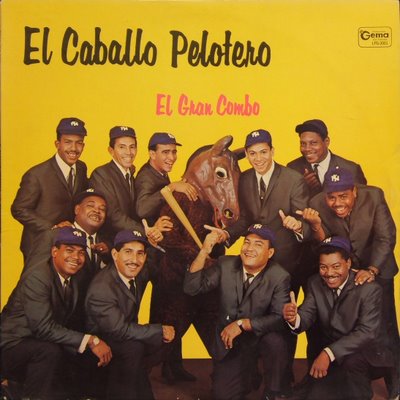
grancombo.JPGSo from now until players report, I will have a daily bit of baseball-iana to get you through the rest of the winter. The inaugural submission comes to me courtesy of WFMU's Beware of the Blog, via Give the Drummer Some. Yesterday, he put up his weekly post of mp3s, and it included a beisbol-centric jam by Puerto Rican musical legends El Gran Combo.

They've been around for almost 50 years and are probably the most famous salsa group in the world. This tune, entitled "El Caballero Pelotero", is about exactly what its title states: a horse who plays baseball.

My Spanish isn't good enough to translate all the lyrics to this song. Or even most of them. In fact, all I can really catch are the lines "jugaba a beisbol" and "los Yanquis". But apparently, this horse was quite the hitter.

Still, it puts me in the baseballing mood, and I hope it does the same for you. In addition to the original audio below, you can also see/hear El Gran Combo playing the song with another salsa legend, Hector Lavoe, on YouTube (which I would have included here, except the sound is sub-bootleg quality).


Download here.

3-2-1 Contact!

Direct all mash notes and hate mail to scratchbomb@scratchbomb.com.

Feed Me!

Recent Comments

Archives

August 2010

Sun Mon Tue Wed Thu Fri Sat
1 2 3 4 5 6 7
8 9 10 11 12 13 14
15 16 17 18 19 20 21
22 23 24 25 26 27 28
29 30 31        

The 1999 Project

The Grand Slam Single! The Best Infield Ever! Kenny Rogers (boo!)! Read all about the best team to never win a World Series here.

Best Show Logs

An ongoing attempt chronicle the awesomeness that is The Best Show on WFMU. Corrections and comments welcome.

2000

2001

2002

2003

Holy Goddamn!

The official Scratchbomb.com podcast. SUBMIT YOURSELF!
Subscribe via iTunes XML Feed

Links of Reknown!

Feeder

Why not visit Scratchbomb's spouse-site? Give me one good reason, ya punk.

Sweaty Dudes

The Funny

Powered by Movable Type 4.3-en